Since I am staying the weekend, I have a relaxed morning.
While the others are packing, checking out, and storing luggage, I have a cup
of coffee and pastry.
Our program today is packed with speakers from all arenas of
government from civil servants to local authorities, and even a representative
from the UK’s European Parliament Office. The head of the senior civil servants
trade union is dynamic and energetic. Generally, he says, Britain’s civil
servants support Tony Blair’s modernization efforts (it may have something to
do with the fact that they know, if they don’t, the Blair government will not
hesitate to privatize their jobs).
While not the private-sector crusader that Thatcher was, Tony Blair rode to victory on his “third way” platform. He is intent on bringing a “new” Labour government to Britain. The third way refers to Blair’s reform policies―not liberal-social ideas of the old Labour party, but not the free-market Conservative agenda either. We are left scratching our heads a little bit, but generally get it that he is trying to thread the needle between left and right.
The afternoon is devoted to Tony Blair’s Modernizing Government scheme. Our
speaker is Jeremy Cowper, head of the Modernizing Government Secretariat in the
Blair Cabinet. It sounds suspiciously like the Reinventing Government reform at home. One of its precepts is
improving the quality of government-delivered services based on “Best Value”
(UK’s term for measuring efficiency) and benchmarking performance, which is
what I am here to study.
I note ironically that the Best Value program applies only to local governments, not the national government, which is imposing it. The Blair government has created a standardized set of measures for all towns (called local authorities here). One speaker we heard said emphatically that, yes, measurement has led directly to an improvement in the way services are delivered; a conclusion I am appraising in my research paper.
At the round-up at the end of the day, the BC staff asks for suggestions and criticisms. They say, “Please be blunt.” We remind them that we’re Americans. The group, of course, has a lot of ideas—they want more interaction with speakers; they want speakers who can address implementation, not just policy; they want additional social events among Fellows; they want spouses to participate; and more.
I think people are quibbling and wasting time. We are in London! I want to be out in it. Dean thinks that, being from Maine, I have a better perspective on life outside of work. Perhaps. I do see the fellowship as an opportunity to travel while doing just enough research and writing to get by. I don’t intend to neglect my studies, but still, no one is grading me.
I am disappointed as we continue talking until nearly 6:00 PM and, once again, I miss my chance to go to Harrods, which closes early on Fridays.
He Came Silently Out of the Shadows – Jack the Ripper’s London
I had picked up a brochure in the hotel lobby about a Jack the Ripper walking tour. It starts at 6:45 PM and I have just enough time to make it to Tower Hill tube station where it begins, if I leave right now. I grab a cucumber and cream cheese sandwich at Embankment station and go.
I’m afraid I’ll be the only one on the tour, but there’s a
group of about 20 of us. Our guide Tony, a Beefeater by day who conducts tours
at the Tower of London, says to me, “Have we met? Have I seen you today?” I
assure him I was in meetings all day and that we have never met. He is lively,
enthusiastic, and articulate—a consummate actor—and he offers an historically
accurate, if a bit dramatic, overview of the Jack the Ripper story.
We walk from the Tower through grimy streets, crossing from the new part of the city to the old into an area known as Whitechapel, and follow the path of the Ripper’s gruesome rampage through London’s East End. From the Tower, to Petticoat Lane, to Spitals, to the Docks, Tony augments his story with reproductions of actual news articles, police documents, and photographs of the time. He even has four Victorian pennies, the cost of lodging for one night in a rented box (literally, a box) in a boarding house of the kind in which the Ripper’s prostitute victims would have slept.
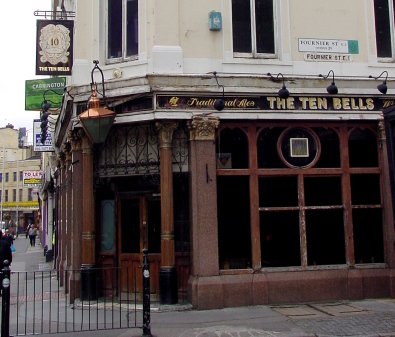
Pub frequented by Ripper’s victims, Ten Bells Pub, London
At the end of the tour, we stop for a drink at the Ten Bells Pub, which several of the murdered prostitutes frequented. I have a cider.
To this day, no one knows the identity of the serial killer
who murdered and dissected five prostitutes between August and November in 1888
when the grisly murders stopped as abruptly as they began. There are as many
theories as there are books on the subject. Tony has his own notion in the
person of Edward Albert Victor, Prince of Wales, son of King Edward VII and
grandson of Queen Victoria, who died at the age of 28, four years after the
murders. But I have read the theories and this one seems unlikely. The first
person to put forward the royal connection in the 1960s later retracted it as a
hoax.
There seems to be evidence that the Metropolitan police, under Superintendent Sir Charles Warren, destroyed evidence linking the Ripper to the Freemasons. Tony believes that the Freemasons committed the murders to cover up Albert Victor’s supposed illegitimate child by an Irish-Catholic shop girl; a friend of the murder victims who could expose the father’s secret identity. He says with his tongue very definitely in his cheek, it was all a conspiracy between:
a man named Jack
the police
an Irish-Catholic
the Freemasons
a man named Warren
As conspiracy theories go, this one sounds all too familiar.
In today’s news: The Evening Standard newspaper announces the conclusion of the investigation into the accident that killed Diana, Princess of Wales. The French report was released today. It blames the driver, Henri Paul, speed, alcohol, and a lack of seatbelts. In addition to several leading stories on the front page, the Standard prints the report’s entire contents inside.
A BC staffer starts the day’s program by telling us that it is 333 years to the day that the Great Fire of London started in 1666. But, he says, “Don’t worry. Fire protection is much better today.”
We listen to the Head of the North American Division of the British Foreign and Commonwealth Office, Philip Priestly, Commander of the Most Excellent Order of the British Empire (CBE), which confers on him an honorary knighthood, but not high enough to be called “sir”. He is an old-time politician and speaks with a lot of dramatic pauses, making him sound like Winston Churchill. He asks us, “Do Britain and the U.S. have a special relationship?” When we all say yes, he says, “No, they don’t! No Whitehall minister would say that they do.” I don’t quite understand his point and he doesn’t elaborate.
Dennis Kavanah―a professor of politics from the University of Liverpool—speaks quickly in clipped words and I have to listen carefully. He gives an excellent comparison of US and UK political power. He says, “The prime minister does not have the constitutional powers of the president, but he is more powerful.” In a Unitary government, as long as the party is behind him, the prime minister can do whatever he wants. But the president has to work within a system of checks and balances, a written constitution, federalism, and weak parties. He must build coalitions for the things he wants to do and the resulting initiatives are riddled with compromises.
Lunch is elegant: curry, quiche, green beans, salad, and a seafood dish. I pass on dessert, a chocolate mousse kind of thing. I am proud of myself as I also pass on the biscuits and tarts at tea.
There are four bottles on our table—sparkling and still
water and lemon and orange barley water. I pour a full glass of the orange
barley water (the Queen drinks barley water) and take a sip. It is thick and
strong and sweet. One of the British Council staffers brings me a clean glass,
points to the water and says, “You have to dilute it.” Oops. Andy who is
sitting next me said he did the same thing earlier. We have an embarrassed laugh
together.
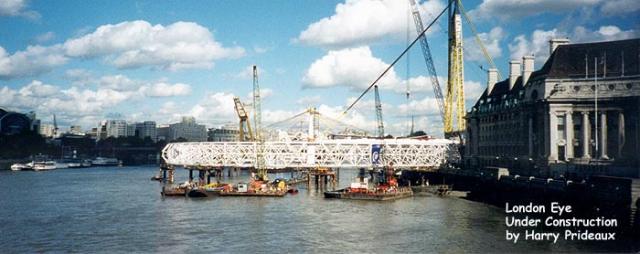
The break room looks out over a pretty garden. Across Embankment Road is the Thames where I see a huge crane and construction equipment in the river. Apparently, it’s a Ferris wheel that is being built for the millennial celebrations―something called the London Eye.
There is a mini coup d’etat as some of the Fellows want an agenda change to discuss the program’s travel schedule including the other planned group meetings in Edinburgh, Northern Ireland, and maybe even Belgium. The BC staffers quickly arrange to have someone here tomorrow afternoon to answer our questions.
I return to my room and change and head out walking down the
Embankment. I intend to go to Harrods, but unfortunately I have missed it; they
close at 7 PM. I retire early and watch a Morse mystery on TV.
I gobble down breakfast and hurry to catch the bus to the train station and on to London. Tony says he never goes to London as it is too crowded. He tells me that in 1900, when people traveled in horse-drawn carriages, the average speed on London streets was 4 mph. Today, he says, because of all the automobile traffic and congestion, it is still 4 mph.
Tony now thinks that I am a very important person because, first, the British Council called me yesterday, and now I am going to London. He was quite impressed with the coach that brought me the first day and has commented on it several times. As I leave, and Caroline asks me if I want a taxi, he says, “No, she’s probably got a coach waiting for her around the corner.”
Billionaire Richard Branson―the businessman who owns Virgin Airlines—also owns Virgin Trains, which takes me to London. I have a reserved seat on the 9:15 AM train; so look for Coach F, Seat 13. I walk past three carriages of first-class seats with their linen tablecloths and flowers on the tables to my plain carriage with a bare table. It is an easy ride and I arrive at Euston at 10:45 AM. The BC called me to say they had moved the fellowship meeting to a hotel near Embankment. It costs the same to travel to Embankment as it does to Charing Cross, so I assume I can use my existing ticket right through to Embankment. It works!
Getting off at Embankment, I walk around with my London A-Z trying
to find Whitehall Court, the street where my hotel is located. I walk in two
different directions before my third try brings me to the intersection I
want.
I am booked in for three nights at the 5-star Royal Horseguards Hotel. I plan to stay an extra night and spend a day in London at the end of the meeting. The hotel is luxurious. Meticulously decorated, the bed is unbelievably comfortable with four, huge down pillows. There is a safe in the room where I stash my passport and extra cash.
Our meeting starts later this afternoon and I have a few hours to explore. I hurry out to reacquaint myself with this fabulous city.
Faces of a Nation, National Portrait Gallery
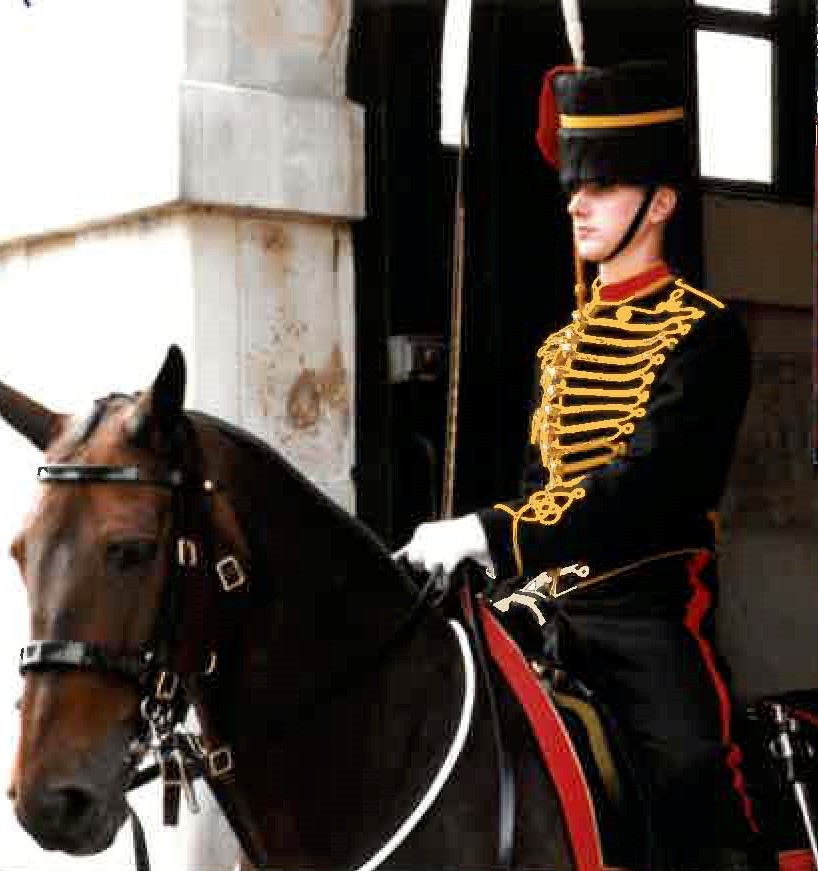
I cross the Horse Guards Parade, a massive open courtyard off St. James Park, where Henry VIII jousted. Today, it is used for royal parades and ceremonies including the Trooping the Color, the Queen’s birthday parade in June. Two passive, unmoving sentries of the Queen’s Life Guard are posted there. They are required to remain motionless for two hours before being replaced. I snap some pictures and walk on through to St. James’ Park.
Horse Guards Parade
I grab a hot dog at a sidewalk stand and head over to
Trafalgar Square. There doesn’t seem to be as many pigeons as I remember.
Still, when a car backfires, so many birds fill the air it looks like an Alfred
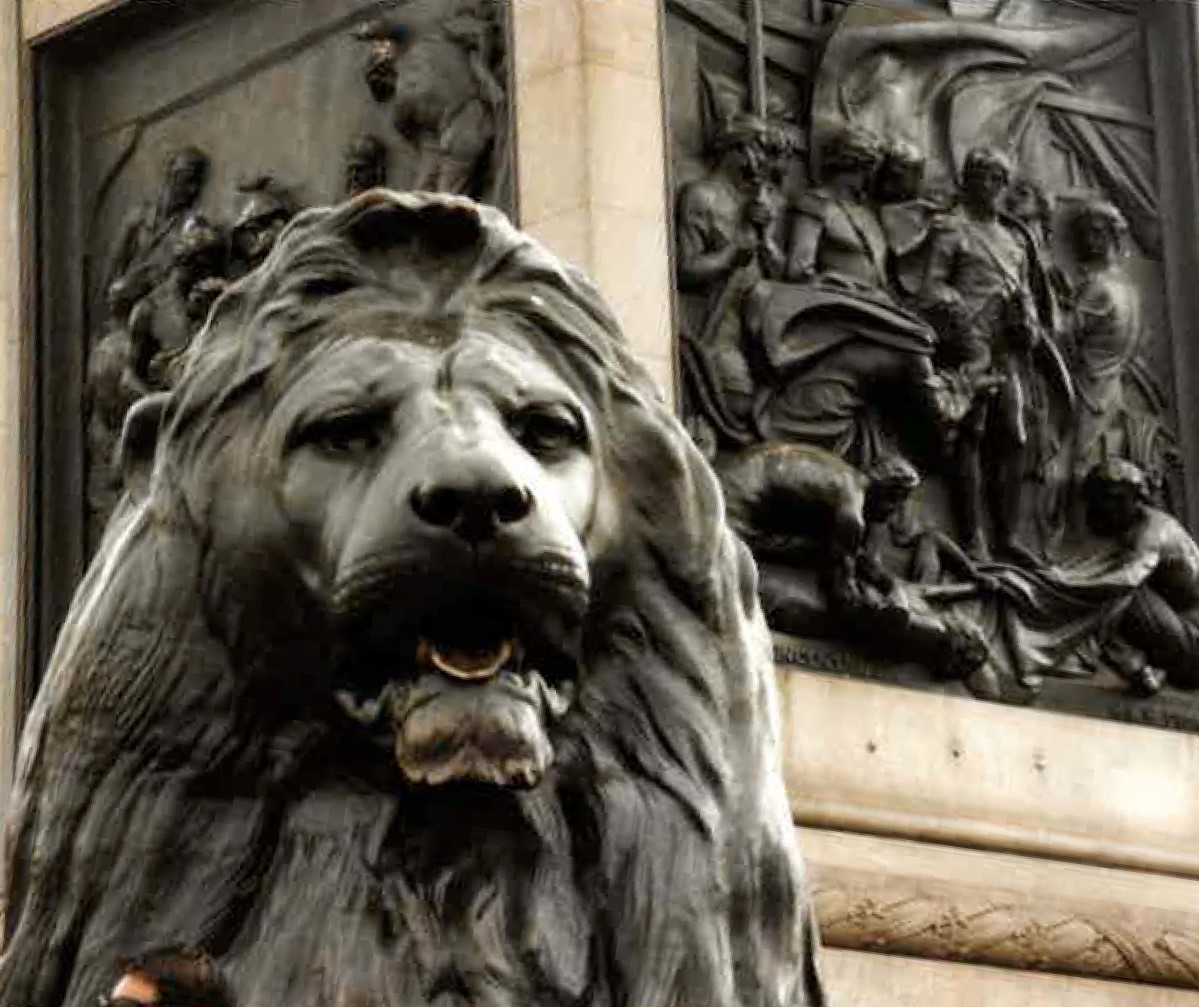
Hitchcock movie. I cross the square, walking among the famous 7-ton, black
lions at the base of Nelson’s column, to the National Portrait Gallery.
Lion at base of Nelson’s Column, Trafalgar Square
The portrait gallery is under renovation; things are all moved around. The staircase where the Royal Family portraits normally reside is bare and they are scattered all over. I find Diana between Sirs Elton John and Paul McCarthy. There are pictures of Edward VIII and the woman for whom he gave up the throne—the twice-divorced Wallis Simpson—but not together. There are at least a half-dozen portraits of George VI, the current Queen’s father.
On the first floor, there is a new one of the Queen looking very regal in a sequined white gown.
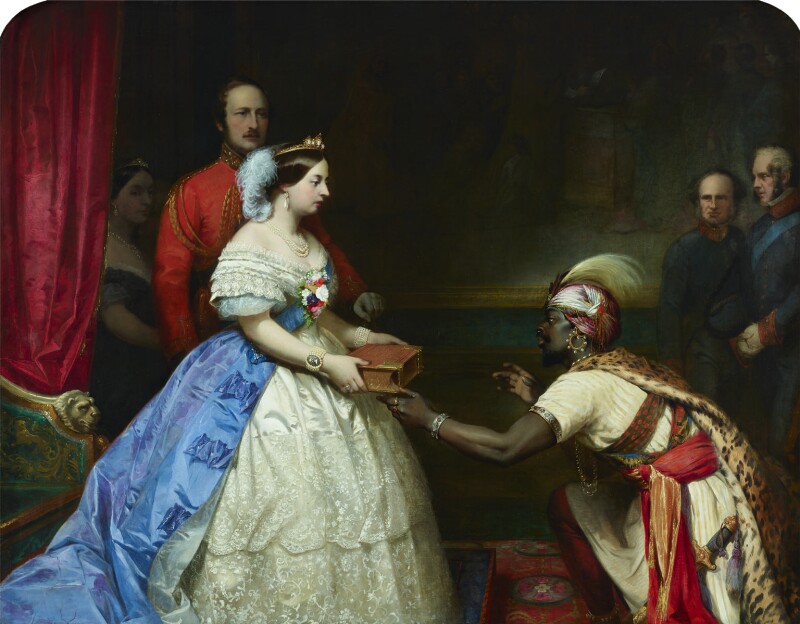
In the upstairs Victoria wing, I find a dazzling portrait of Victoria handing a bible to an African prince. Despite its wildly outdated and patronizing attitude of Christian superiority, the painting ―with its vibrant crimsons, teals, and blues―looks so real, it could be a photograph. And although he is bowed obsequiously, I believe there is a gleam of independence in the Prince’s eye.
I retrace my steps back to the hotel for the start of our orientation.
Stepping Back in Time, The National Liberal Club
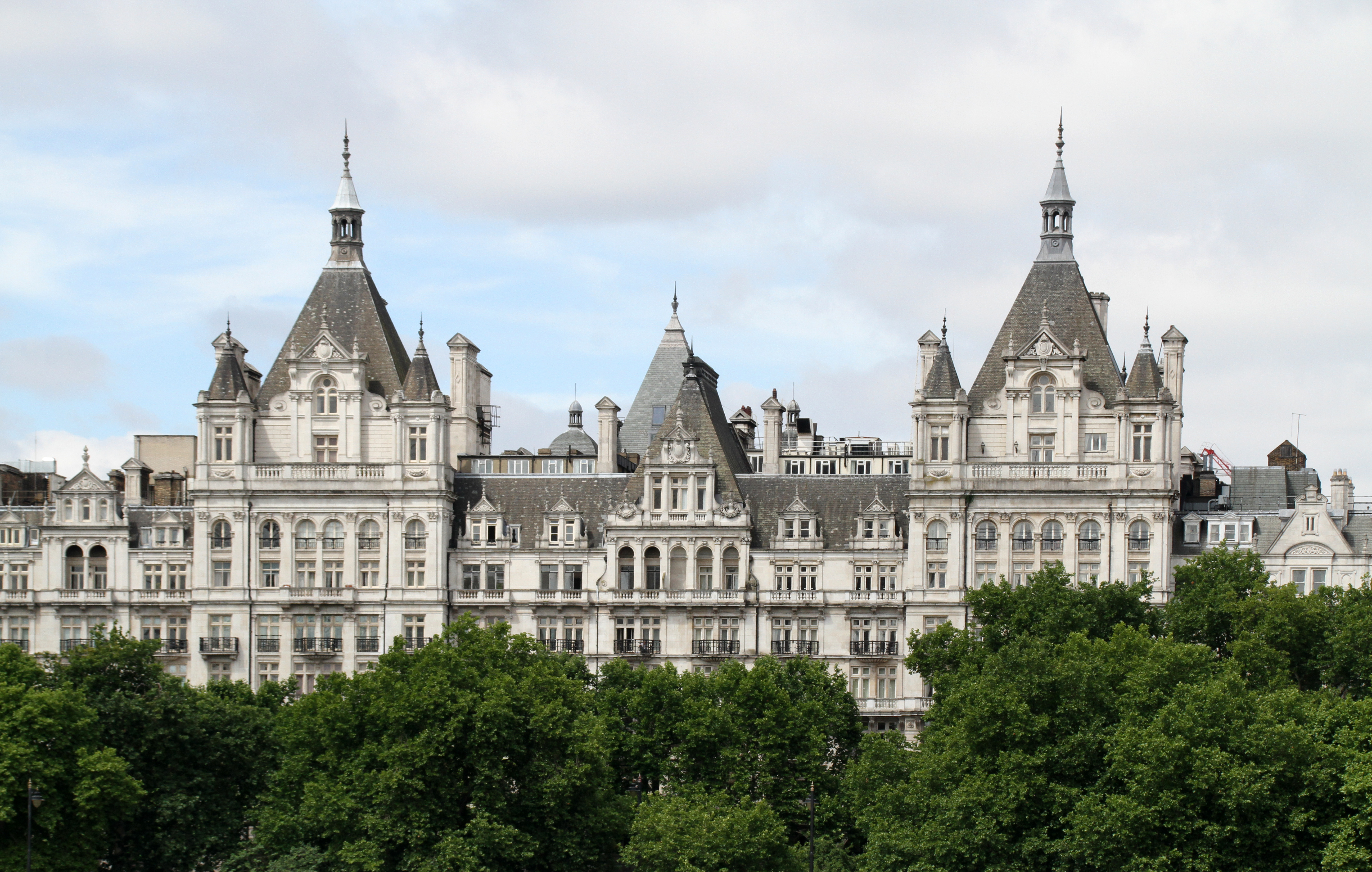
The Royal Horseguards Hotel spans a full city block along the Embankment fronting the River Thames. With its ornate, white stone façade, the hotel was built in 1844 in the style of a French chateau. It sports gray slate slanted roofs with corner turrets looking like two of Quebec’s Chateau Frontenacs joined together.
Royal Horseguards Hotel, London Photo: Tony Hisgett, Wikimedia Commons
Because of its proximity to the Houses of Parliament and the Foreign Office, the hotel has hosted politicians, statesmen, and diplomats. The Secret Intelligence Bureau used the building as its headquarters during the First World War. It is also home to the Authors’ Club. It was within these walls that:
Club members welcomed Emile Zola and Mark Twain; that Ford Madox Ford took sherry with the poet FS Flint the night he returned from combat in France; and Sir Arthur Conan Doyle won the Authors’ Club billiard handicap four times.
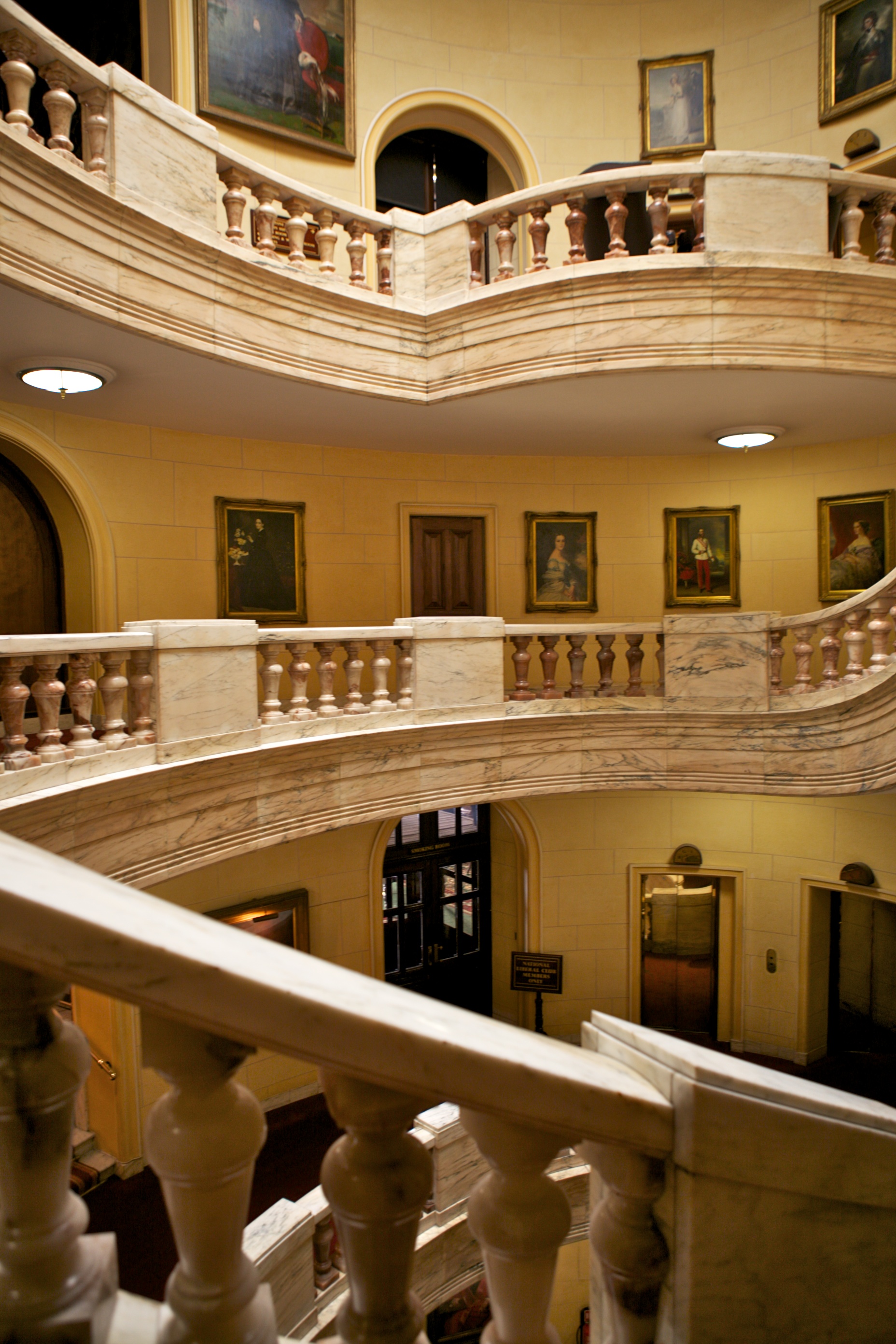
The Royal Horseguards Hotel is attached to a gentleman’s
club—the National Liberal Club—which is where our meetings are held. I didn’t
know there were any of these 19th century dinosaurs left. I wonder
if women are allowed as members. It is stunningly elegant with portraits lining
the 3-story, white-marbled, red-carpeted, circular staircase, including one of
Queen Victoria. I feel like I am still in the National Portrait Gallery.
Its website says of the National Liberal Club (NLC):
Founded in 1882 by William Gladstone, the National Liberal Club exists to provide the very best club facilities for relaxing and entertaining in the heart of London, for members whose interests vary from liberal politics to the liberal arts
It has admitted women members since the 1960s.
Meeting My Fellow Fellows
I am the first to arrive and meet BC staffer, Frank Tham,
who has organized our orientation. He looks like a bookish Tiger Woods.
Shortly, the others arrive. There are nine fellows in all. I had met them
during the orientation in New York, but I didn’t remember everyone’s name.
Dean Kaplan: Dean is my compatriot in Birmingham. His project is similar to mine; looking at UK’s performance measurement program for government services. Dean served as budget director for the City of Philadelphia, working for Mayor Rendel, who completes his mayoral term this year. Barbara, his wife, and their two children, Ari, and Max join him for his year-long program.
Kathy Taylor-Gaubatz: Kathy resigned her position as head of a nonprofit to come on this fellowship. Kathy is from California. She is here with her husband, Kurt, and two children; one a teenage daughter who shortly dyes her hair pink in a British punk style. Kathy is placed at Oxford University (lucky lady!). Her husband will be teaching there as well.
Stacy Dean and Matthew McKearn: Stacy and Matthew are newly married. Theirs is a wonderful story. They both applied for the very competitive fellowship and as unlikely as it could be, they both received it. They didn’t tell any of us that they were engaged and they got married a few days after the Washington DC interviews. Stacy works for the Center on Budget and Policy Priorities, a leading policy organization in Washington, DC, and Matthew for OMB. Stacy is at a small London-based nonprofit studying the integration of immigrants into the UK and their ability to access services. Matthew will be at the Institute of Education in London.
Andy Bindman: Andy and his family live in San Francisco. He is a medical doctor. His wife, Rebecca, is also a doctor. They have three very young children. Andy is looking at England’s National Health Service. He is placed at the School of Public Policy at the University of London. They are renting a house in London. Andy and his family just arrived today with his children and 27 suitcases!
Carolyn Galbreath: Carolyn with her husband, Frank, are also from San Francisco. Carolyn is at the School of Law at Kings College in London. In the U.S. she works for the U.S. Attorney’s Office. She is looking into telecommunications issues. Frank is retired and is taking the year in England to enjoy.
Jonathan Weiner: A doctor at Johns Hopkins University in Baltimore, Jonathan is the only fellow that is here for a shorter time than me. His fellowship is for three months. He is at the Kings Fund, a nonprofit think tank, looking at the National Health Service too. His wife, Jen, is homeschooling their two boys, ages 8 and 12.
Maryellen O’Connell: Maryellen is placed at the University of York in northern England. Her husband, Kelly, mother-in-law, and one young child is with her. Maryellen’s project has to do with homelessness. Kelly is doing some consulting work. I think he is an engineer.
Glen McGee: Glen is a biophysicist and teacher and is looking at the ethics of cloning. He is here for the orientation, but doesn’t actually start his fellowship until December. I never see him again after this week.
We spend most of the afternoon talking about mundane things like bank accounts and health care. I need to register with a GP even though the National Health Service does not cover me since I am here less than six months. Once registered though, I can use that GP for any health needs and the doctor will even come out to me if I am too sick to go to the doctor’s office.
Some of us go for drinks at a nearby pub—The Georgian—before dinner. I have a cider, which is less sweet than the American-style Woodchuck cider that I am used to. I like it better. The pub is smoke-filled. I know I am going to die from second-hand smoke before this Fellowship is over.
Our fellowship dinner is elegant and they keep our wine glasses full. We have a Thai curry chicken salad, poached salmon, rice, pea pods, and some kind of custardy dessert; then chocolates and coffee. I am seated next to Tim Chamberlain, a BC staffer, who is an elected member to his local council in Manchester. The issues, such as school funding formulas, are amazingly the same as in the US. His district is measuring performance and he is quite proud of their efforts.
I fall asleep quickly—a combination of the wine on top of a long day.
In today’s news: Faithful Demand a Diana Memorial. Yesterday, on the second anniversary of her death, people were asking, “Where’s Diana’s Memorial?” or “Where is her Tribute?” A government committee led by Gordon Brown is looking at permanent public memorials including a Diana Walkway, Diana coins, a Diana nursing scheme, and Diana awards for children. There is also a play area next to Kensington Palace to be redeveloped and renamed in the Princess’s honor.
I am loaded down with my computer, briefcase, raincoat, umbrella, shoes, and packages to mail. I feel like it is the first day of school. The only thing missing is lunch in a shiny new lunchbox. Weighed down like this, the walk seems longer than 10 minutes. I stop at Mailboxes, Etc. to mail my packages, letters, and postcards. On to the School of Public Policy, but now I am hopelessly turned around and can’t find it. I approach a couple of workmen and one of them asks, “Are you lost, love?” They don’t know it either and are funny trying to read the map.
I finally locate the building and tramp up two flights of stairs with all my stuff. Saroj Purbick is wonderfully helpful. She shows me my office that I will share with the mysterious, Simon. He isn’t there and it doesn’t look like he has been there in a long time. Most of the faculty and staff are away. With yesterday’s bank holiday, the last one until Christmas, many people take this week off. My mentor, Dr. Watt, is in Hong Kong for two weeks so I won’t see him until then. Dean, the other American Fellow at Birmingham University, won’t be in until next week either. Saroj shows me around and introduces me to the few people that are there.
The School of Public Policy consists of four parts: the Center for Urban and Regional Studies, International Development Department, Health Service Management Center, and my division, the Institute of Local Government Studies (INLOGOV). Their website says INLOGOV is
…the leading UK centre for the study of public service management, policy and governance. With over 30 years of experience working within local government and the public sector, the Institute of Local Government Studies creates the latest thinking for public servants.
At 11:00 AM, it is time for tea. I have coffee and Saroj
offers me a homemade Scottish shortbread from a little tin that she has on her
desk. Her family is from Scotland and she brought some back from her last visit.
I notice they are almost gone, so she is being very generous.
I settle into my office and wait for Saroj to type my letter of introduction that I need to collect my ID badge. But first she takes me to the stockroom to load up on supplies: paper, notepads, stationery, pens, and post-it notes (which in England they call “Note Jotter”). She also introduces me to the Head of School, Ken Spencer. He is tall, gray, and very inquisitive (What am I studying? Who is my mentor? Where am I from? Did they show me where to get coffee? Can they get a name plate for the door of my office? This last question to Saroj). But he is genuinely interested in my project and shortly brings me a magazine with articles related to performance measurement.
I take my letter over to get a picture ID card and then an account at the library. I’m not sure whether I am considered part of the faculty or a student. The ID card is for faculty, which I need to access the Staff House, but it is also for students to use the library.
University of Birmingham Library
I stop to say hi to Chris at the Student Guild, who is busy, so I grab a sandwich and walk back to my office. My name is now typed neatly and tacked up on the door. Finally Nasir Yasmin, the IT guy, sets up my email account and a university email address. I can also access my AOL account via the Internet.
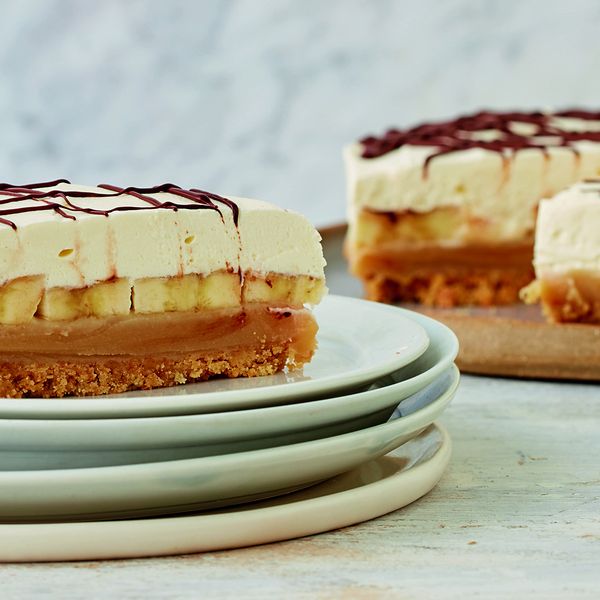
Before I realize it, it is nearly 6:00 PM so I pack up and stop at Tesco’s on the way home to pick up supper. I get a salad and breadstick and a small Banoffee Pie—a delicious toffee “pudding” (dessert). “Banoffee” is a made-up word combining banana and toffee. I write down the ingredients; it seems quite simple to make. Later, back in the U.S., try as I might, I can never find toffee sauce like they have in the UK. Not really a sauce at all, it is thick and dense; darker than butterscotch and richer than caramel. Even following directions for making it, mine is never as thick as I remember it being. It is one of those UK things that I cannot figure out how to replicate.
Banoffee Pie: Shortbread cookie crust. Top with thick toffee sauce. Layer in fresh banana slices. Top with thick whipped cream or Devon cream. Decorate with chocolate curls
When I get home, Tony asks me to call him sometime and say, “Hello, this is Jody.” I have no idea what he is talking about. He says it’s a very famous song. Caroline tells him, “No, the song is ‘Hello, this is Joanie.’” I still don’t know it.
I do some laundry, which Caroline says she will put in the dryer for me. I watch a history program about Lady Georgiana Spencer, coincidentally of the Spencer family from Althrop and about whom I just purchased a biography at Dillon’s bookstore yesterday. Is there such a thing as a big coincidence? In a Seinfeld episode Elaine goes on a tirade that there is no such thing as big coincidences or small coincidences. There are no degrees of coincidences. It’s either a coincidence or it’s not. In any event, I think my meeting the Lady Georgiana three times in three consecutive days in a big coincidence.
Tomorrow I have an early start. I am off to London.
It is a bank holiday today so
we are still on the weekend breakfast schedule of 9 instead of 8 AM. I go down
for coffee and croissant and meet the newest guest—Akiko, a doctor from Japan. Akiko
is staying for a week. She admits she is here on a research trip, but laughingly
says the real reason she is here is to learn to speak English. I think she
speaks English very well already.
I take the city bus this morning to Birmingham City Centre. The bus stops at the University gate on Bristol Road, so the walk from Glenelg is much shorter than to the train station. And at 90p, the fare is less than the train too. Upstairs in the New Street terminal, I discover an Internet Exchange. It is easy and not too expensive at £2 for 20 minutes. Hopefully, tomorrow I will have my university email set up.
I walk through the Palisades, the shopping mall above the
train station. Some of the shops look familiar—McDonalds and Woolworth’s. Some
I can guess at what they are, like Britain’s version of the dollar store called
“Poundland.” Some are beyond my wildest imagination, like the Newt and
Cucumber.
I walk down the exit ramp; familiar from when I was here on my first day with Chris. The weather is gorgeous. I can’t imagine what it will be like when it rains. Chris asked me on my first day if I brought an umbrella with me. When I affirmed that I had, he said, “It will become an extension of your arm.”
Following the signs for the Convention Center, I walk through Victoria Square again. The Council House looms large over the open square filled with statues and monuments.
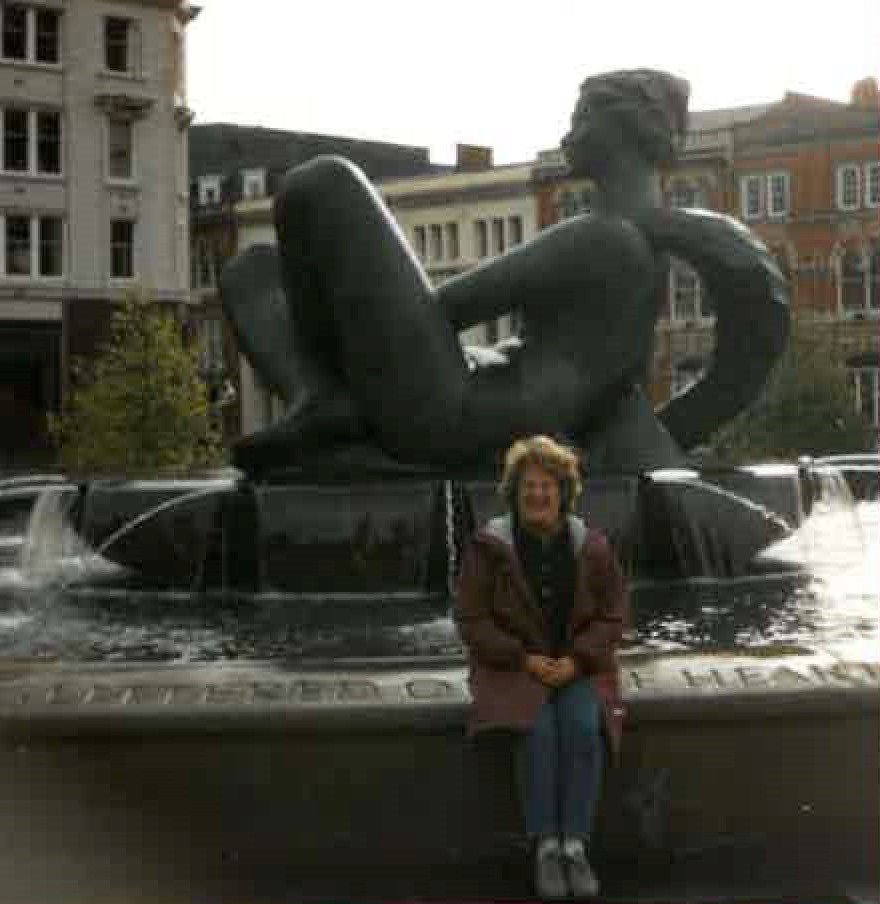
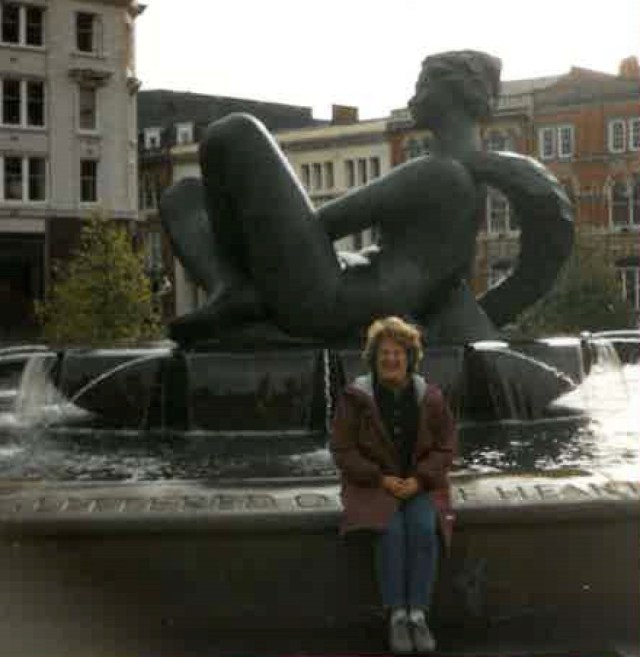
I love the public art in Birmingham. A large, bronze statue of a reclining woman in the middle of a pool amidst spouting water is guarded by two giant stone Sphinx. Titled the River Goddess, she is however known locally as the Floozie in the Jacuzzi. Water flows into the pool at 3,000 gallons a minute. Around the rim of the pool is the poem:
And the pool was filled with water of sunlight, And the lotus rose, quietly, quietly, The surface glittered out of heart of light, And they were behind us, reflected in the pool. Then a cloud passed, and the pool was empty.
— T.S. Eliot
The old, stone buildings surrounding the fountained public square remind me of Rome’s lovely piazzas although much bigger than Rome’s squares and less old-world and intimate.
Birmingham’s River Goddess Statue, Victoria Square
A bit further on is Chamberlain Square in the center of which is the Chamberlain Memorial Fountain, an elaborate, 65-foot-high curlicued spire that reminds me of the Albert Memorial in London. Sir Joseph Chamberlain (1836 –1914) was a Member of Parliament, leader of the opposition party, secretary of state for the colonies, and Birmingham mayor. He was also university chancellor and the clock tower is named for him. He seems to have been a controversial figure having been both blamed for causing the Boer War and then playing a central role in winning it. He was arrogant and much hated, but he advocated for worker’s compensation and for benefits for England’s agricultural laborers. My guidebook says, “Despite never becoming prime minister, he was one of the most important British politicians of his day.” His son, however, did become prime minister; the pre-WWII appeasement prime minister, “Peace for our time” Neville Chamberlain.
Chamberlain Memorial and Square Photo: David Stowell
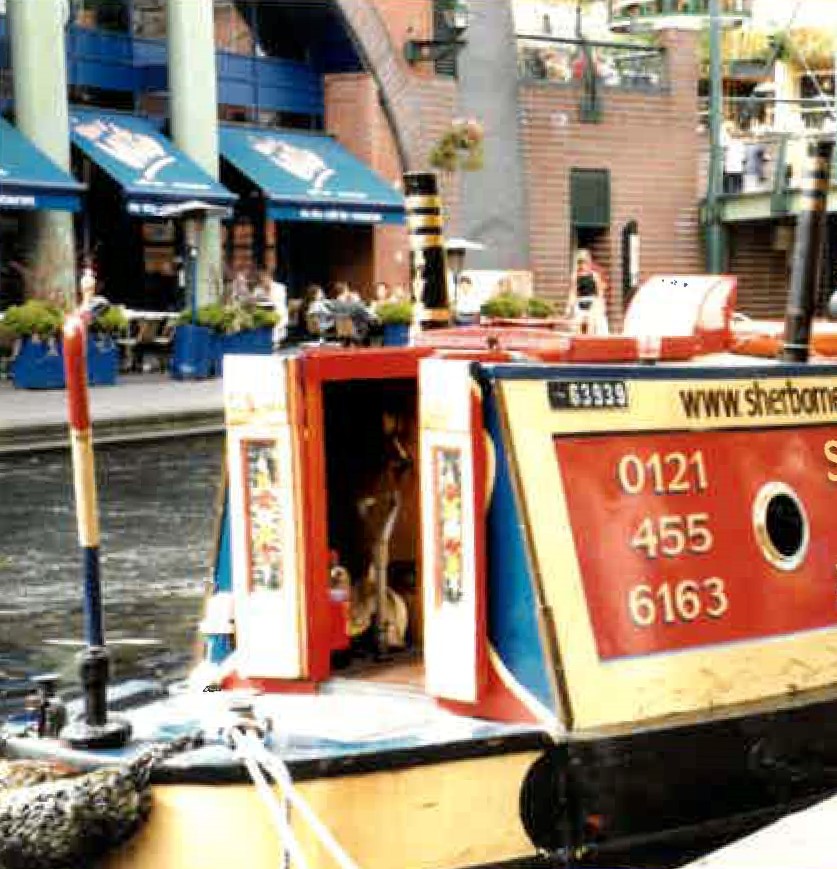
I cut through the huge convention center (it houses 11 concert halls) to get to the canals. I jump on one of the narrowboats for a sightseeing tour just as it begins to pull away. The narrated tour boat meanders through the canals that that crisscross Birmingham and most of the Midlands. The tour takes about an hour and we follow the old canal lines that loop around the city. We pass dingy industrial buildings before the area around us opens up into grassy countryside. At 3 mph, it is a slow, peaceful ride.
Birmingham Canal Boat
Birmingham industrialists built the canals to haul coal to their factories during the Industrial Revolution; which had its heart in Birmingham. There was an article in the Boston Globe dubbing Birmingham, “the Venice of London.” The 18th century canals that span the city cover 33 miles compared to Venice’s 32 miles. “Not that the gondoliers are jealous,” the article says.
An engineer named James Brindley oversaw the canals’
construction, so it is appropriate that we end our tour back at the Convention
Center, opposite Brindley Place; a newly renovated marketplace of pubs and
restaurants. People are sitting outside eating and drinking. A silver-painted mime,
dressed as an English bobby, is entertaining the crowd. I have lunch—pizza—and make
my way back to Victoria Square
I find a wonderful bookstore—Dillon’s—and a young woman responds to my inquiry about whether they have phone cards, asking me, “You’re not from here, are you?”
For dinner, I first try the pub at the end of the street—Gun Barrels. But the cigarette-smoke-filled pub serves mostly hamburgers, which I am trying to avoid what with the risk of Mad Cow disease. So, I walk the other way until I see a fish and chips shop. The fish and chips certainly are cheap at 99p, but the chips are salty and not very crisp. I can’t help but think Tony and Caroline’s chips (I can smell their mouth-watering aroma coming from the kitchen) are better.
I am off on my long-anticipated, eagerly-awaited trip to Althrop, the ancestral home of Princess Diana’s Spencer family. As soon as I knew of my fellowship start date in Birmingham, my visit to Althrop was one of the first things I arranged. In fact, I scheduled my arrival a few days early so I could visit here. Althrop is open for only a few weeks a year and closes for the season on August 31.
At breakfast Tony tells me that part of the investigation of Diana’s car crash was done here at the University of Birmingham, where they have specialists in accident reconstruction. He says it’s a big secret but that Caroline, from where she works at the University, saw lots of coming and going and someone there told her about what they were doing.
Caroline tells me to leave a few minutes earlier than I planned so that I can stroll to University station. Tony says it only takes 15 minutes to walk there, but Caroline turns up her nose at him and says it takes longer than that. For the record, it takes me 25 minutes to walk there, but I never claimed to set any land speed records.
At New Street Station, I catch the Silverlink to Northampton. During the hour-long ride, we pass quaint sounding places―Coventry, Rugby, Long Buckley—and arrive in Northampton at 12:10 PM. While I wait for the coach to Althrop, I look around to see if anyone else looks like they are going to Althrop. One lady is a certainty. She carries a big bouquet of white lilies, which can only be for Diana’s graveside. Eventually, a big, double-decker bus with a sign that says ALTHROP arrives. A long queue of eager visitors climbs aboard and the bus sets off.
I consider the people on the bus. For some reason, I assumed they would all be Americans. There are mostly women, but I see two men each traveling alone, an elderly British couple, and lots of British ladies. The woman with flowers is speaking French to a young couple that accompanies her. Oh, yes, there is one loud American couple too.
At the gates of Althrop, the bus turns onto a narrow, bumpy road.
More than once, sheep grazing on the edge of the road scatter at our approach.
A pheasant runs past. As we drive nearly a mile into the estate, the fields dotted
with sheep stretch for as far as the eye can see.
The bus obscures my first views of Althrop, but I glimpse the stables to the left of the house. I know this to be the building in which Earl Spencer put the exhibit of Diana’s life. We pull into a circular drive. There is a large green lawn in between the house and the stable and people are milling around.
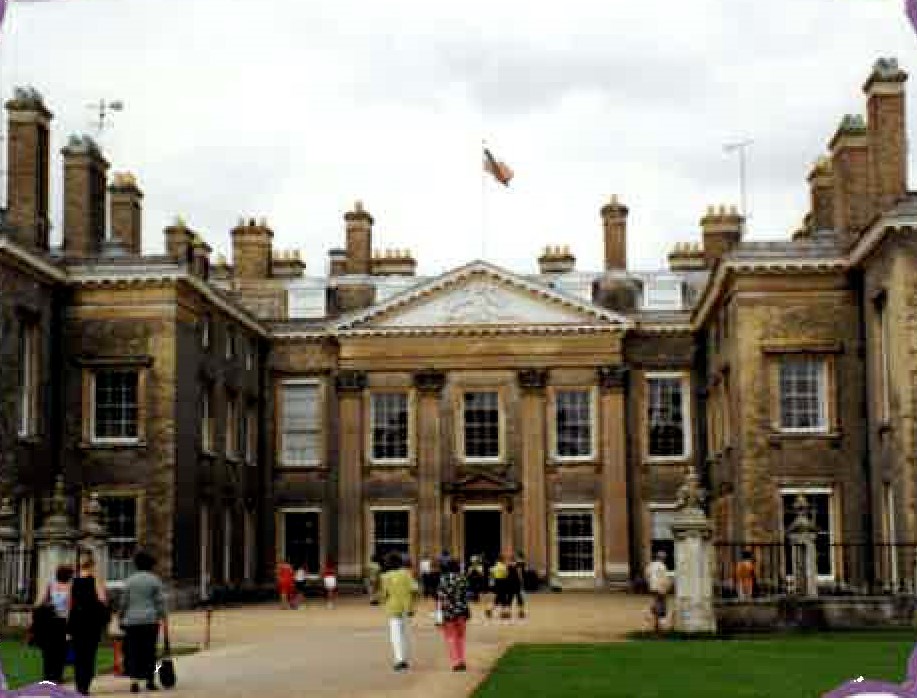
Althrop House, The Spencer Family Home Since 1508
There has been a house on this site owned by the Spencer family since 1508, rebuilt and remodeled numerous times. No one knows for sure what the first house looked like. Today’s house bears the hallmarks its 1770 re-design.
Althrop House, Spencer Family Estate
Althrop is a Saxon word dating from the Doomsday Book in 1087 when chroniclers called the grassy land “Olletorp.” Throp is Danish and would have been pronounced “throop” 600 years ago. I read somewhere that Charles Spencer pronounces it “Awltrupp” not All-thrope as one would assume and, since he is the owner, “He can pronounce it however he wants.”
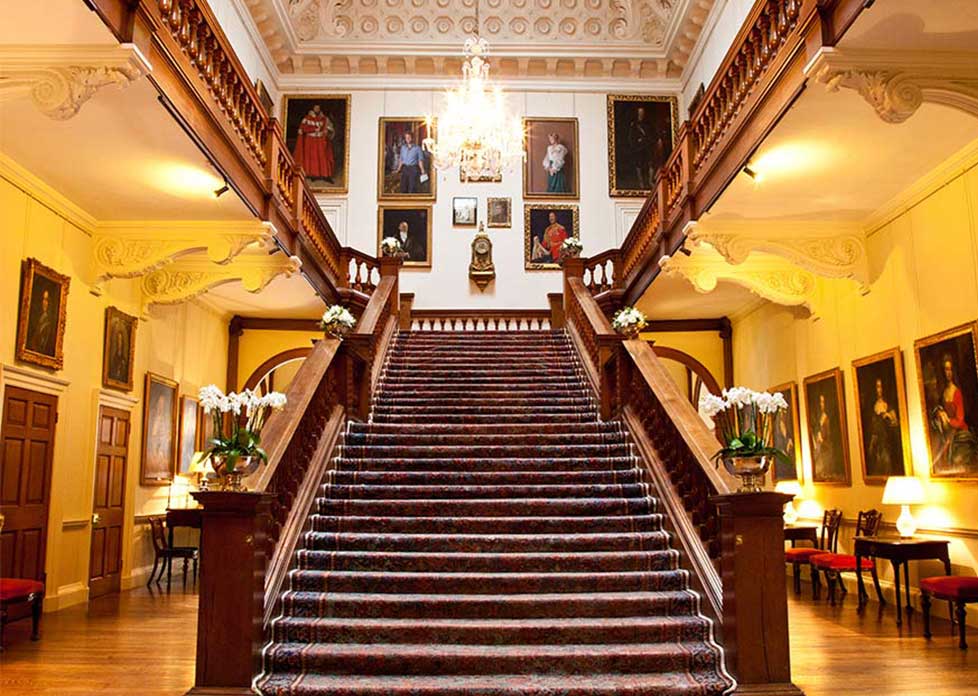
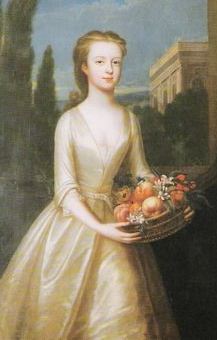
The house’s interior is staggering. There are 90 rooms of furniture, bronzes, Waterford Crystal, sculptures, books, miniatures, and porcelain. Life-sized paintings cover every inch of wall space. The highlight of the house is the magnificent “saloon” with its imposing staircase. It is a gallery of Spencer ancestors. A portrait of Lady Diana Spencer, who was sister to the 1st Earl Spencer in the 18th century, is paired with a modern painting of Lady Diana Spencer who became Princess of Wales in 1982.
Lady Diana Spencer, Princess of Wales (1961-1997) Photo: Nelson Shanks
Lady Diana Spencer (1710-1735)
Besides the obvious one, the house has many royal connections:
“Johnnie” Spencer, the 8th Earl of Spencer, the current Earl’s father, served as Equerry to King George VI and later for Queen Elizabeth II.
The Princess of Wales bedroom is named, not after Diana, but for the wife of the future King Edward VII, Alexandra, who stayed at Althorp in 1863, while the Queen Mary bedroom is named for the wife of King George V, who visited Althorp in 1913.
The Great Dining Room, added in 1877, is said to be inspired by the ballroom of Buckingham Palace.
The Garden Lobby Room contains the Spencer porcelain collection including a set of blue and gold porcelain cups for serving chocolate, which was once owned by Marie Antoinette.
Through Charles Spencer’s 1700 marriage to Anne Churchill, daughter of the Duke and Duchess of Marlborough, the dukedom of Marlborough passed to the Spencers. Winston Churchill is also descended through this line.
The art collection at Althrop is better than most museums and includes paintings by Rubens, Titian, and Van Dyke, while one of a young lady said to be “of the School of Leonardo da Vinci” bears a striking resemblance to the Mona Lisa. There are also 17 Joshua Reynolds portraits, mostly of the Spencers themselves.
Good Night, Sweet Princess
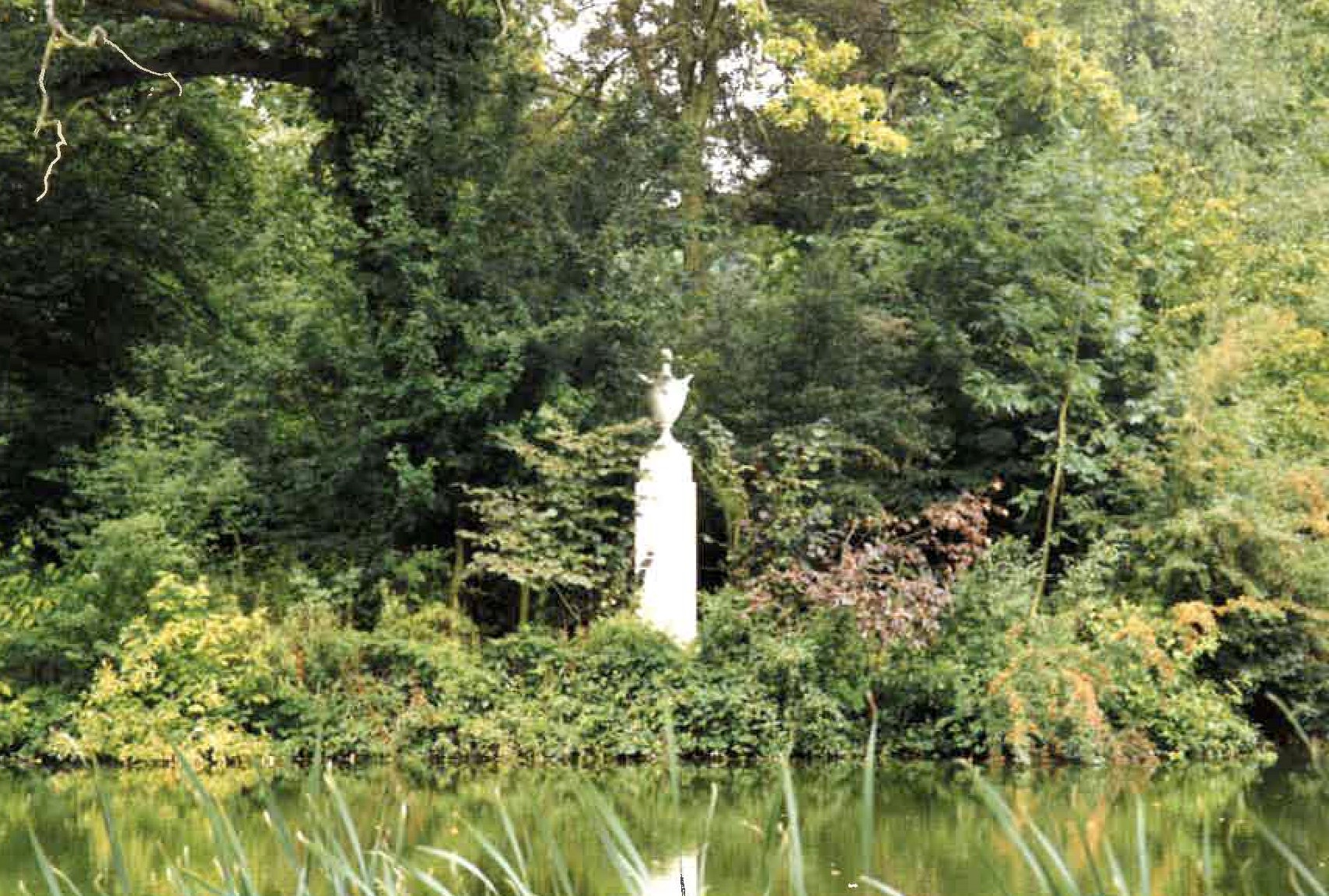
I exit the house in the rear and walk to the Round Oval
where Diana is buried. Soon the dense path opens up to the pond with the
miniature island at its center. The white memorial column with a stone urn on
top is simplistically elegant. Everyone is respectful, standing in quiet contemplation.
Then a jet plane roars overhead. The Althrop guard remarks how the engine noise
spoils the peacefulness and I think, “Yes, that is exactly how I would describe
this spot—peaceful.” Far different from Diana’s life.
Diana’s grave, Althrop
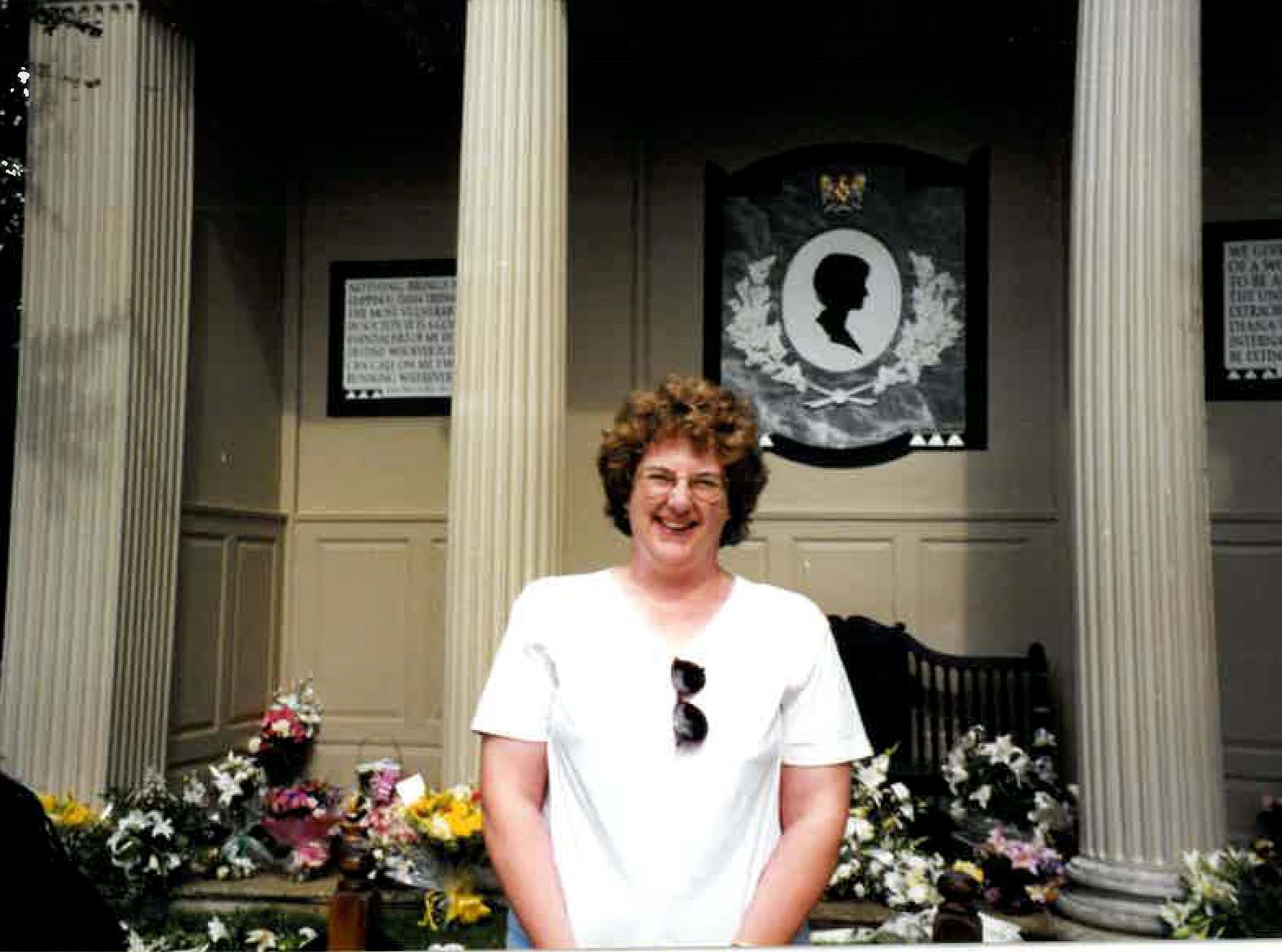
As I move left along the path that circles the pond, I come
to the 18th century summer house that is now a memorial to Diana. A marble
plaque with a black and white, cameo-like silhouette of Diana’s profile is at
the center of the temple framed by Greek columns. The air is heavy with the scent
of the flowers that visitors have left. It is astonishing how strong the
fragrance is. I can only imagine how the flowers must have perfumed the air at
Kensington Palace where they were stacked waist high in the week leading up to
Diana’s funeral.
Diana’s Memorial, Althrop
Saddened anew by Diana’s death, so tragic because it was avoidable, I return to the front of the house and walk towards the stables. The renovated stables are huge. At one time they housed 100 horses and 40 grooms. The courtyard is scattered with tables where people are drinking tea and eating sandwiches from the café.
I slowly make my way through the crowds in the stable’s
exhibit rooms.
The Wedding Room contains the famous flouncy, ivory, silk wedding dress with its sweeping 25-foot train. When we were in London in 1996, Mom, Brian, and I visited the Royal Ceremonial Dress Collection in Kensington Palace but the Royal curators had removed Diana’s wedding dress from the display following her separation from Prince Charles. At the time I remember thinking them just sad and petty. I admire it now―one of the most famous dresses in the world.
In other rooms, the exhibit showcases Diana’s charity works.
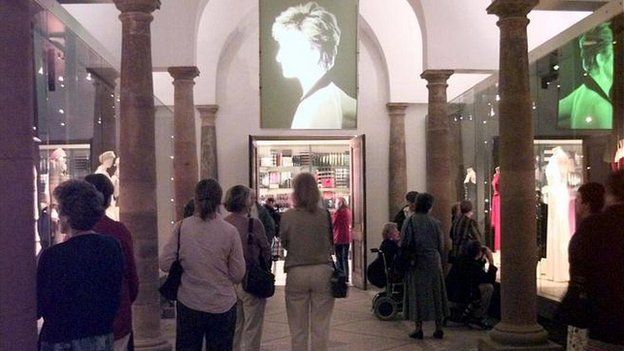
Two cases of stunning designer dresses show how tall and thin she was. An enormous
bed of dried petals from flowers from the funeral are mounded on the ground
behind a glass wall. There is also book case after book case—nine in all― stacked
from floor to ceiling with condolence books from all over the world.
Dress Exhibit, Althrop
And there is a display of Diana’s childhood with memorabilia from her school days. Home movies show a happy, carefree girl swimming, dancing, riding a bike, and snuggling a pet rabbit. An American rock song is playing:
Another turning point, a fork stuck in the road Time grabs you by the wrist, directs you where to go So make the best of this test and don’t ask why It’s not a question, but a lesson learned in time.
It’s something unpredictable, but in the end it’s right I hope you had the time of your life.
The song is poignant and it sticks in my mind long after leaving Althrop. Even years later when I hear it, I am immediately transported to the Althrop stables and the home movie of a young Diana standing on her toes doing ballet twirls.
Charles Spencer is Here!
I buy some things in the gift shop including a sweet, pink demitasse cup and saucer decorated with an English rose and, on the reverse, the inscription, “the very essence of compassion, of duty, of style, of beauty”―an excerpt from Charles Spencer’s eulogy at Diana’s funeral.
I also buy Earl Spencer’s new book, Althrop, The Story of an English House, after which I head to the café. I chose a prawn and green onion sandwich, a honey flapjack (a kind of oatmeal bar), and sparkling water. I sit down at a table with two women from my bus who tell me Charles Spencer has just arrived back from South Africa and is at this very moment signing books in the gift shop. I grab my book and dash into the gift shop. Sure enough, he is there.
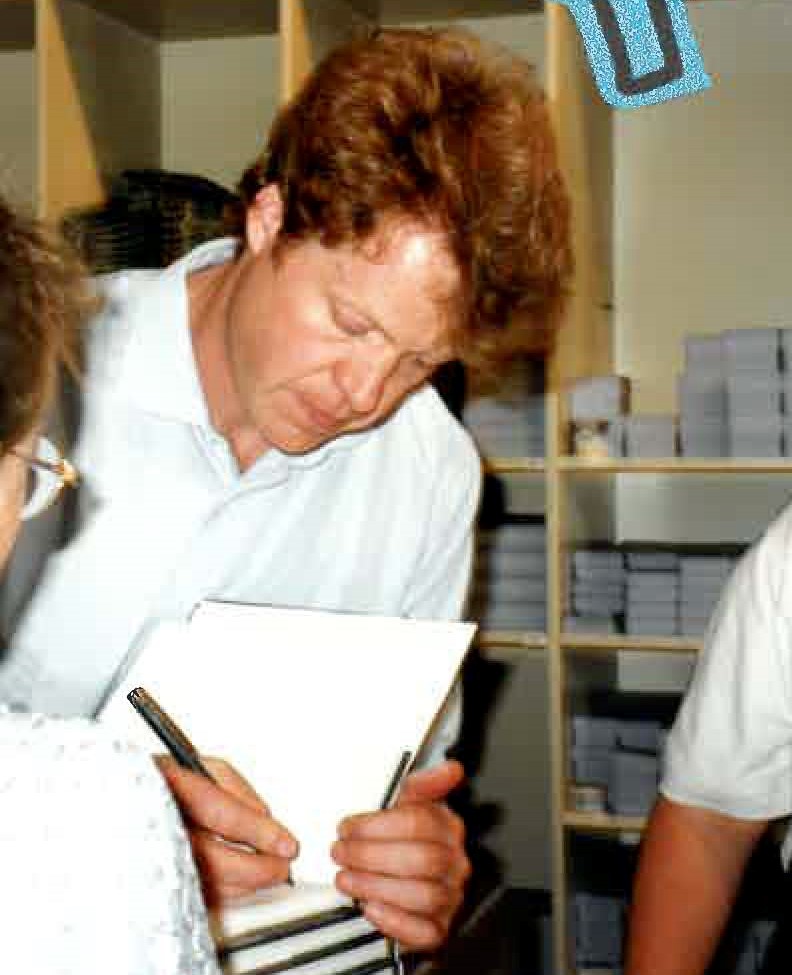
Earl Spencer at Althrop
As I give him my book to sign, he asks, “Who’s it to?” I say, “Jody” and spell it out. He asks me where I am from and I say, “Maine in the United States.” “Yes,” he nods his head, and I say, “North of Boston.” He repeats, “Yes,” and seems to know it. He says, “You are coming into a lovely time of year there, aren’t you, with the leaves.” I am surprised that he not only knows where Maine is, but knows about our fall foliage. He signs my book, “To Jody, With Best Wishes, Charles Spencer.” I ask him if I can take a picture and he says oddly, “Yes, but I can’t look at the camera because of my eye” (he points to his left eye), but he says, waving, “You go ahead.” I snap one picture and return to my table where I had hastily left my sandwich uneaten. I thank the ladies profusely for telling me about the Earl and I happily finish eating my lunch.
Charles Spencer is no slouch. At just 35, at the time of Diana’s death two years ago, not only was he a published author and successful manager of this massive estate with all of its lands, livestock, art, and historic heirlooms, he also braved the wrath of the Royal Family at Diana’s funeral by publicly criticizing them in what are probably some of the most astonishing remarks made in front of the Queen and ― embarrassingly for her―to the rapturous applause of the millions of people listening outside Westminster Abbey. He eulogized:
Diana was the very essence of compassion, of duty, of style, of beauty. All over the world she was a symbol of selfless humanity. All over the world, a standard bearer for the rights of the truly downtrodden, a very British girl who transcended nationality. Someone with a natural nobility who was classless and who proved in the last year that she needed no royal title to continue to generate her particular brand of magic.
In today’s news: Betrayal! James Hewitt is to reveal sensational details about six lovers in Princess Diana’s life in an effort to rescue his own tarnished reputation. As the second anniversary of the Princess’ death approaches, the former Guards officer; branded a “traitor” by Diana, hopes to bank at least £1 million from his new book by disclosing her intimate thoughts on her relationships.
My first morning in Birmingham, I head downstairs for breakfast. Tony makes the guests’ coffee with a French press and it is not too strong, which I have come to expect of coffee in England. I drink two cups. It is a continental breakfast with cereal, fruit, and pastries. I eat a half a grapefruit, croissant, and toast; which will be my daily fare for the next four months. A young, British couple―staying for just one night―is quiet and reserved. But when I say I am from Maine, on the Canadian border, she brightens and tells me she has a cousin in Canada. They tease each other. She says if they get divorced, she gets his Furby; the latest toy craze.
I work on my journal. The laptop powers up fine with the unit for converting to UK’s 220 voltage electricity. The voltage is double the U.S. standard of 110 and without a converter it will zap the inside of your American appliances. I also need a plug adapter to accommodate Britain’s slanted 3-pin outlets.
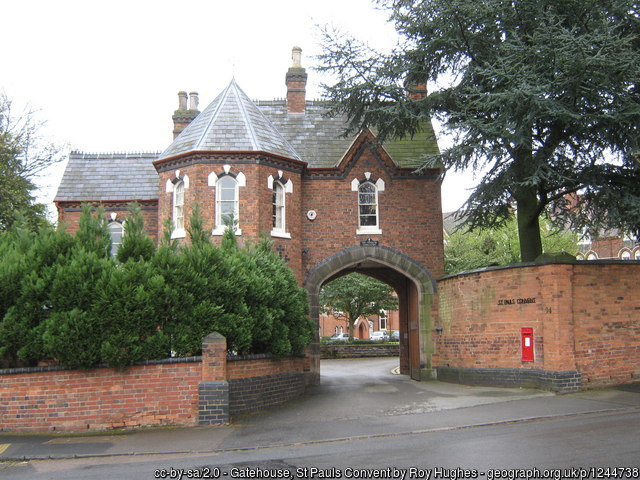
Caroline and I take Lutchford for a walk around the Selly Oak neighborhood. It is a quiet, residential street with a row of beautiful brick Victorian houses. We walk by the extensive grounds of St. Paul’s Convent. I didn’t know there were convents anymore, but apparently this one is still a functioning nunnery. Our walk is brisk and I decide my poor blisters will only get worse before they get better.
I try my email. Tony, the proprietor, is willing to allow me to connect through his phone line, but he is worried about missing business calls. I connect to AOL International, which Tony at SPO had installed for me before I left. Click, click, I’m in. Instead of the normal, “You’ve got mail” notification, a British-accented voice says, “Hello, you’ve got post.” I love it! I stay on for only a few minutes conscious of tying up the phone line.
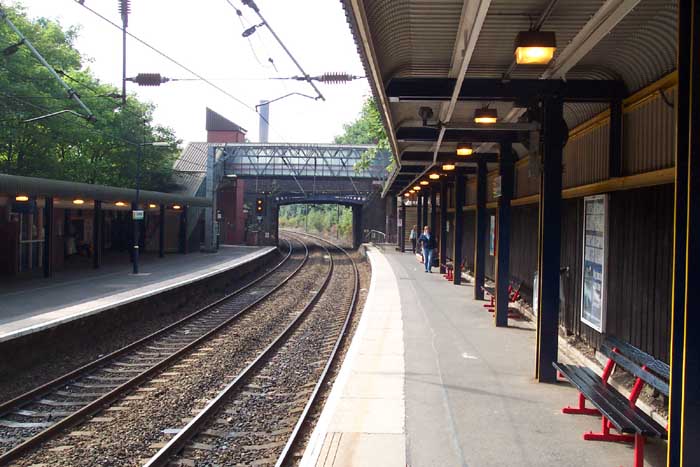
I decide to tackle my train reservations. I walk to the University station on the other side of the campus from Glenelg and take the train to City Centre.
Upstairs at New Street station is the travel center where you get tickets and reservations. Although I have to wait in line for a long time, it is worth it when I finally get to the ticket agent. The ticket agents are wonderfully helpful and take as much time as you need to answer to your questions, help you find the right train, and give you time schedules. I buy a ticket for tomorrow’s trip to Althrop and reserve a seat to London for Wednesday. The train to London goes from Birmingham’s New Street station to Euston station. The agent recommends I buy a ticket to London’s Charing Cross station that is near my London hotel. I can get off the train at Euston and hop on the tube to Charing Cross all on the same ticket and with some savings.
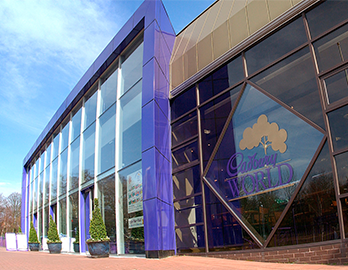
Cadbury World, The Sweet Smell of Chocolate
After having satisfactorily made all my travel arrangements,
I am off to Cadbury World in Bourneville on the south side of Birmingham. I
grab a tomato and bacon sandwich and a bottle of water that I have on the
train. I notice my bottled water is Malvern water; the brand the Queen drinks.
Sure enough, as I peer closely at the label, there is the familiar coat of
arms—By Appointment to her Majesty Queen Elizabeth
II. I wonder if the Queen knows that Malvern water is bottled by Schweppes;
the same bottler of a common American ginger ale.
As I exit the train station at Bournville, the aroma of sweet
chocolate permeates the air.
I ask a man at the factory visitor’s window about the tour.
“Oh, you want Cadbury World, love. Cross the street, turn left around the
corner of the building, and follow the path to the right.” I walk for what
seems like forever along the path as it careens around factory buildings and
over hill and dale. When I finally arrive at Cadbury World, the number of
children running around almost makes me turn around and go home. I weave my way
through the throng of kids and buy my £6.50 ticket for the next tour.
Waiting for my tour to start, I browse the gift shop. I look
for the shortbread and caramel candy bar that Brian bought out of a vending
machine during our last trip. It immediately became our favorite, but neither of
us can remember its name. I buy one each of the miniature “pick and mix” bars:
Twirl, Crunchie, Wispa, Wispa Gold, Caramel, Fudge, and Chomp. None of these is
it.
Cadbury is offering a new caramel-y Aztec 2000 “limited
edition” candy bar for the Millennium. While most people prefer just the plain
Cadbury Dairy Milk bar, they say a new candy bar introduced in 1996—Fuse—is
incredibly successful. It is a trail mix type of thing with raisins, peanuts, and
cereal, “to adapt to the changing lifestyles of busy, young adults.”
On the tour, we walk through the Mayan jungle where the Aztecs grew the first cocoa beans and from where the conquistador Cortez brought them back to Spain. We sip the original chocolate drink that the Aztecs called “chocolatl.” It is not sweet and a pinch of red chili pepper makes it daringly spicy. Not like Swiss Miss, that’s for sure. Next we walk through the Court of Charles II. Although the Spanish Court tried to keep it a secret, in 1615, the King’s daughter, Anne, married Louis XIII of France and her maid brought her recipe for hot chocolate with her to France. It swept through Europe like wildfire. We continue our tour, strolling through the fashionable St. James Street where, in 18th Century London, coffee and chocolate houses were popular. Finally, we hear the story of the rise of Cadbury from a humble tea and coffee shop. In 1854, Queen Victoria is amused and grants the Cadbury Brothers a royal warrant.
Machines in the packing room wrap 1,000 candy bars a minute and where, our guide says, they manufacture 1 million creme eggs a day all year long to meet the Easter demand. Today, they are making fruit and nut bars and we get a sample bar. At several points along the tour, smiling guides hand out more chocolate bars.
I stand in a long line for the magical Beanmobile ride through the cocoa beanie village. Think, It’s a Small World meets Mr. Potato Head. It is corny and definitely for kids.
The tour ends back at the gift shop. Practically in a sugar
coma, I manage to escape without buying any more chocolate. I exit past the
Cadbury Creme Egg motorized cars and walk back along the factory paths to the
train station.
On the way back to Glenelg, I stop at Tesco and buy The Times, a salad, and Cornish pasty; a
mildly spicy meat pie. I read The Times
and eat my pasty, which makes me thirsty all night.
As I sit at my vanity and write, my hosts are working in their lovely garden. I hear Caroline whistling a tune from Phantom of the Opera.
Off in the direction of the clock tower, I can see the sun setting. If I look carefully I can see the clock tower through the leaves as it chimes out 8:00 PM. The bells chime every 15 minutes and, on the hour, strike out the hour. The tune is the same four notes as Big Ben, but without Westminster’s deep, booming multi-tone bells. Click here to hear it ring. Sitting at the windows in my lovely room with the bells’ sonorous chiming, is one of the things that will stay with me even years after leaving Birmingham.
The weather has been beautiful for the last two days.
Yesterday it was too warm for my new Gore-Tex raincoat from LL Bean. Today, I
wore no coat. It has been in the upper sixties with plenty of sun. It is
supposed to stay nice through the weekend and the Bank Holiday on Monday.
I watch the Edinburgh Tattoo on the BBC. The Tattoo is a hugely popular annual display of guards, military bands, and bagpipers parading at the foot of Scotland’s golden, light-bathed Edinburgh Castle. Despite the spin-doctors jazzing it up with Barbadian stiltwalkers and American marching bands, it is still a smart precision display and military spectacle. This year is the 50th anniversary of the tattoo and the Queen’s daughter, Princess Anne, who was born the same month and year as the first tattoo, is on hand to mark the occasion. I go up to bed humming Scotland the Brave.
In today’s news: Oh, you call it aubergine? The Earl and Countess of Essex were at Dublin Castle on their first formal engagement outside Britain since their June wedding, to launch Millennium Gold Encounter, an international program linked to the Duke of Edinburgh Awards. The Countess is dressed in an aubergine colored jacket to meet Irish President Mary McAleese, only to find her host in an almost identical jacket.
I make my way through immigration control, customs, and on to baggage claim…oh, no…baggage claim! Did we arrive in Newark in time to for my bags to make it on the plane to Birmingham? But, yes, here they come around the carousel. I load up my “buggy” and go looking for the British Council representative who is to meet me.
Almost immediately, I see a distinguished-looking, white-haired man holding a placard with my name. Mr. Chris Gately of the Guild of Students, University of Birmingham, and our driver, Roger, take over the buggy and we exit the airport. The British Council (BC) has hired a bus (what in the UK they call a coach) to take me to my lodging. How much luggage did they think I would have? We’re off; my empty, queasy stomach made even more so by the bouncing coach, not to mention the backwards “roundabouts.”
My First Glimpses of Birmingham
We leave Roger and the coach at Thomas Cook’s travel agency where
we also pick up the first installment of my stipend. Then we walk through the
city’s public squares.
Birmingham is a city of 1 million people but it feels approachable
and, at least on this early Friday morning, not very crowded. We walk through
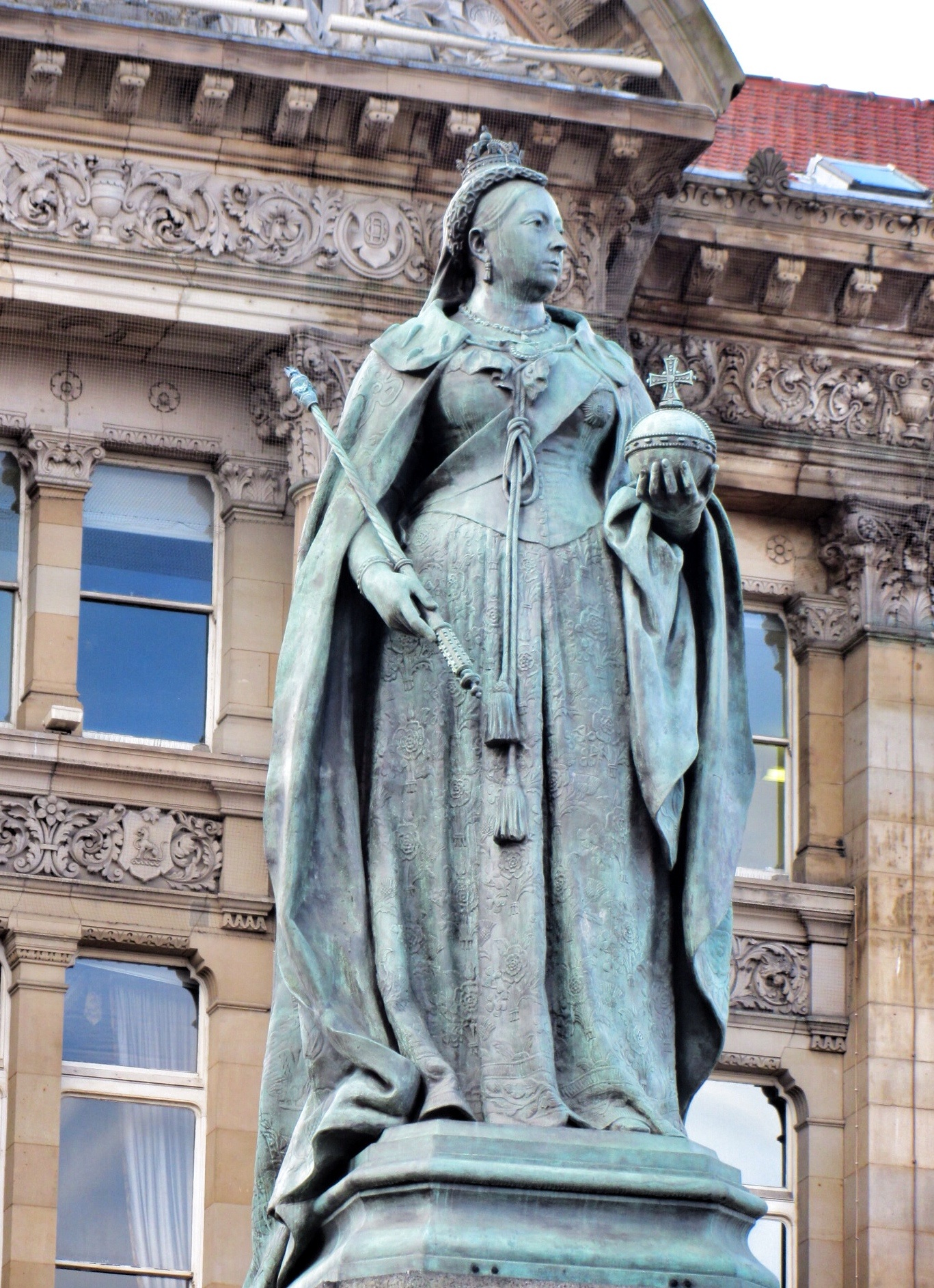
Victoria Square; one of the biggest public squares I have ever seen. Dominated
by the massive, ornate 19th century city council building, long, low
stairs form almost an amphitheater sweeping down to an open, spacious,
cobblestoned central square. Water cascades down the stairs directly in front
of the city hall; part of the square’s focal river fountain. The city
completely redesigned Victoria Square in 1993; only the bronze statue of Queen
Victoria remains in its original location. Diana, Princess of Wales, re-opened
the new square in May 1994.
I will learn that Princess Diana left her imprint on Birmingham in life and death: From commemorating the redeveloped Victoria Square; to opening the first-of-its-kind-in-the-world children’s hospice in Selly Oak; to the University of Birmingham accident reconstruction team secretly examining the demolished Mercedes in which she was killed (which Caroline at my B&B talks about in almost in a whisper); to the city naming a new children’s hospital in her honor a year after she died.
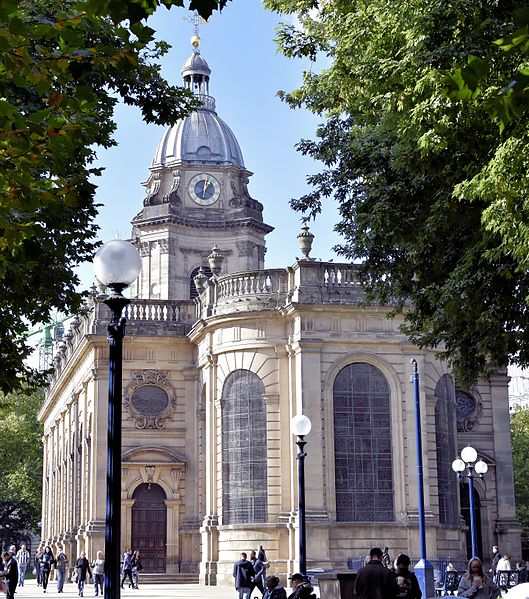
We walk to Birmingham’s St Phillip’s Cathedral. Small by
cathedral standards, it is quite pretty; a little oasis of green amongst the
urban pavement. Thomas Archer, the “gentleman architect,” designed the
cathedral in 1715. We go in and admire the stained glass windows by Victorian
artist, Edward Burnes Jones.
Chris tells me that Bill Clinton, when he came to the UK last
year to promote the Good Friday agreement, visited Birmingham. Chris points out
the sewer grates that the City of Birmingham sealed off for security reasons;
the Hyatt where the Clinton entourage had the full top four floors to
themselves, and the pub along the canal where Bill quaffed ale and ate chips.
His visit seems to have made quite an impression on the Brums (as people from
Birmingham are locally and affectionately known).
At the Birmingham Museum and Art Gallery, we have tea and scones in the Edwardian Team Room. Chris asks, “Do you drink tea?” “Well, normally I am a coffee drinker, but tea sounds nice.” I am thinking to myself that it could help soothe my querulous stomach. “Do you drink Earl Grey?” “Sure, I reply, not really having a preference.” “Do you?” “Yes, depending on the time of day. Alternatively, I drink Assam,” Chris says. I vaguely know that Assam is a strong, black tea, but do you drink different teas at different times of the day? How do you know which is morning tea and which is for the afternoon? I realize I am way out of my league in the tea department.
I never do find out if Chris prefers Earl Grey in the
morning or the afternoon. His British reserve is showing. I don’t get very
expansive answers to my questions about him, although he readily talks about
England, about the Royal Family (whom he supports), and about university issues.
Chris says he admires the Pre-Raphaelite paintings of which the Birmingham Art Museum has a big collection. He says that I must come back and see them. I don’t know who the Pre-Raphaelites were or what their paintings are, but I assure him that I will. Little do I realize, but his one off-hand comment to me sparks a life-long love of the colorful and brilliantly rendered literary subjects by the Victorian brotherhood of Hunt, Millais, and Rossetti.
The Y2K Menace and Some Advice
Chris is the advisor to foreign students at the University. He is younger than I originally thought. He might not be that much older than me; his white hair belies his age. He dispenses advice that he thinks I need to know. Get insurance for your personal belongings. Take a taxi, rather than the train, if you’re traveling late at night. Purchase train tickets after 9 AM and before 3 PM and avoid traveling on Fridays when the rates are higher. He also confirms something I read in the briefing material. The BC does not recommend that we travel by air from December 19 through January 11 because of Y2K. But, he says, it’s up to me. Hmmm, I am flying home on January 4. Hopefully air traffic controllers will have any bugs from the turnover to the year 2000 worked out by then.
He is knowledgeable about most things in America with regards to news and politics. “Who do I think will be the next president? George Bush?” “Yes, most likely, I answer. “Unfortunately,” I add. However, at the same time, he asks unexpectedly funny questions, “What is that holiday in November that Americans celebrate by eating turkey? And just what does it commemorate?” I don’t think he intends it to be funny, but I laugh nevertheless.
University of Birmingham, A Victorian Edifice
We board the train at the New Street station located in City
Centre. Two stops away from New Street, at the stop for the University/Queen
Elizabeth Hospital, we disembark. The University has its own train station!
We walk through the campus, with all of its grassy quadrangles
and august Victorian brick buildings. Queen Victoria granted the university a
charter in 1900. But it was Joseph Chamberlain, the university’s first
chancellor, whose vision for a “red brick” research institution propelled it
into the 21st century. One of the top 100 universities in the world,
Birmingham University’s pioneering research developed the pacemaker and X-ray
telescope among many other scientific and medical breakthroughs. England’s beloved
“Pomp and Circumstance” composer,
Edward Elgar, was head of the school of music here. Today the school has 20,000
students; it also caters to a large population of foreign students, of which I
suppose I am one.
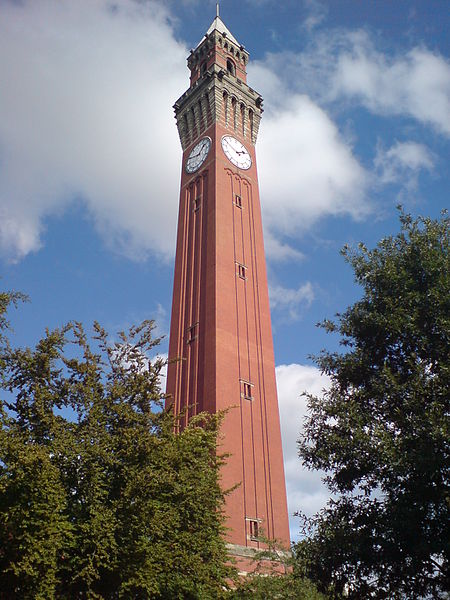
The University boasts an impressive clock tower. The massive brick clock tower—the tallest in the world—is said to be modeled after the Torre del Mangia clock tower in Siena, Italy.
Chamberlain Clock Tower, University of Birmingham
We continue to walk crossing over the canal and to the Guild of Students where Chris’s office is located. The Guild is home to numerous student groups and societies. It contains an insurance agent, travel agent, grocery store, and post office. There is also the foreign student’s office. I pick up a map of the campus. The Guild appears to be like a student union, although I do not see a bookstore with hats and t-shirts of the kind that are on American campuses.
I raise my eyebrows when Chris points out the bar on campus for faculty and students. He says drinking is allowed on campus; the drinking age in England is 18. And, just as on U.S. campuses, the freshmen drink heavily. Classes don’t start until later in fall, although some students are here now taking exams. Chris is surprised when I tell him U.S. university classes start this week.
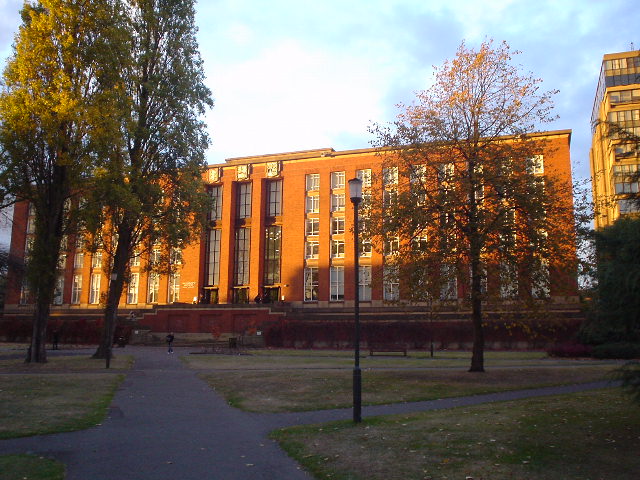
School of Public Policy Photo: University of Birmingham
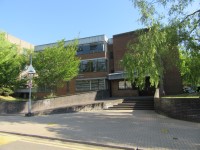
We head to the School of Public Policy on the west side of campus. It is a small, plain, office building that looks like it was built in the 1970s, rather than in the Victorian era. We go upstairs to see Dr. Peter Watt, who is to be my mentor. He is a very tall man with a broad grin, beard, and glasses. He is stooped a bit in the way that tall men in middle age do and vaguely reminds me of Dr. Taylor at UMO, although he is much more outgoing. Saroj Purba, the office assistant, assures us that I will have an office when I come in on Tuesday. I am happy to know they have at least been thinking about an office for me.
It’s about a 10-minute walk from the Public Policy School to the bed & breakfast Chris has arranged for me. Chris tells me if I like the B&B, I can stay for the duration and he takes his leave after warning me to call him immediately if there is an emergency. He defines an emergency as an illness or being robbed.
Glenelg B&B, My Home Away from Home
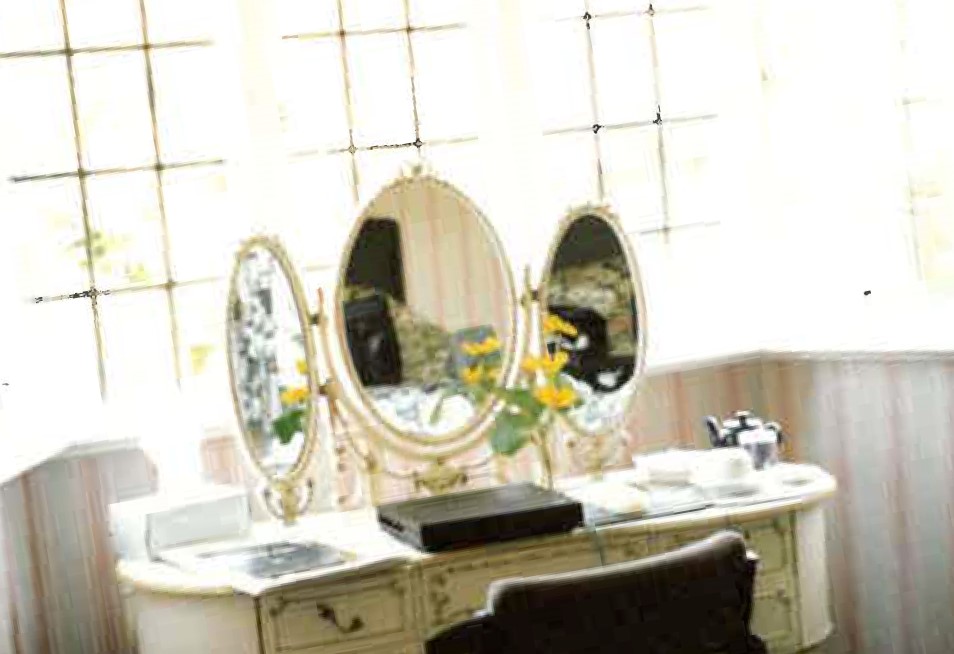
Glenelg B&B is lovely. My ensuite room, on the second floor, looks out over the back gardens. It has pale, pink-striped wallpaper, a double-sized bed with a flower-print bedspread, and a small, white, mirrored vanity with a tea service and lovely vase of fresh flowers on it. It includes continental breakfast, use of the laundry, and they do all the housekeeping. It is all the comforts of home as well as charming hosts.
My Room at Glenelg B&B
I take a nap for about an hour and then go downstairs in search of my host. Tony Regan, the proprietor, is on hand with Lutchford―a big, black, muscular boxer who doesn’t like strangers but, once introduced to you, is your friend. Lutchford is playful and both Tony and his wife, Caroline, are warm and friendly.
Tony and I speak of my arrangements for accommodations. I tell him I would like to stay here for the full term through December 29 when I leave for a week in London before flying home. While I am traveling, I will pay for the room for the privilege of keeping my “thinks” in my room. (The Brum way of pronouncing ing-ending words is with a “k” as in “somethink.”) During longer trips, Tony says he can store my cases and, if the opportunity arises, rent out my room while I am away; he will not charge me for those nights.
I think I can afford the £30 per night with my fellowship stipend. It’s high, but Chris assures me I will not find anything better-situated or nicer for less and even then I would have to pay a minimum six-month lease and a security deposit.
The Fellowship covers my roundtrip airfare, all the
sponsored travel within the UK, and an allotment for both personal travel and
living expenses. My stipend is:
UK Travel (£250 per month) £1,000
Shipment £ 300
Setting Up Allowance £ 600
Stipend (£906 per month) £3,624
Total £5,524
Lodging will cost me £3,750, which leaves £1,774 for food, travel, and incidentals. It will not cover it all, but fortunately I am still receiving a paycheck at home during my educational leave of absence. I decide to use my remaining stipend funds to travel as much as I can.
I call Mom and give her Glenelg’s phone number. The AT&T
phone card, which allows for 60 minutes of calling time in the U.S. converts to
only six minutes of international time. Mom and I use the full six minutes.
Tony recommends a First National phone card that is reasonable and convenient.
Caroline offers me tea in their garden. They have a huge back yard with a much-loved, well-tended flower garden. At the far end of the property, bordering a tiny trickling brook is a wooden arbor that forms an archway to a little hedge-fenced stone patio with table and chairs. We sit and sip tea and I can hear the burbling stream as well as the chiming of the University clock tower.
As they tell me about their previous guests—many international professors—I can see they have a nice “word of mouth” reputation. One Argentine doctor, Geraldo, they say, came for one night and stayed for two years. They leave me in the garden to prepare dinner for their guests. I sit quietly enjoying the view. Looking back at the house, it looks very Tudor with a white/brown exterior and chimneys. However, Tony tells me it was built in the 1930s.
Caroline recommends an Indian restaurant located on the High Street, a 10-minute walk. I order a mushroom omelet with “chips” and peas. Susan Allen Toth’s book, My Love Affair with England, said the omelets are always good in English restaurants. It is also easy on my still queasy stomach. I am still not tired and go back to my room and begin journaling, typing away until almost 10:30 PM. I have now been awake for 26 hours.
I still can’t believe I am here. I am excited for this once-in-a-life-time adventure to begin.
I arrive at Logan in plenty of time and check in. I have four suitcases and am surprised when they don’t charge me extra baggage fees. Then, weather and air traffic control problems push my 4:30 flight to 4:45, then 5:00, and then 6:00 PM. Finally we board, but the pilot announces we are waiting in line for clearance to take-off.
Luck is with us though. We move forward into a take-off position at about 6:20 PM. We will be in Newark in less than an hour. I think I can still make the 8:00 PM flight to Birmingham. Our pilot tells us that when flight #355, scheduled to take off before us, returned to the gate for help from airport security with a disruptive passenger he maneuvered us to the front of the line. Once we are finally in the air, the flight to Newark is uneventful.
A note about mobile phones: The proliferation of cell phones is unbelievable. Everyone has them and everyone uses them everywhere. From my seat in 14C, the person beside me in the window seat has one; the young girl across the aisle has one; the businessman in front of me has one…From car services to boyfriends to business partners, they are all being called.
We arrive in Newark at 7:05 PM, but this time there is no
clear gate and we sit on the tarmac for what seems like an eternity. Finally, I
hurry off the plane. Gate C73 is a long way and I have about 10 minutes before
my flight’s scheduled boarding time. I hotfoot it; sometimes jogging, sometimes
walking fast.
Arriving breathless and perspiring at the check-in counter, I ask, “Have you started to board?” “No.” Phew, I have made it. But wait, a uniformed Continental agent is beckoning me to follow her. “Are you traveling alone?” The sweat is rolling down the back of my neck. Tap, tap on her keyboard. I stare in dismay as she rips up my boarding pass in front of my eyes. But then she says, “A seat in business first class, on the house.” We board almost immediately.
Traveling in Style
At first I am confused. Business class—that will be nice.
But wait! No, this is FIRST class, baby! I stretch out. I peruse the dinner menu.
The stewardess offers champagne. I had told myself, no alcohol on the flight as
it aggravates dehydration and jet lag. But faced with Chateau du Val d’Or 1996
or St. Emilion Grand Cru, my resolve weakens. “Just water for now,” I tell the
stewardess. “Lovely,” she says, “I’ll be back just before take-off to take your
dinner order.”
Each seat has its own TV and fully reclines for your
sleeping comfort. A man who resembles Hugh Grant is sitting next to me. I am
still sweating. I wash my face with the steaming hot towel that the stewardess
offers and sit back and relax.
I succumb. I order red wine and it is served with mixed
nuts. But these are not your regular airplane peanuts in a foil wrapper. These
come in a little bowl and are served warm. They are followed by smoked
Norwegian salmon and sliced goose breast with horseradish sauce; then rolls,
salad, more wine, and the entrée. I select the Cappelli Napolene Bianchi, a healthy-ish
pasta dish with eggplant. I am still resolved to beating jetlag, so I drink
lots of water and say, “No, thanks,” to the third glass of wine the stewardess
apologetically offers me after she sees that she has neglected to refill my
nearly empty glass. With a sigh, I skip the fruit and cheese served with port
and the Häagen-Dazs with chocolate topping. I watch Seinfeld re-runs and about 11 PM lie
back and go to sleep. The next thing I know, someone is shaking my shoulder.
“Do you want breakfast?” “No, thanks, just coffee.” It is 7:00 AM Greenwich
Mean Time, but only 2 AM EST. I’ve slept for about three hours. I feel groggy,
but get ready for landing.
This blog is taken from the journal I kept while I was
studying and traveling in the UK on a fellowship program from late August 1999
through the Millennial New Year of 2000 (updated and annotated 20 years later).
It is hard to believe it has been 20 years. Some things I remember like yesterday. But, just as often I have no memory of the events I recorded in those journal pages two decades ago and, as is the way with passing time, my recollection is sometimes flawed ― exaggerating either for better or worse those now fading memories.
The fellowship program managers placed me at the University of Birmingham in Birmingham, England and it was my home for four months. A city that most Americans know little about, I came to love it as much as I did the family that hosted me. I hope through these posts you come to know Birmingham and the quirky ― sometimes frustrating, but always rewarding―parts of living abroad.



 Jody’s UK Memories
.jpg)


