It is a bank holiday today so we are still on the weekend breakfast schedule of 9 instead of 8 AM. I go down for coffee and croissant and meet the newest guest—Akiko, a doctor from Japan. Akiko is staying for a week. She admits she is here on a research trip, but laughingly says the real reason she is here is to learn to speak English. I think she speaks English very well already.
I take the city bus this morning to Birmingham City Centre. The bus stops at the University gate on Bristol Road, so the walk from Glenelg is much shorter than to the train station. And at 90p, the fare is less than the train too. Upstairs in the New Street terminal, I discover an Internet Exchange. It is easy and not too expensive at £2 for 20 minutes. Hopefully, tomorrow I will have my university email set up.
I walk through the Palisades, the shopping mall above the train station. Some of the shops look familiar—McDonalds and Woolworth’s. Some I can guess at what they are, like Britain’s version of the dollar store called “Poundland.” Some are beyond my wildest imagination, like the Newt and Cucumber.
I walk down the exit ramp; familiar from when I was here on my first day with Chris. The weather is gorgeous. I can’t imagine what it will be like when it rains. Chris asked me on my first day if I brought an umbrella with me. When I affirmed that I had, he said, “It will become an extension of your arm.”
Following the signs for the Convention Center, I walk through Victoria Square again. The Council House looms large over the open square filled with statues and monuments.
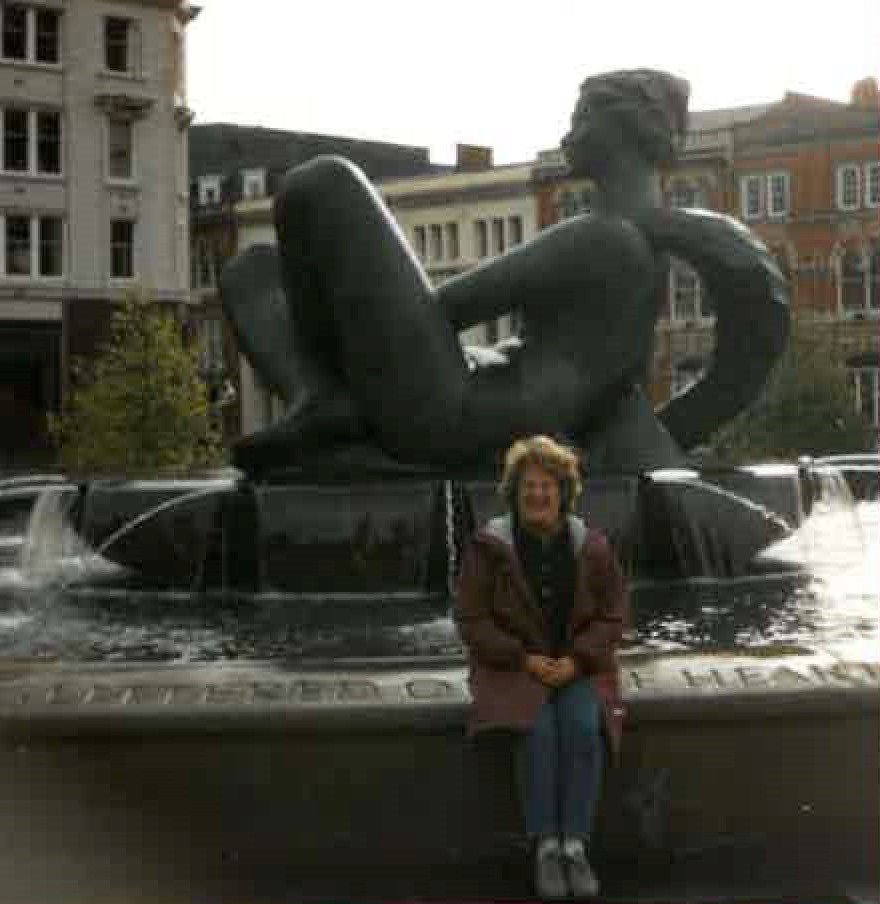
I love the public art in Birmingham. A large, bronze statue of a reclining woman in the middle of a pool amidst spouting water is guarded by two giant stone Sphinx. Titled the River Goddess, she is however known locally as the Floozie in the Jacuzzi. Water flows into the pool at 3,000 gallons a minute. Around the rim of the pool is the poem:
And the pool was filled with water of sunlight,
— T.S. Eliot
And the lotus rose, quietly, quietly,
The surface glittered out of heart of light,
And they were behind us, reflected in the pool.
Then a cloud passed, and the pool was empty.
The old, stone buildings surrounding the fountained public square remind me of Rome’s lovely piazzas although much bigger than Rome’s squares and less old-world and intimate.
A bit further on is Chamberlain Square in the center of which is the Chamberlain Memorial Fountain, an elaborate, 65-foot-high curlicued spire that reminds me of the Albert Memorial in London. Sir Joseph Chamberlain (1836 –1914) was a Member of Parliament, leader of the opposition party, secretary of state for the colonies, and Birmingham mayor. He was also university chancellor and the clock tower is named for him. He seems to have been a controversial figure having been both blamed for causing the Boer War and then playing a central role in winning it. He was arrogant and much hated, but he advocated for worker’s compensation and for benefits for England’s agricultural laborers. My guidebook says, “Despite never becoming prime minister, he was one of the most important British politicians of his day.” His son, however, did become prime minister; the pre-WWII appeasement prime minister, “Peace for our time” Neville Chamberlain.

Photo: David Stowell
I cut through the huge convention center (it houses 11 concert halls) to get to the canals. I jump on one of the narrowboats for a sightseeing tour just as it begins to pull away. The narrated tour boat meanders through the canals that that crisscross Birmingham and most of the Midlands. The tour takes about an hour and we follow the old canal lines that loop around the city. We pass dingy industrial buildings before the area around us opens up into grassy countryside. At 3 mph, it is a slow, peaceful ride.
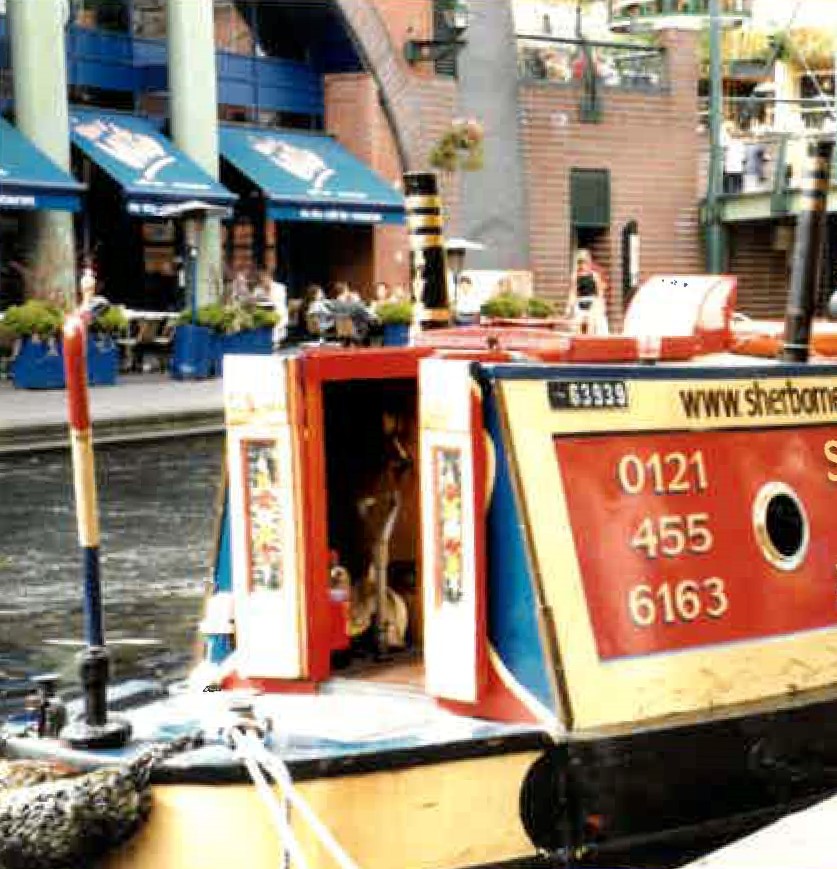
Birmingham industrialists built the canals to haul coal to their factories during the Industrial Revolution; which had its heart in Birmingham. There was an article in the Boston Globe dubbing Birmingham, “the Venice of London.” The 18th century canals that span the city cover 33 miles compared to Venice’s 32 miles. “Not that the gondoliers are jealous,” the article says.
An engineer named James Brindley oversaw the canals’ construction, so it is appropriate that we end our tour back at the Convention Center, opposite Brindley Place; a newly renovated marketplace of pubs and restaurants. People are sitting outside eating and drinking. A silver-painted mime, dressed as an English bobby, is entertaining the crowd. I have lunch—pizza—and make my way back to Victoria Square
I find a wonderful bookstore—Dillon’s—and a young woman responds to my inquiry about whether they have phone cards, asking me, “You’re not from here, are you?”
For dinner, I first try the pub at the end of the street—Gun Barrels. But the cigarette-smoke-filled pub serves mostly hamburgers, which I am trying to avoid what with the risk of Mad Cow disease. So, I walk the other way until I see a fish and chips shop. The fish and chips certainly are cheap at 99p, but the chips are salty and not very crisp. I can’t help but think Tony and Caroline’s chips (I can smell their mouth-watering aroma coming from the kitchen) are better.
Tomorrow is my first day of work.
 Jody’s UK Memories
