I gobble down breakfast and hurry to catch the bus to the train station and on to London. Tony says he never goes to London as it is too crowded. He tells me that in 1900, when people traveled in horse-drawn carriages, the average speed on London streets was 4 mph. Today, he says, because of all the automobile traffic and congestion, it is still 4 mph.
Tony now thinks that I am a very important person because, first, the British Council called me yesterday, and now I am going to London. He was quite impressed with the coach that brought me the first day and has commented on it several times. As I leave, and Caroline asks me if I want a taxi, he says, “No, she’s probably got a coach waiting for her around the corner.”
Billionaire Richard Branson―the businessman who owns Virgin Airlines—also owns Virgin Trains, which takes me to London. I have a reserved seat on the 9:15 AM train; so look for Coach F, Seat 13. I walk past three carriages of first-class seats with their linen tablecloths and flowers on the tables to my plain carriage with a bare table. It is an easy ride and I arrive at Euston at 10:45 AM. The BC called me to say they had moved the fellowship meeting to a hotel near Embankment. It costs the same to travel to Embankment as it does to Charing Cross, so I assume I can use my existing ticket right through to Embankment. It works!
Getting off at Embankment, I walk around with my London A-Z trying to find Whitehall Court, the street where my hotel is located. I walk in two different directions before my third try brings me to the intersection I want.
I am booked in for three nights at the 5-star Royal Horseguards Hotel. I plan to stay an extra night and spend a day in London at the end of the meeting. The hotel is luxurious. Meticulously decorated, the bed is unbelievably comfortable with four, huge down pillows. There is a safe in the room where I stash my passport and extra cash.
Our meeting starts later this afternoon and I have a few hours to explore. I hurry out to reacquaint myself with this fabulous city.
Faces of a Nation, National Portrait Gallery
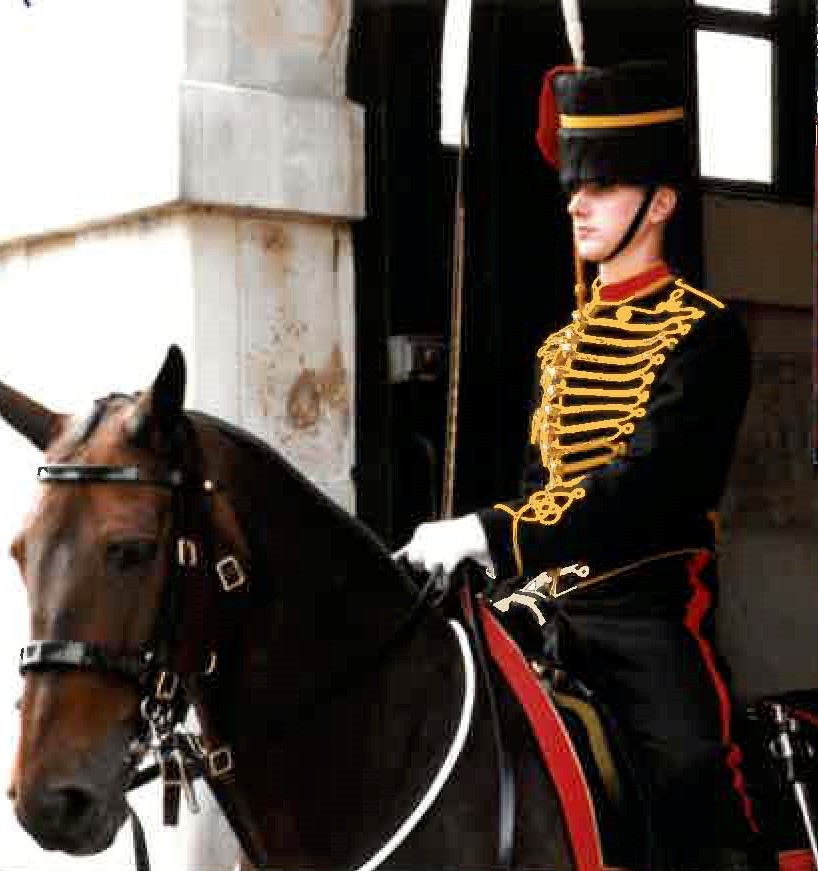
I cross the Horse Guards Parade, a massive open courtyard off St. James Park, where Henry VIII jousted. Today, it is used for royal parades and ceremonies including the Trooping the Color, the Queen’s birthday parade in June. Two passive, unmoving sentries of the Queen’s Life Guard are posted there. They are required to remain motionless for two hours before being replaced. I snap some pictures and walk on through to St. James’ Park.
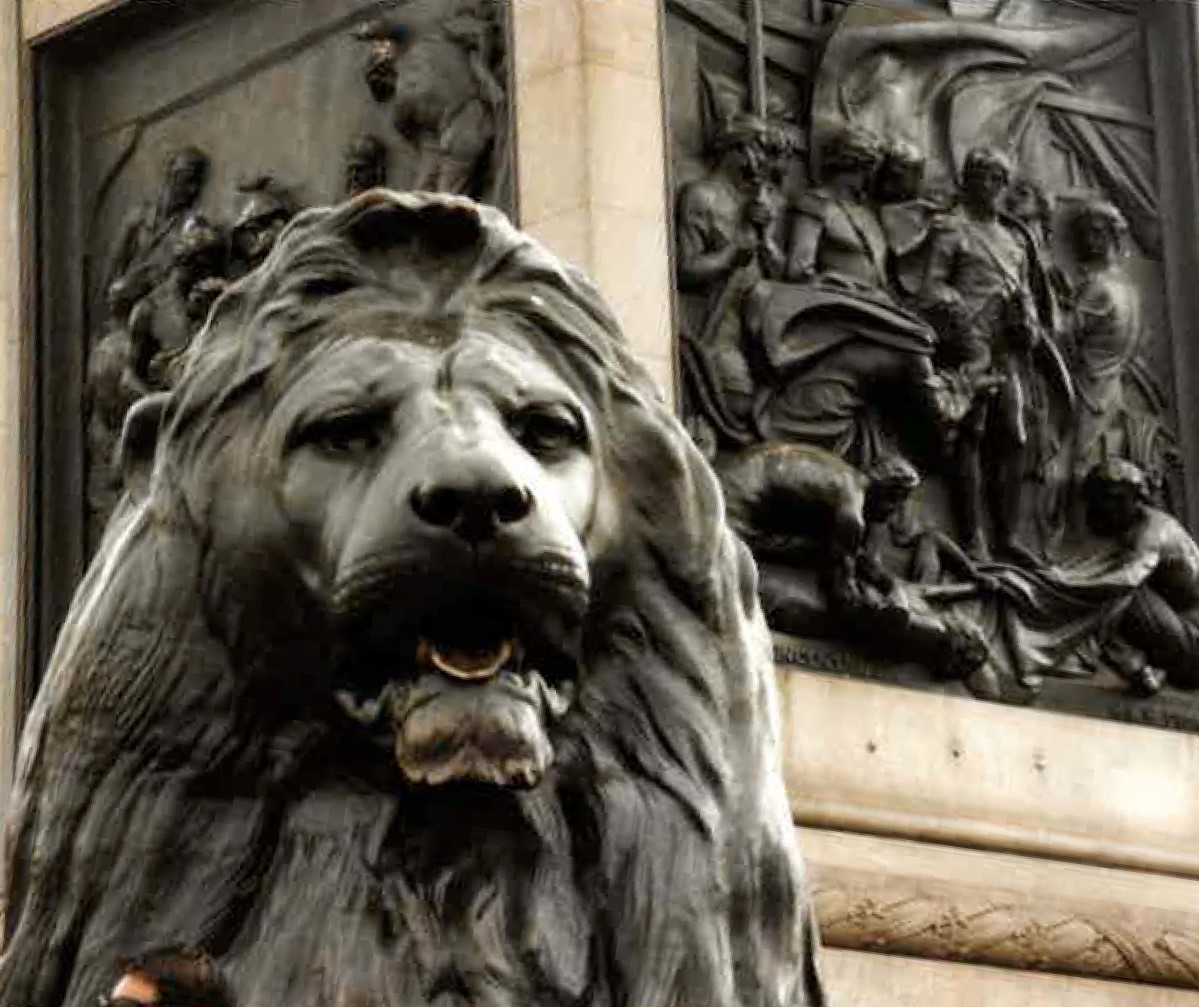
I grab a hot dog at a sidewalk stand and head over to Trafalgar Square. There doesn’t seem to be as many pigeons as I remember. Still, when a car backfires, so many birds fill the air it looks like an Alfred Hitchcock movie. I cross the square, walking among the famous 7-ton, black lions at the base of Nelson’s column, to the National Portrait Gallery.
The portrait gallery is under renovation; things are all moved around. The staircase where the Royal Family portraits normally reside is bare and they are scattered all over. I find Diana between Sirs Elton John and Paul McCarthy. There are pictures of Edward VIII and the woman for whom he gave up the throne—the twice-divorced Wallis Simpson—but not together. There are at least a half-dozen portraits of George VI, the current Queen’s father.
On the first floor, there is a new one of the Queen looking very regal in a sequined white gown.
In the upstairs Victoria wing, I find a dazzling portrait of Victoria handing a bible to an African prince. Despite its wildly outdated and patronizing attitude of Christian superiority, the painting ―with its vibrant crimsons, teals, and blues―looks so real, it could be a photograph. And although he is bowed obsequiously, I believe there is a gleam of independence in the Prince’s eye.
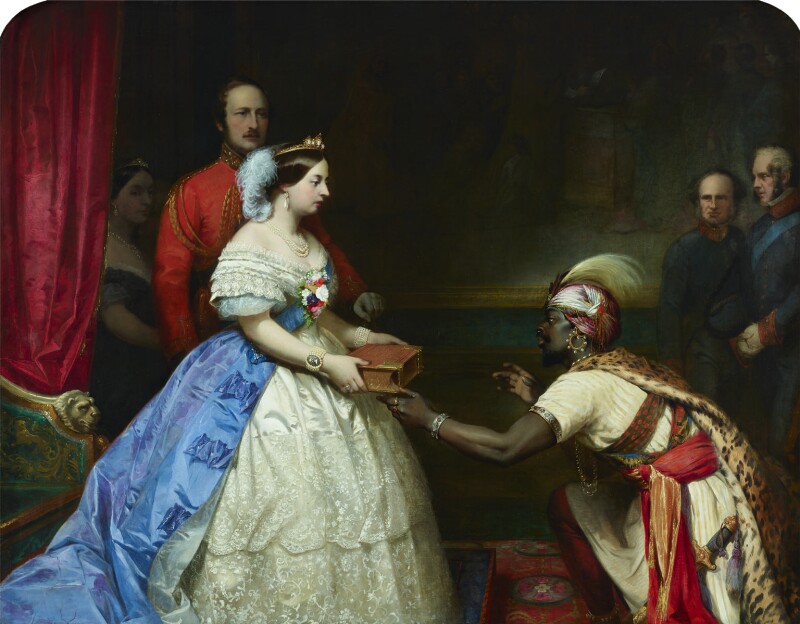
Photo: National Portrait Gallery
I retrace my steps back to the hotel for the start of our orientation.
Stepping Back in Time, The National Liberal Club
The Royal Horseguards Hotel spans a full city block along the Embankment fronting the River Thames. With its ornate, white stone façade, the hotel was built in 1844 in the style of a French chateau. It sports gray slate slanted roofs with corner turrets looking like two of Quebec’s Chateau Frontenacs joined together.
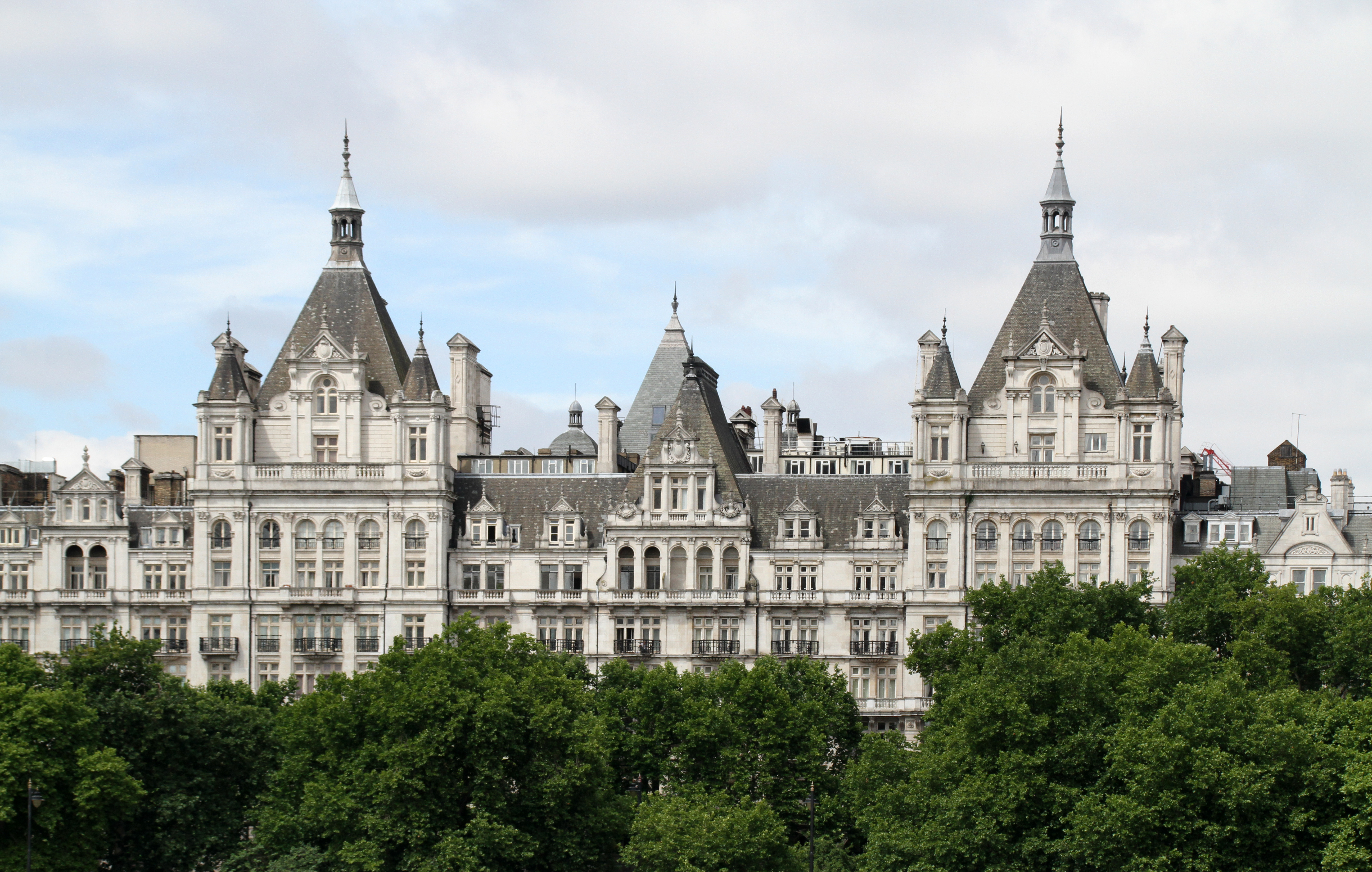
Photo: Tony Hisgett, Wikimedia Commons
Because of its proximity to the Houses of Parliament and the Foreign Office, the hotel has hosted politicians, statesmen, and diplomats. The Secret Intelligence Bureau used the building as its headquarters during the First World War. It is also home to the Authors’ Club. It was within these walls that:
Club members welcomed Emile Zola and Mark Twain; that Ford Madox Ford took sherry with the poet FS Flint the night he returned from combat in France; and Sir Arthur Conan Doyle won the Authors’ Club billiard handicap four times.
Author’s Club 1891 website
The Royal Horseguards Hotel is attached to a gentleman’s club—the National Liberal Club—which is where our meetings are held. I didn’t know there were any of these 19th century dinosaurs left. I wonder if women are allowed as members. It is stunningly elegant with portraits lining the 3-story, white-marbled, red-carpeted, circular staircase, including one of Queen Victoria. I feel like I am still in the National Portrait Gallery.
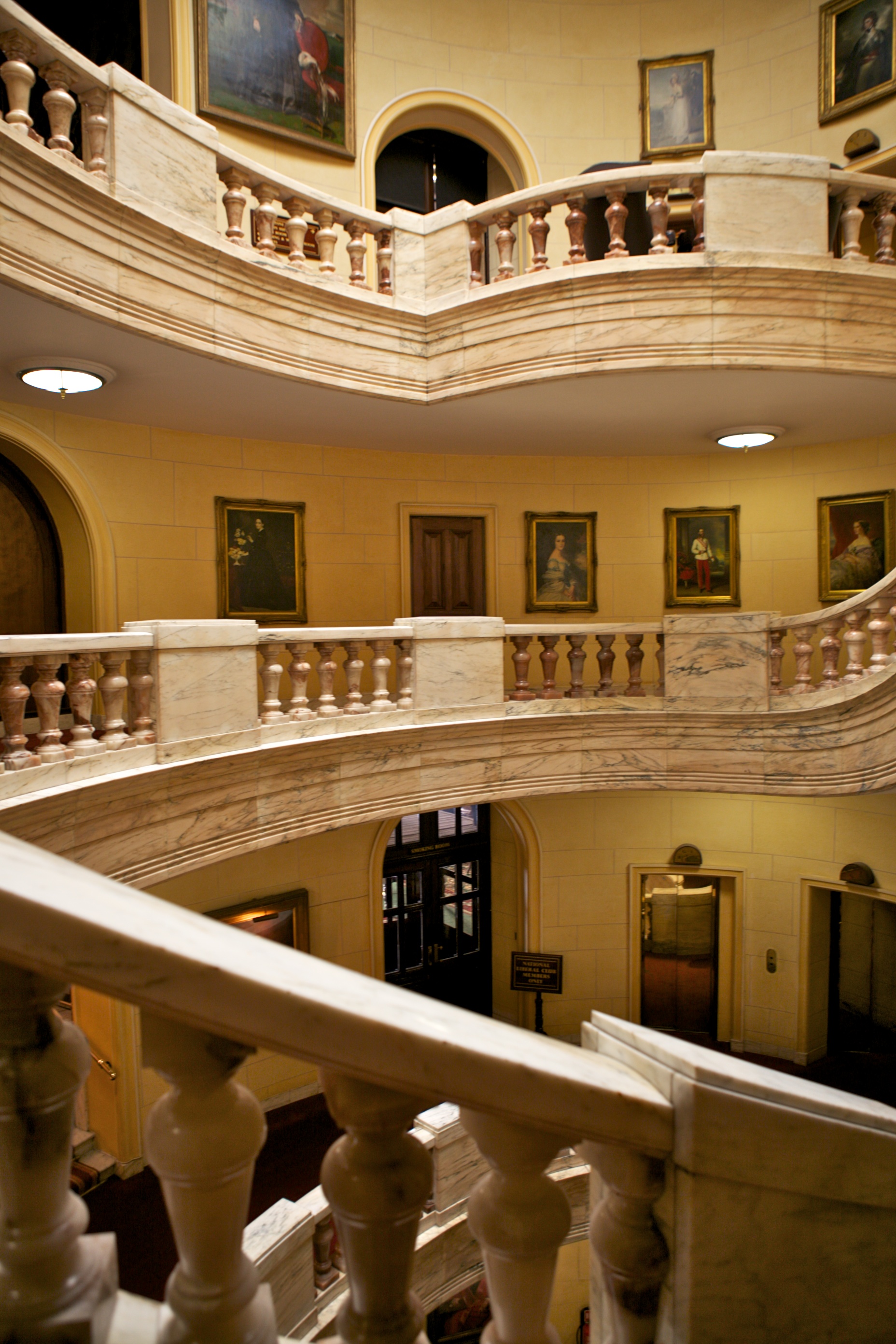
Its website says of the National Liberal Club (NLC):
Founded in 1882 by William Gladstone, the National Liberal Club exists to provide the very best club facilities for relaxing and entertaining in the heart of London, for members whose interests vary from liberal politics to the liberal arts
It has admitted women members since the 1960s.
Meeting My Fellow Fellows
I am the first to arrive and meet BC staffer, Frank Tham, who has organized our orientation. He looks like a bookish Tiger Woods. Shortly, the others arrive. There are nine fellows in all. I had met them during the orientation in New York, but I didn’t remember everyone’s name.
- Dean Kaplan: Dean is my compatriot in Birmingham. His project is similar to mine; looking at UK’s performance measurement program for government services. Dean served as budget director for the City of Philadelphia, working for Mayor Rendel, who completes his mayoral term this year. Barbara, his wife, and their two children, Ari, and Max join him for his year-long program.
- Kathy Taylor-Gaubatz: Kathy resigned her position as head of a nonprofit to come on this fellowship. Kathy is from California. She is here with her husband, Kurt, and two children; one a teenage daughter who shortly dyes her hair pink in a British punk style. Kathy is placed at Oxford University (lucky lady!). Her husband will be teaching there as well.
- Stacy Dean and Matthew McKearn: Stacy and Matthew are newly married. Theirs is a wonderful story. They both applied for the very competitive fellowship and as unlikely as it could be, they both received it. They didn’t tell any of us that they were engaged and they got married a few days after the Washington DC interviews. Stacy works for the Center on Budget and Policy Priorities, a leading policy organization in Washington, DC, and Matthew for OMB. Stacy is at a small London-based nonprofit studying the integration of immigrants into the UK and their ability to access services. Matthew will be at the Institute of Education in London.
- Andy Bindman: Andy and his family live in San Francisco. He is a medical doctor. His wife, Rebecca, is also a doctor. They have three very young children. Andy is looking at England’s National Health Service. He is placed at the School of Public Policy at the University of London. They are renting a house in London. Andy and his family just arrived today with his children and 27 suitcases!
- Carolyn Galbreath: Carolyn with her husband, Frank, are also from San Francisco. Carolyn is at the School of Law at Kings College in London. In the U.S. she works for the U.S. Attorney’s Office. She is looking into telecommunications issues. Frank is retired and is taking the year in England to enjoy.
- Jonathan Weiner: A doctor at Johns Hopkins University in Baltimore, Jonathan is the only fellow that is here for a shorter time than me. His fellowship is for three months. He is at the Kings Fund, a nonprofit think tank, looking at the National Health Service too. His wife, Jen, is homeschooling their two boys, ages 8 and 12.
- Maryellen O’Connell: Maryellen is placed at the University of York in northern England. Her husband, Kelly, mother-in-law, and one young child is with her. Maryellen’s project has to do with homelessness. Kelly is doing some consulting work. I think he is an engineer.
- Glen McGee: Glen is a biophysicist and teacher and is looking at the ethics of cloning. He is here for the orientation, but doesn’t actually start his fellowship until December. I never see him again after this week.
We spend most of the afternoon talking about mundane things like bank accounts and health care. I need to register with a GP even though the National Health Service does not cover me since I am here less than six months. Once registered though, I can use that GP for any health needs and the doctor will even come out to me if I am too sick to go to the doctor’s office.
Some of us go for drinks at a nearby pub—The Georgian—before dinner. I have a cider, which is less sweet than the American-style Woodchuck cider that I am used to. I like it better. The pub is smoke-filled. I know I am going to die from second-hand smoke before this Fellowship is over.
Our fellowship dinner is elegant and they keep our wine glasses full. We have a Thai curry chicken salad, poached salmon, rice, pea pods, and some kind of custardy dessert; then chocolates and coffee. I am seated next to Tim Chamberlain, a BC staffer, who is an elected member to his local council in Manchester. The issues, such as school funding formulas, are amazingly the same as in the US. His district is measuring performance and he is quite proud of their efforts.
I fall asleep quickly—a combination of the wine on top of a long day.
- In today’s news: Faithful Demand a Diana Memorial. Yesterday, on the second anniversary of her death, people were asking, “Where’s Diana’s Memorial?” or “Where is her Tribute?” A government committee led by Gordon Brown is looking at permanent public memorials including a Diana Walkway, Diana coins, a Diana nursing scheme, and Diana awards for children. There is also a play area next to Kensington Palace to be redeveloped and renamed in the Princess’s honor.
 Jody’s UK Memories
.jpg)