This blog is taken from the journal I kept while I was
studying and traveling in the UK on a fellowship program from late August 1999
through the Millennial New Year of 2000 (updated and annotated 20 years later).
It is hard to believe it has been 20 years. Some things I remember like yesterday. But, just as often I have no memory of the events I recorded in those journal pages two decades ago and, as is the way with passing time, my recollection is sometimes flawed ― exaggerating either for better or worse those now fading memories.
The fellowship program managers placed me at the University of Birmingham in Birmingham, England and it was my home for four months. A city that most Americans know little about, I came to love it as much as I did the family that hosted me. I hope through these posts you come to know Birmingham and the quirky ― sometimes frustrating, but always rewarding―parts of living abroad.
The alarm wakes me at 6:00 AM. I haul my suitcases down two flights of stairs. By the end of today, I will be very tired of schlepping luggage around.
On Inverness Terrace, the road in front of my hotel, I hail a taxi. I ask him to take me to Trafalgar Square to pick up the rest of my luggage and then to Gatwick. He says, “You know it is expensive to go to Gatwick. I could take you to Victoria station.” I thank him but I have too much luggage to take the train. We proceed to the British Council where I am half expecting them to a) not be there; or b) never have heard of my luggage. But they very efficiently collect my two suitcases from storage.
I have my large green suitcase on wheels and the matching soft-sided one, my medium-sized maroon suitcase, the medium-sized gray suitcase that belongs to Mom and four carry-ons: my computer, a tote bag with fragile things, my everyday bag filled to the brim, and my poster tube. It is much more than one person could manage without the wonderful trolley system they have in UK airports.
I wheel my unwieldy trolley into Gatwick. The board does not have my 11:15 flight posted yet. A Virgin Atlantic representative directs me to Check-in Area A. There is a long, snaking line that goes far beyond the roped area that they have set up. But being good Brits, passengers continue the snaking pattern even without benefit of ropes to guide them.
An airlines representative checking people in line tells me, “You know this 11:15 flight has been changed to 2:00 PM? Your travel agent should have informed you.” She says I can still check-in, but I will have to wait for my gate to be posted. I am fine with being early to the airport and I am even happier that I am already here when the fire alarm goes off and airport officials stop any new passengers from entering the terminal. If I had been departing at 11:15, I would have been very nervous. I figure that by 2:00 they will have cleared up whatever set off the alarm.
I have coffee, read the paper, check my email, do some last-minute shopping, read, get some lunch… Finally, they post my flight to Boston departing from Gate 34.
On board, the steward takes my poster as it is too long to fit in the overhead bin. I think, “I’ll never see that again.” He assures me he will bring it back a few minutes before landing. True to his word, he does.
The Captain announces we are going against the wind—adding another hour to the already seven-hour-long flight.
I watch an in-flight movie with dinner: salmon with linguine, salad, bread, brownie, cheese and biscuits. Also, complimentary red or white wine. After dinner, they bring around after-dinner drinks—brandy or Bailey’s. I chose the Bailey’s. A while later, there is ice cream. Then around 4:00 PM (which is really 9:00 PM for me), tea is served—sandwiches and a muffin. I have just water.
We land a few minutes after 5:00 PM and I make my way through immigration, baggage claim, and customs. It takes two minutes to go through immigration and two minutes to go through customs. It takes an hour to get my luggage. They have trolleys at Logan too and I load up my luggage for what is still not yet the last time today.
I make my way to Concord Trailways where they have buses to Portland every hour and get the next bus. At the Day’s Inn in Portland, the hotel guy helps me with my luggage. I call Mom and Dad, who happily agree to come get me in the morning. I watch a few minutes of news and fall asleep. It is 3:30 AM GMT.
Today, my last day in the UK, I am on a walking tour of London’s affluent Mayfair district. It is not raining as we start out but, by the time we are half-way through the tour, it is pouring and the deluge continues for the rest of the day.
The tour, London Walks, starts out at Green Park tube station, near the Ritz Hotel. Green Park got its name because it is…well, green. Some say, Queen Henrietta had all the flowers removed when she saw King Charles II picking flowers in the park for his mistresses leaving just the green grass. Whether its King Charles’ dalliances or the lime that was spread on leper’s graves, it is green.
King Charles’ flower-picking escapades may also be the reason for the name for the next street we turn onto—Piccadilly—as in Pick-a-lily. But it is more likely that it was named for the ruffled lace collars that Queen Elizabeth I and her courtiers wore, known as picadillos, which merchants sold on this street.
Mayfair is so called because in the 1600s, it was the site of a fair, held in May.
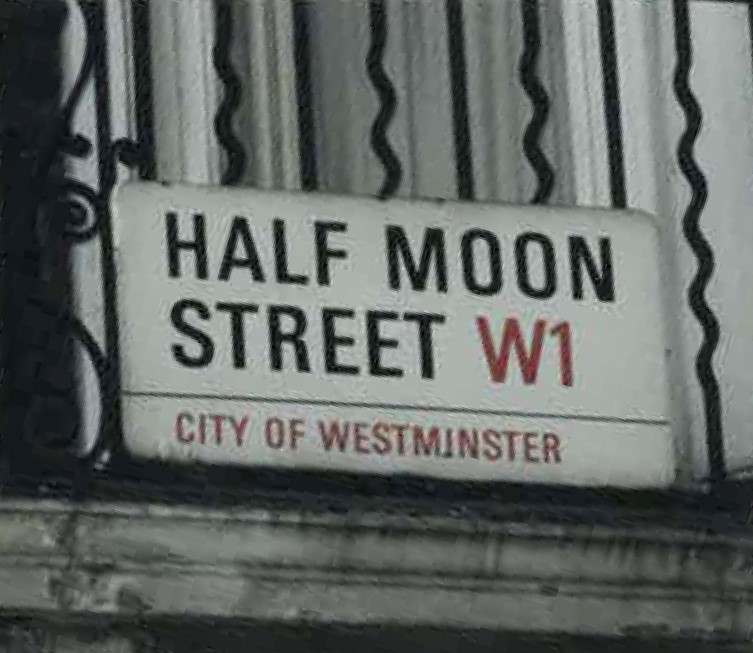
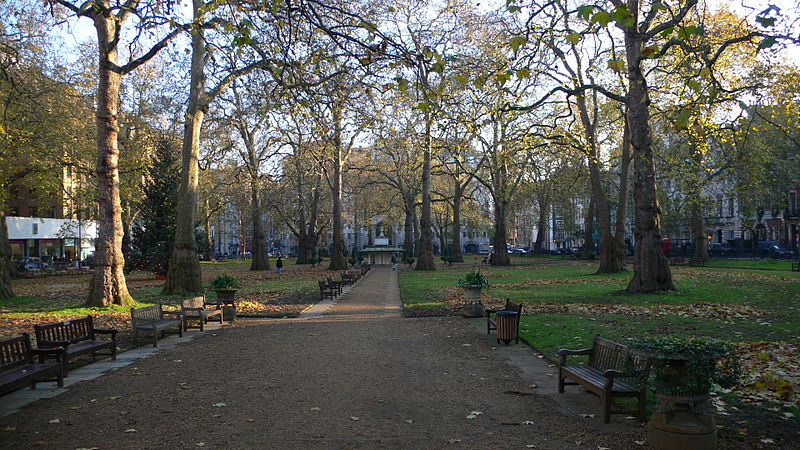
Many of the streets have been used in popular literature. One—Half Moon Street—is the address of Dorothy Sayers’ upper crust detective, Lord Peter Whimsey, not to mention the location of Algernon’s flat in Oscar Wilde’s The Importance of Being Earnest. While P.G. Wodehouse’s Bertie Wooster and his valet, Jeeves, live in a flat near Berkeley Square.
Mayfair
London’s recognizable blue plaques mark the residences of famous people and some of the ones we see include:
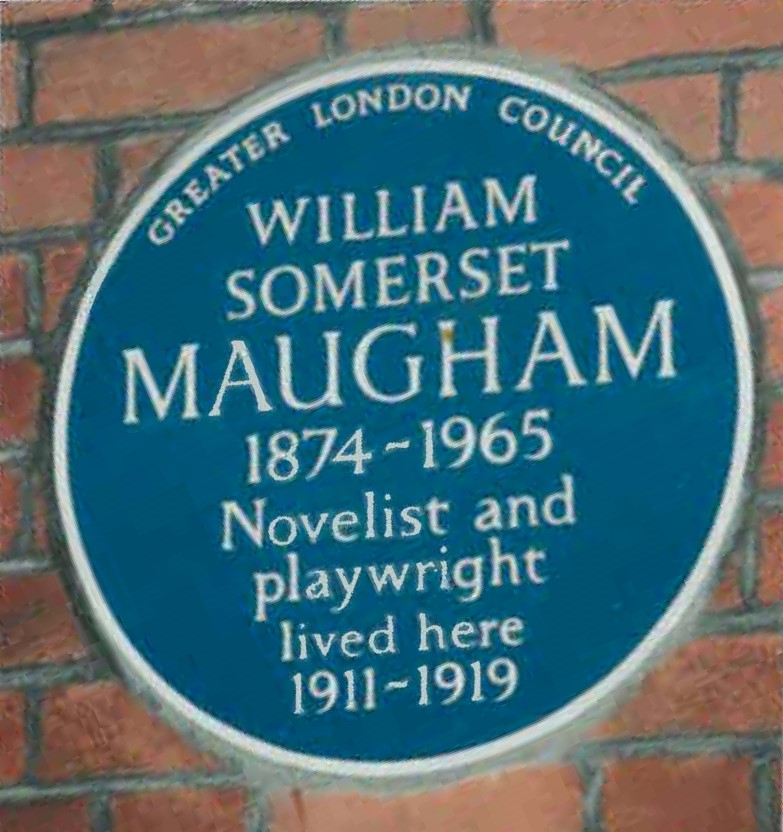
Playwright Somerset Maugham (the Andrew Lloyd Webber of his day with multiple plays at a time running on the West End)
King William IV (where he lived with his actress mistress, Mrs. Jordan, and their 10 children, before becoming king and dismissing her)
Benjamin Disraeli (Conservative Prime Minister, 1874 – 1880)
The composer Handel and Jimmy Hendrix (who both lived in the same house two centuries apart).
Mayfair
We walk from one posh square to another: from Green Park to Berkeley Square, to Grosvenor Square, to Hanover Square. In Grosvenor Square, home of the U.S. embassy, are statues of Eisenhower and FDR. The statue of FDR, erected at the end of World War II, was paid for by subscription by individual British people who contributed and raised enough money to build the statue in just four days. It shows in what high regard FDR was held by the people of war-torn London.
We end our tour on Oxford Street, an upscale shopping district which I take advantage of.
My movie tonight—in Leicester Square—is TheClandestine Marriage, the movie that was filmed at the Stanton Manor House in the Cotswolds. I wanted to see the movie just to see the house and it is just as I remember it. The movie was fun too. It stars Nigel Hawthorne and Joan Collins.
I go back to my hotel to pack.
More Musings
It is my final day in London and my last day in Britain and I ponder what I have learned.
I have learned that I can travel on my own in another country under sometimes strange conditions. I learned how to use public transportation to get to where I want to go, although I did not develop a sense of direction and, when faced with a choice of turning left or right, always picked the wrong way.
That people in England are polite but not necessarily warm. People in Ireland and Scotland are genuinely warm and friendly.
That, unexpectedly, I loved Scotland. I had always thought my heart would be in Ireland where my ancestors were; or England where I knew the history. But Scotland won my heart for its beauty, its independence of spirit, and generosity of heart.
I learned that Paris is perhaps lovely in the springtime, but not when it rains and you are lost in the dark.
That as much as things are different, they are the same. This is particularly true with my project. The UK is struggling with the same issues related to performance measurement as we are at home.
I learned that Britain is modernizing and not perhaps for the good. Centuries-old traditions are being done away with at the stroke of a pen. As relieved as people were to see the Conservative government go, the Labor government is wreaking just as much havoc but in a different way.
That Britain is civilized and refined and understated. Ostentatiousness doesn’t play here. That Americans are loud, annoying, and demanding. They expect everything to be the same as it is in the U.S. and are disgusted when it is not.
That sometimes you just can’t get good customer service no matter how polite people are.
I learn the 24-hour clock; the military system for telling time―and it may be a better system.
It doesn’t matter if you wear jeans to the theater. Elgar’s Pomp and Circumstance march has words. They don’t sell Cool Britannia Ben and Jerry’s ice cream in Britain. The best fish for fish and chips is cod, not plaice.
If you walk straight ahead with purpose, people will get out of your way and you won’t be constantly jostled, especially if you are carrying an open umbrella.
That it is good to go home. But, that you can probably never go home. Frank told me, “You leave expecting things to be different. You go home thinking things will be the same. In either case, they won’t be.”
Am I ready to go home? Yes, it is time. I very much want to see family and friends.
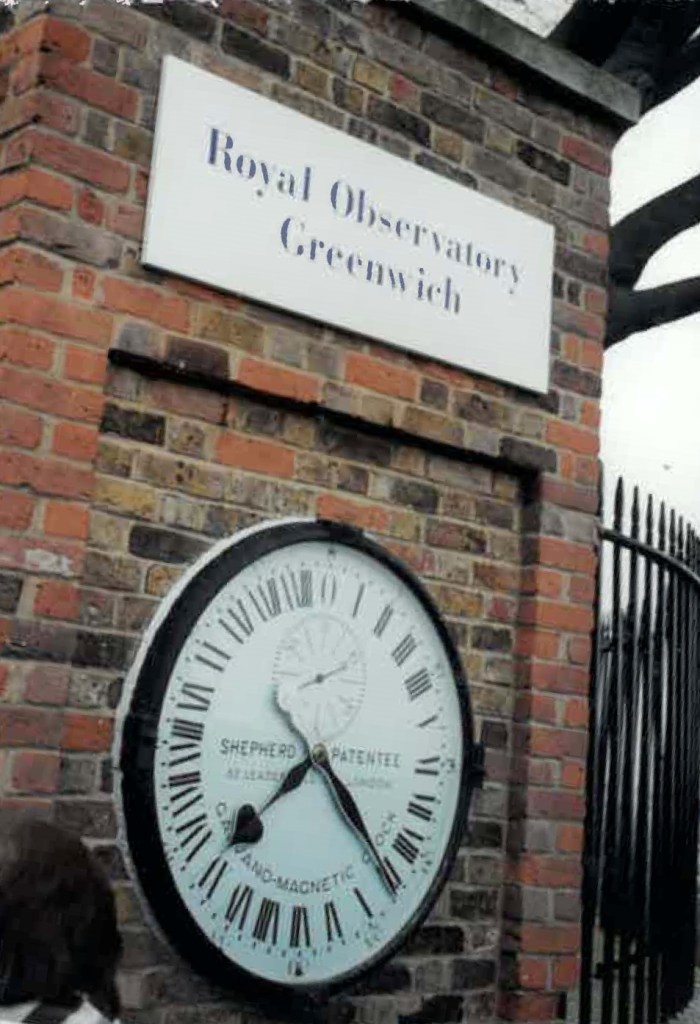
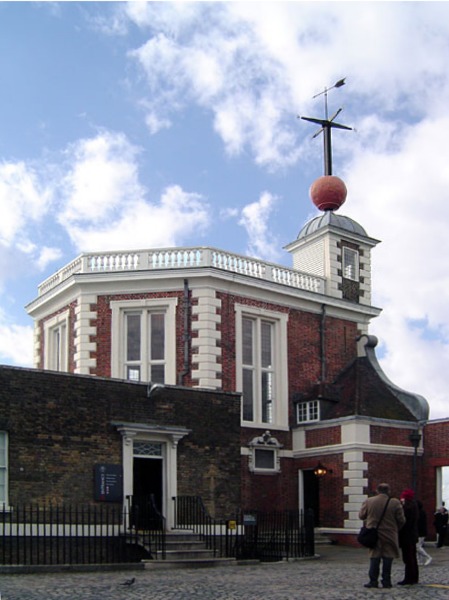
“The Millennium starts here!” That’s what a plaque says outside the Royal Observatory in Greenwich. Greenwich is the official home of world time and the perfect place for a Millennial experience. But first, I am off to the Millennium Dome.
I take the Jubilee line from Bond Street to North Greenwich. It is a shiny new tube line with lots of metal and modernized systems. The platforms are enclosed with glass walls with sliding doors that align with the coach doors. So, no one can get onto the train until it pulls up and the glass doors open. This is, I understand, to keep people from throwing themselves onto the tracks.
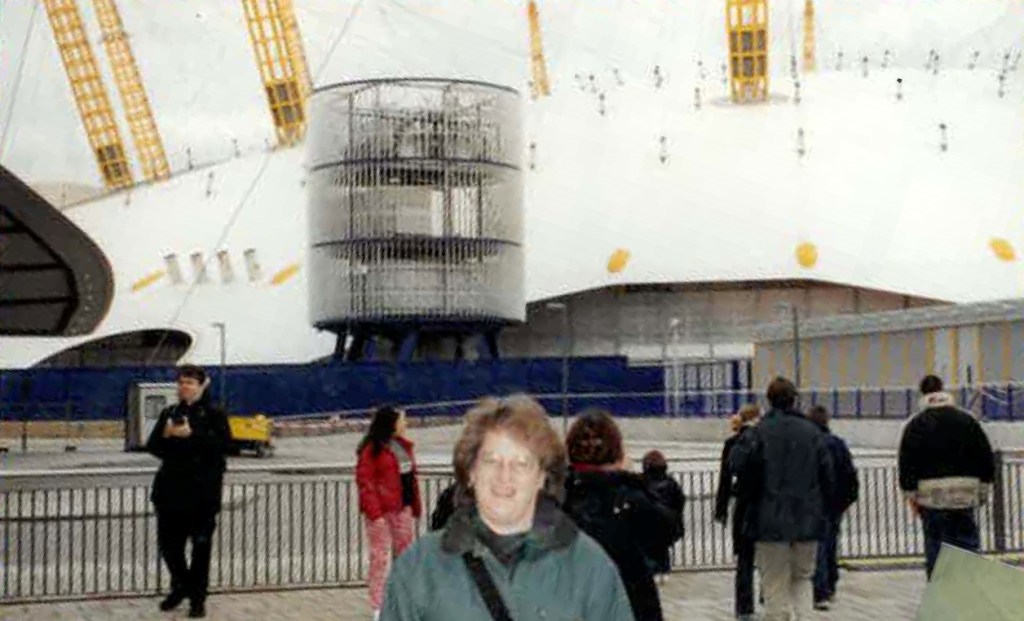
As I exit the tube station, I get my first glimpse of the Millennium Dome. It is massive. It is very crowded by the time I arrive for my 11:00 AM entry time. Inside there is a big top, like at a circus, with huge display areas ringing it. Participants can see the latest and greatest gadgets and modern technology in a dozen exhibits of what 21st century life has to offer from the Body, to Play, Work, Money, Faith, Talk, Mind, Rest, Work, Learning, Journey, and Timekeepers of the Millennium.
Jody at the Millennium Dome
A giant, gold, reclining figure holds the display about the human body. A long queue to enter at the figure’s elbow has already formed. The Timekeepers display also has a prohibitively long line. I wander around, go in the gift shop, and head to the Black Adder film.
Outside in the Skyscape, the Dome’s entertainment venue, a brand-new Black Adder comedic film, made just for the Millennium Dome, is being featured. The entire original cast is re-assembled for Back and Forth, a tale about Black Adder’s time machine. It ends with Black Adder changing history and making himself King, and Baldrick, his Prime Minister. Brian would love it.
I go back into the Dome in time for the Big Top performance—a modern Romeo and Juliet story of Earth People and Sky People played by acrobats and dancers. I don’t really like it and leave after the first half.
Instead, I head for Greenwich Village and the Royal Observatory. It is a long walk up a steep hill to the Observatory.
The Observatory has its roots as far back as the 17th century when King Charles II appointed the first Royal Astronomer. By the mid-nineteenth century, Britain needed a way to keep time across their global dominions. In the late 1800s it adopted Greenwich Mean Time; the U.S. followed suit and GMT became the standard for world time.
Royal Observatory, Home of World Time Greenwich, England
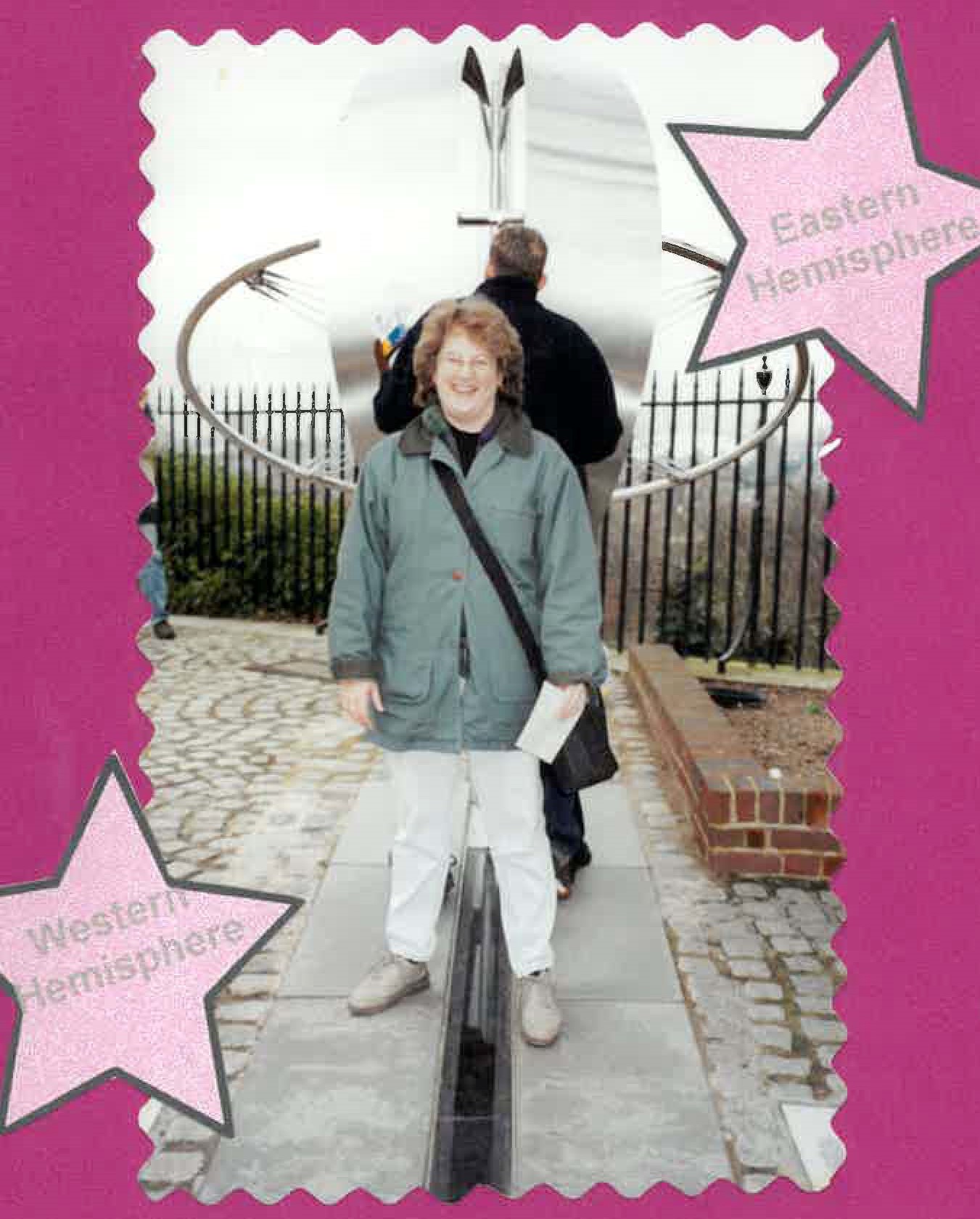
In the courtyard of the Old Royal Observatory, there is a brass bar embedded in the ground that marks the Prime Meridian; the starting point for the International Date Line and its 24 time zones. I stand with one foot in the Eastern Hemisphere and one foot in the Western Hemisphere and ask someone to take my picture.
Dividing line between the hemispheres, Greenwich, England
A huge brick-red ball at the top of the Christopher Wren-designed Octagonal Room of the Observatory ascends like the New Year’s ball in Times Square and drops exactly at 13:00 every day for ships in the Thames to set their clocks by. A huge laser shines out of the Observatory at night with its beam marking the Prime Meridian, Longitude 0.
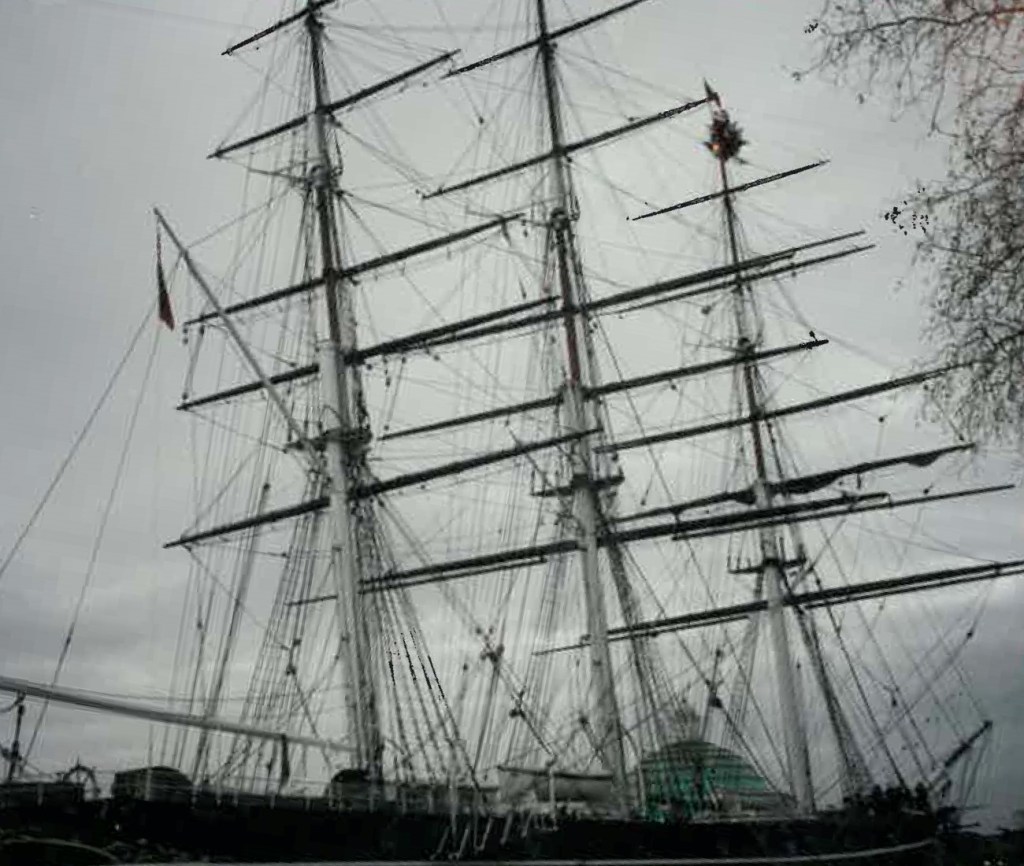
The Cutty Sark ship is docked at Greenwich. The big, sleek, masted, clipper ship was constructed in 1869 and spent its days in the tea and wool trade. She was one of the fastest ships of her time.
Cutty Sark, Greenwich, England
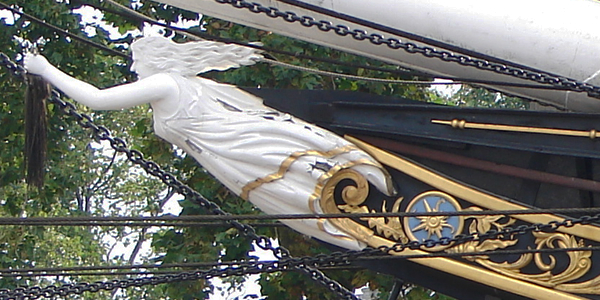
The name Cutty Sark is taken from Robert Burns’ poem, Tam O’Shanter. It is the nickname of the witch that chases Tam and his horse, Meg. Indeed, the ship’s figurehead is a white figure of a woman with long hair holding a grey horse’s tail.
I have dinner and take in another movie—Sleepy Hollow with Johnny Depp and Christina Ricci. It is quite gory, but Johnny Depp is great. Of course, he is.
There is a Ben and Jerry’s just outside the theater and I get a cup. I ask for Chubby Hubby, my favorite. The guy scooping ice cream looks like he’s never heard of it. How about Coffee Heath Bar Crunch. He looks even more bewildered and says they only have the flavors that are in the case. I select Butter Toffee Crunch, which turns out to be Heath Bar Crunch. They have Cherry Garcia and Cookie Dough, and also something called Caramel Chew Chew. Oddly, there is no Cool Britannia.
In today’s news: The Millennium Dome celebrations went off on New Year’s Eve despite a bomb threat. The Queen made the decision to proceed, reports the Daily Telegraph, following other recent bomb threats that have turned out to be false.
The Daily Telegraph showed a picture of a rather glum-looking Queen linking arms with Tony Blair for the singing of Auld Lang Syne. It said she forgot to cross her arms in front of her and that she struggled with the words…and with her dignity.
The River of Fire was overhyped said the Millennium celebration organizers. It went off just as planned with the simultaneous discharge of a fan of fireworks at the stroke of midnight. Reports of 60-meter high flames shooting down the river were exaggerated (it was actually 6 meters but traveling at the speed of sound nonetheless). People are disappointed or thought that the River of Fire was a dud because they were misled about what to expect.
Despite huge concerns regarding the digital and computing practice of abbreviating a four-digit year to two digits (thus potentially making the year 2000 indistinguishable from 1900), widespread disruption of computer systems by the ‘Y2K bug’ failed to materialise.
Not all the celebrations went smoothly. Hundreds of the 10,000 invited guests to the Millennium Dome were kept waiting to be allowed in, due to an administrative error.
The Millennium Wheel – officially known as the London Eye – was unveiled but was not able to take passengers due to one of its pods failing a safety check. It finally began carrying customers a month later.
Two million people attended the celebrations along the banks of the Thames in London, but many were left stranded for hours in their attempts to get home as four of the main tube stations were closed due to overcrowding concerns.
Westminster City Council workers collected more than 150 tons of rubbish after the New Year’s Eve celebrations. About 15% of the rubbish was made up of champagne bottles.
The Millennium Experience at the Dome opened to the public on January 1 and ran to December 31. Despite being declared a critical success, it failed to attract anything like its target of 12 million visitors and went on to incur huge losses.
I go through all my guidebooks looking for something that is open today. There is not much. British Museum. Closed. Imperial War Museum. Closed. Dickens House. Closed. National Portrait Gallery. Closed. The Museum of the Moving Image is closed until 2003. The BBC is open by appointment, but I only get an answering machine.
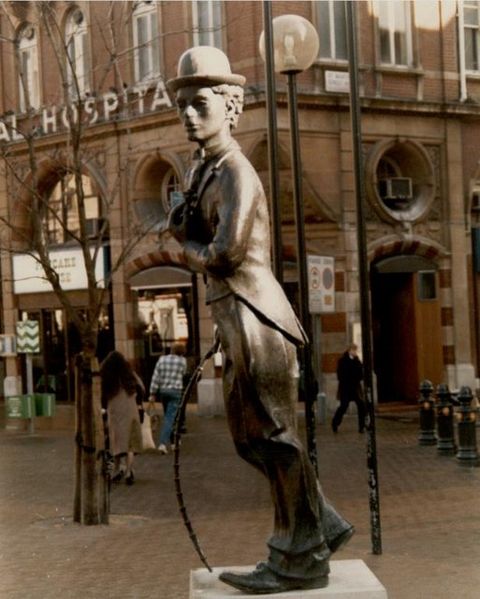
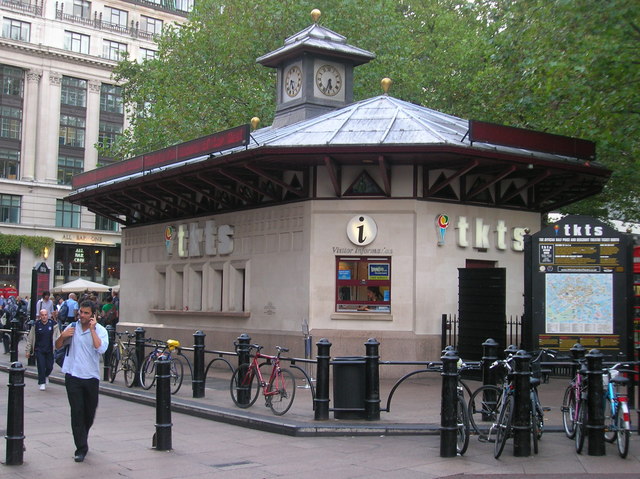
Around 1:00 PM, I go to Leicester Square but nothing much is open. Nevertheless there are a lot of people milling around. Leicester Square is the home of London’s half-price ticket booth for the many surrounding theaters. It features a large marble statue of Shakespeare at its center. There is also a fun little statue of Charlie Chaplin as “The Tramp” in bronze.
The few restaurants that are open have long lines and I wait about 15 minutes for a table at one of them. They seat me in an area that is right in the line of traffic for the waitstaff. It takes a while to get my food then, when it comes, someone walks by my table and knocks my plate to the floor. They bring me another sandwich, but it is noisy and crowded. I leave as soon as I can get my bill.
I walk back to Charing Cross station. The streets, buried in smashed champagne bottles, are a sea of broken glass.
Inside the station, I hear a woman yell, “Thief.” I turn to see a man running up the stairs on another line behind me. A woman is following him close behind. I hear yelling as they continue to run down the corridor. I hope she gets him.
I get off at Victoria station for the “Easy Everything Internet”. Closed. When I get back on the tube, lots of police are standing around; the Victoria line is closed due to a fire alert. I get on the Circle line and come back to the hotel for a nap.
Frank and Carolyn live on a street called The Little Boltons. I love the name of it. I get off at Earls Court. Despite our hotel being in the Earls Court neighborhood when we were here in 1996, nothing looks familiar to me now. Walking along Old Brompton Road, I pass a block of flats called ColeherneCourt; the London flat where Lady Diana Spencer lived before she became engaged to Prince Charles!
Carolyn and Frank’s flat is very nice. It is in quite a posh neighborhood. You can tell, Frank says, from the “rolling stock”―Jaguars, Mercedes, Aston Martins―parked in the streets.
They open their New Year’s champagne and share it with me, along with some Beluga caviar. I am touched at the thoughtfulness of this gesture. We chat and sip champagne and look at Carolyn’s digital pictures from the fireworks. They are an amazing quality. For dinner, we go for pizza, one of the few places in the neighborhood that is open.
I am sad to leave these people who I have just gotten to know and like very much. I wish I had more time to spend with them.
In today’s news: Excerpts from Prince Charles’ message on BBC Radio 4: First Thought for the Day of the New Millennium:
The Millennium provides us with an opportunity to abandon the poles of blind optimism on one hand and total despair on the other, and to rediscover a much older emotion—hope.
As we enter a new Millennium with all its hopes and fears, I pray that we may come to realise that life is a strange paradox and that the art of living it lies in striking a balance, and that it is a sacred thing to compose harmony out of opposites.
Two and half thousand years ago Plato was at pains to explain that the great gift of human rationality should not be disparaged. Far from it, he said, it should be exercised to its utmost, but it must not make the mistake of believing it has no limits.
In an age of secularism, I hope with my heart that in the Millennium we will begin to rediscover a sense of the sacred in all that surrounds…But to do that we must first of all understand that life is a more profound experience than we are told it is.
Perhaps in the midst of all the celebrations and hype, deep down inside, many of us may feel intuitively—to paraphrase a wonderful passage from Dante—that the strongest desire of everything, and the one first implanted by nature, is to return to its source. And since God is the source of our souls, and has made it alike unto himself, therefore this soul desires, above all things, to return to him.
It seems strange that we are at the end of a millennium; or yet still at the beginning of a new one. I remember when I was about 6, a teacher asked the class what they thought it would be like in the year 2000. I remember thinking I would be 40 and I would be so old I would be practically dead. And now here I am.
I wonder what people were doing on December 31, 1899. What were they thinking? Did they have their own Y2K bogie man? Could they imagine the future? Were they optimistic about the future?
I wonder if I am optimistic about the future. I would have to say yes, overall. Well, except for our seemingly irreversible environmental degradation…and terrorism…and ethnic cleansing…and the threat of nuclear war…and whether lasting peace in Northern Ireland is possible…and Mad Cow disease…
Millennium Prom Concert
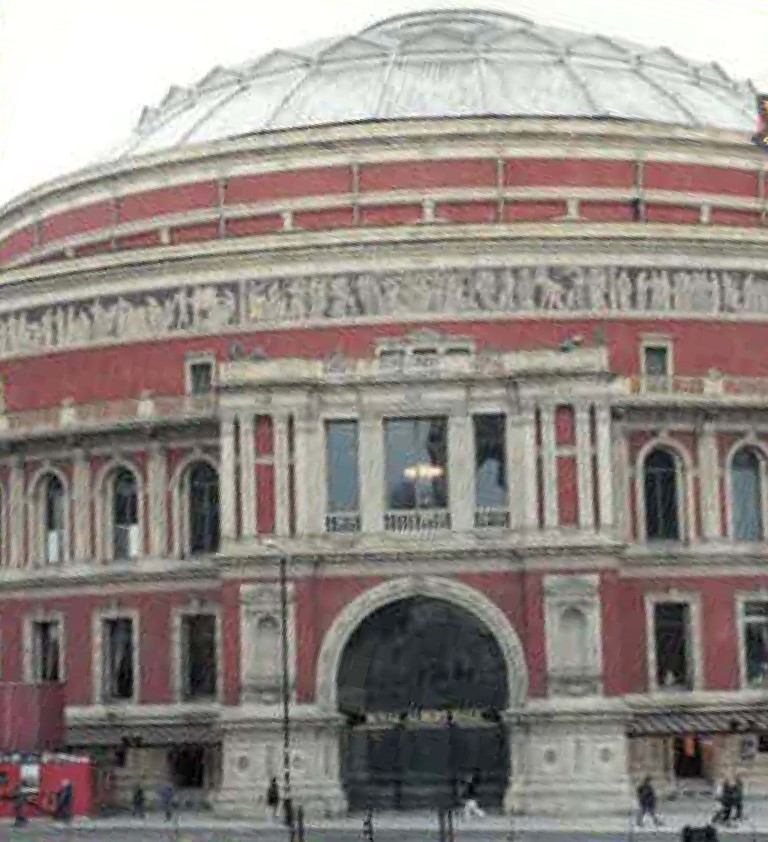
After a leisurely morning, I get ready for the Millennium Prom concert. I walk from the Kensington High Street station to the Royal Albert Hall (RAH).
Royal Albert Hall
Photos line the halls of the star-studded RAH events—Lisa Minnelli, Phil Collins, Cliff Richards. I decline a drink knowing I have champagne coming in my box. But, of course, there is not. The box to my left has champagne. But my box and those to my right do not. I am bummed. I buy a glass of white wine at intermission because for some strange reason they do not sell champagne by the glass.
The auditorium is stunning. It is astonishingly large with rows and rows of boxes. The orchestra seats and the stage look small in comparison. It must hold 5,000 people.
Plastic bags on our table contain paper flags, poppers, streamers, and a noisemaker. There are 12 people in my box (not 8 as advertised) including two children. A little boy of about 6 is excited about the poppers and streamers. I gather from what his mother tells him that we are to save our poppers and streamers for the Rule Britannia finale. But that doesn’t stop the little boy from setting off as many as he can get his hands on, looking down at the people below who are being rained on by paper bits, and laughing his head off. I laugh along with him.
Jody’s box seat at Albert Hall
The concert starts with a number from Verdi played by the BBC Concert Orchestra. For the second number, I am surprised to see the conductor pick up a violin and play. Here is the program for the entire concert:
Verdi, Overture, The Force of Destiny
Vivaldi, Winter from the Four Seasons
Mascagni, Intermezzo from Cavalleria Rusticana
Puccini, Act 1 Finale from La Boheme
Tchaikovsky, Grand Pas de Duex from Swan Lake
Vaughan Williams, Fantasia on Greensleeves
Gershwin, Rhapsody in Blue
Sullivan, Overture fromThe Yeomen of the Guard
Johann Strauss, The Blue Danube Waltz
Massenet, Mediation for Thais
Wood, Fantasia on British Sea Songs
Arne, Rule Britannia
Perry, Jerusalem
Offenback, Can-Can from Orpheus in the Underworld
Elgar, Pomp and Circumstance, March No. 1
There are some understudies filling in. The lead soprano is replaced. In addition because one of the dancers is ill, they substitute a dance from Don Quixote instead of the Swan Lake number.
The Johann Strauss dancers are wonderful. Four couples in period costume and ballgowns waltz in formations that portray boating on the Thames, swinging on a swing, riding a carousel, skating, a sleigh ride, and even a revolving door.
Who knew there are words to Elgar’s Pomp and Circumstance? 5,000 Brits at Royal Albert Hall, that’s who! And they all sing along. At the end of the concert they play an additional hymn—Never Walk Alone—and then Auld Lang Syne.
My lasting memory will be the entire RAH audience waving little British flags and singing, “Rule Britannia, Britannia Rules the Waves.”
Once-in-a-Lifetime Fireworks
I make my way to Stacy and Matthew’s for dinner. There are fireworks going off as I walk along Steeples Road where they live. Sir Derek Jacobi has a lovely Christmas tree in his front window.
Stacy and Matthew and their friend, Jill, who flew in from the U.S. yesterday, are watching CNN. They tell me that Yeltsin has resigned and the terrorists have released the hostages on the plane in Pakistan. Despite the grave world events, we are more interested in watching the Millennial celebrations around the world. Afghanistan chimes midnight at 8:30 GMT. We can’t figure out why it is on the half-hour. We watch laser light shows at the Pyramids in Giza. The celebrations in Bethlehem are controversial. For the Jews, according to their calendar, it is the year 5067. For the Muslims, the celebrations come right in the middle of their holy prayers. President Clinton delivers a live message of peace for the world’s children.
We can see the Millennium Ferris Wheel from Stacy and Matthew’s picture window. As the fireworks erupt around the wheel, we can see them on TV and look out the window and watch it all live at the same time.
Apparently, the Ferris wheel failed its latest safety check, so no one is going to be seeing the fireworks from the top of the London Eye tonight. Those people who had tickets for the wheel will be getting, as a consolation, a Millennium party on a barge in the Thames and free plane tickets to a destination of their choice from the wheel’s sponsor, British Airways. Matthew asks, “Would you want to fly in any plane owned by the company whose Ferris wheel failed its safety tests?”
Jill makes supper—a cheesy Spaghetti Pancake—that is delicious. We have salad and bread and a bottle of Merlot that I brought. They have some amazing chocolate desserts. I have a half of a big, dense, truffle-like chocolate covered with cocoa powder.
A little after 10:00 PM we head out to the fireworks.
It is to be the largest Millennial celebration in the world. Organizers are predicting 3 million people will be in central London. Fireworks will be launched simultaneously from 18 barges positioned along the Thames. And a 60-meter high line of flame, called the River of Fire, will shoot down the length of the river at 600 mph.
We take the Jubilee line to Green Park and change to the Victoria line to Vauxhall where we disembark.
All kind of humanity surrounds us. We see a couple of Bobbies making a man come down out of a tree. A group of young teenagers sits on the roof of a bus stop shelter. A quartet is dressed in 17th century costumes complete with hoop skirts and beehive white powdered wigs. Others are wearing neon green and blue wigs or gold lamé wigs. Hundreds of people have hair bands with little 2000 symbols bobbing at the end of Martian-like antennae. People walk along passing bottles of champagne around to all their friends.
We walk along Milbank on the west side of the Thames until we find a clear spot. It is 11:25 PM. We can see the Victoria Tower of the House of Lords, but we are not close enough to see Big Ben. Matthew gives us all poppers and horns and I have my noisemaker from this afternoon’s Prom. We pass the time chatting, tooting our paper blowouts, watching the crowd, and eating shortbread that Stacy cleverly thought to bring.
Matthew and Jody
Stacy and Jody
New Year’s Eve
I look at my watch at two minutes to midnight thinking, “We can’t see the clock on Big Ben. We have no Times Square ball to look at. No one is counting down. How are we going to know when it is midnight?” At that very moment, there is a loud bang and the entire London sky erupts with fireworks heralding the new Millennium.
The fireworks are amazing. We can see two barges to our right and three to our left from the way the Thames snakes through the city. If we stand on tipped toe, and if the illuminations are high in the air, we can see about five more as the river bends at Waterloo Bridge towards Tower Bridge. All the illuminations are identical—18 simultaneous explosions. I read in one article that said, if the night was clear, the London fireworks could be seen from outer space.
The fireworks last about 20 minutes. The air is pungent with gunpowder-scented smoke. The noise is deafening from the screaming rockets of 1 million pounds of fireworks; people cheering and singing, noisemakers being blown, horns honking, and church bells ringing.
But we did not see the River of Fire. A 60-meter high (200 feet) wall of flame would be hard to miss. We suspect it did not take place for some reason.
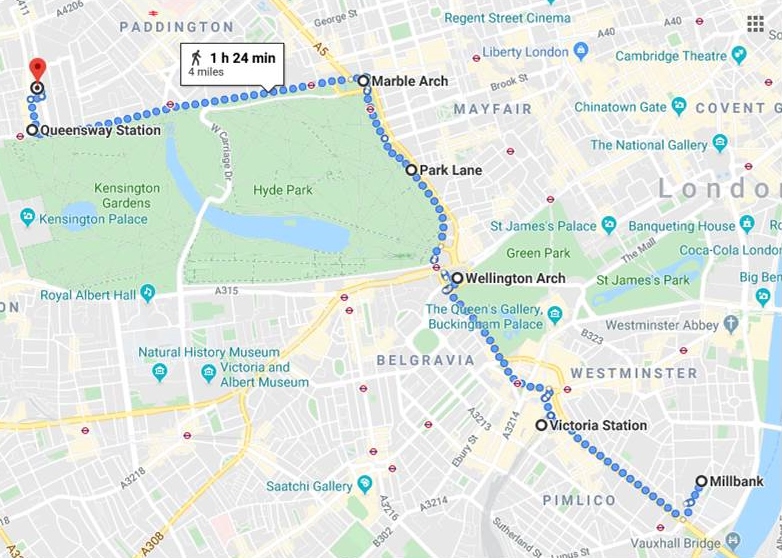
After the fireworks, along with 3 million other people, we try to get home. We walk with the crowds to Victoria station where Stacy, Matthew, and Jill veer off to the Northern line. I bid them a fond farewell and head for the Circle/District line. But, soon, I become part of a tight-squeezed crowd so compact I cannot move on my own. I have no way forward and no way out. Every few minutes the mass surges ahead a little, then stops. After being in the crowd for about 45 minutes, word spreads from the front that that authorities have closed Victoria station; there are too many people and it is too dangerous. I suspect it will open again as the crowd disperses, but I want to get out of the crush. As soon as the crowd eases enough so I can slip away, I do.
I don’t have many options. Taxis are not running tonight in central London. I decide to walk. Maybe another tube station further down the line will be open.
I don’t have a map, but I ask a police officer and he gives me general directions: Go along Buckingham Road, behind the back of Buckingham Palace, to Park Lane and along Hyde Park. I miss the turn behind Buckingham Palace and end up in front of it where the statue of Queen Victoria is delightfully illuminated. The Union Jack is flying (no Queen). I cut through Constitutional Hill to Wellington Arch, Britain’s answer to the Arc de Triomphe, with its bronze winged Angel of Peace also lit up like a herald.
My New Year’s Eve Walk
I feel quite safe. There are thousands of people walking in every direction and it is festive. People are friendly and merry. A very drunk young man comes up to me, shakes my hand, and wishes me a happy New Year before moving on to the next person.
Happily I find a soggy map on the ground and I follow it to Marble Arch where I can finally get on the underground. I go the two stops to Queensway from where I walk home about two blocks. In all I walked about 2.5 miles and it is after 3:00 AM by the time I get to my hotel.
It is raining today, the first time since I’ve been in London. After getting coffee and checking my email at the internet café, I take the Central line from Queensway to Holburn where I walk to the Soane house/museum at Lincoln’s Inns Field.
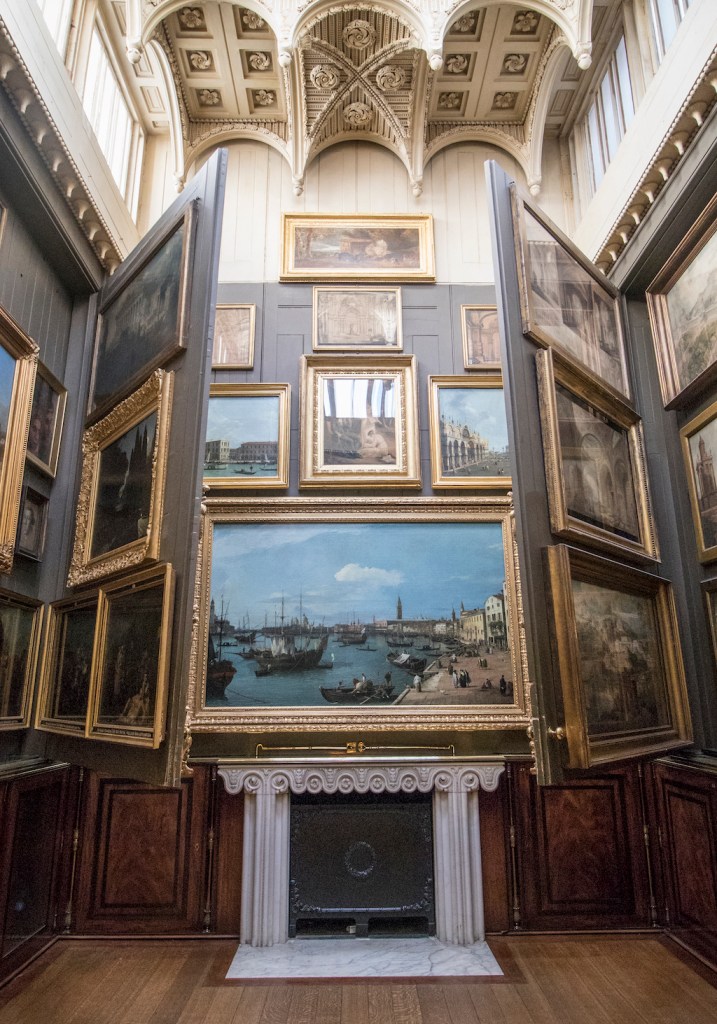
It is a unique and perplexing museum. Sir John Soane was an architect in the early 1800s. In fact, he submitted a design for renovating Buckingham Palace but another well-known architect of the day, John Nash, won out. In the Picture Room, I see a drawing of Soane’s proposed design. It is much lighter and airier and more Victorian than the rather gray and staid palace of today.
More than a talented architect, the Guardian calls Sir John obsessive, eccentric, and brilliant.
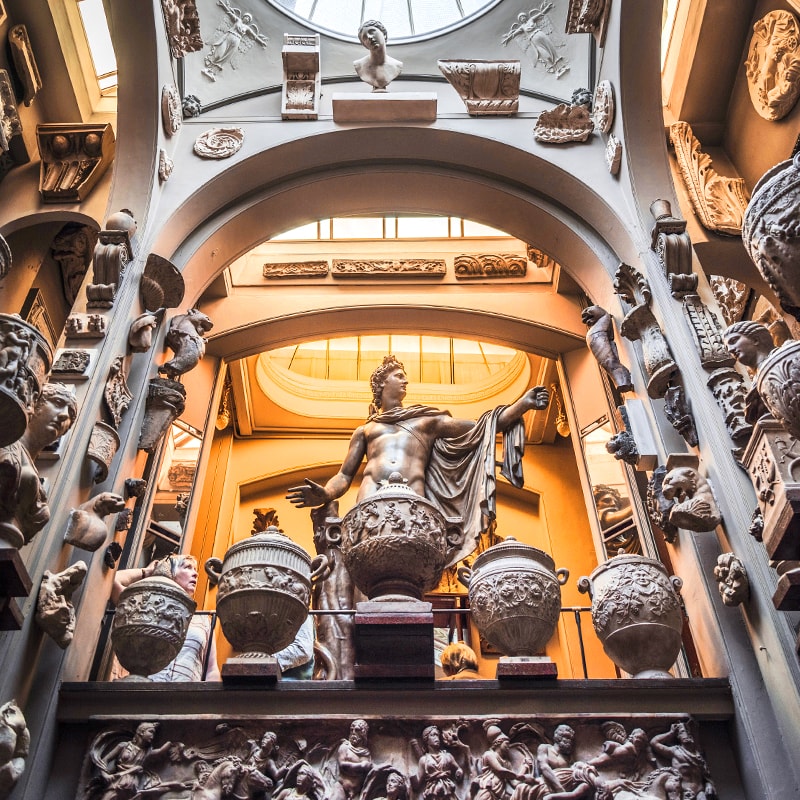
The museum consists of three houses that Soane bought separately having to add more buildings to hold his ever-growing collection. They are now connected and filled with tens of thousands of pieces of art and antiquity, including an Egyptian sarcophagus. Even while he lived there, Soane envisioned his house as a museum and the route through the house recommended by him is laid out for me in the visitor’s brochure. It winds through rooms and passageways and up and down stairs all arranged around a central, light-filled courtyard.
There is so much crammed in—every surface is covered—it is hard to take it all in. In the tiny Picture Room, more than 100 paintings and drawings cover every inch and with walls behind walls there are more paintings are hidden behind the first ones. There are masterpieces by Hogarth, Canaletto, and Turner; the latter two, Soane’s friends.
There are Greek vases, Chinese ceramics, Peruvian pottery, Roman bronzes from Pompeii, and stained glass from the fire-razed Palace of Westminster. The collection is not only eclectic but contains items considered to be some of the world’s greatest treasures. The sarcophagus of Pharaoh Seti I is one of the most important Egyptian antiquities ever discovered. Canaletto’s painting of the bell tower of St. Mark’s Square in Venice is considered one of his greatest works while Soane also acquired original architectural designs by Christopher Wren and a copy of Shakespeare’s First Folio. Every nook and cranny are rife with history.
It is like a fun house too. Once inside you immediately lose all sense of direction in a labyrinth of rooms. Varied ceilings heights, multi-level floors, and mirrors create the illusion of space in the narrow townhouses (there are 100 mirrors in the breakfast room alone). There are secret passageways. Shadowy corridors open up unexpectedly into light-filled rooms. Another of Canaletto’s painting is positioned to look like a view of the famous promenade of Venice out the window. The rooms themselves evoke a sense of time and place―from the Roman arches in the rich Pompeian-red dining room, to the Mediterranean sun-dappled Dome Area and Colonnade, to the eerie gothic-ness of the cryptlike Sepulchral Chamber. There is so much going on here, it would take days or weeks to explore it all. I leave feeling like I have barely scratched the surface.
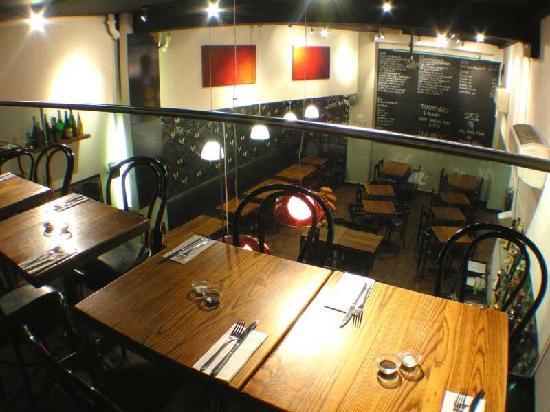
Back at Holburn tube station, I take a circuitous route from Bank to Monument to Blackfriars station and ascend onto Fleet Street. My plan to eat at Ye Old Cheshire Cheese―a famous pub frequented by editors and reporters―is thwarted. Closed. I walk a little further to a pub aptly called the Wine Press. The small pub is housed in what used to be a wine press. I have an eggplant pizza.
Fleet Street was traditionally the headquarters of most of England’s major newspapers thus the reference to the national press generally as “Fleet Street.” Whitehall refers to the British civil service and government, while Westminster means Parliament, all similar to how in the U.S. we use “Houston” to refer to NASA and the space program.
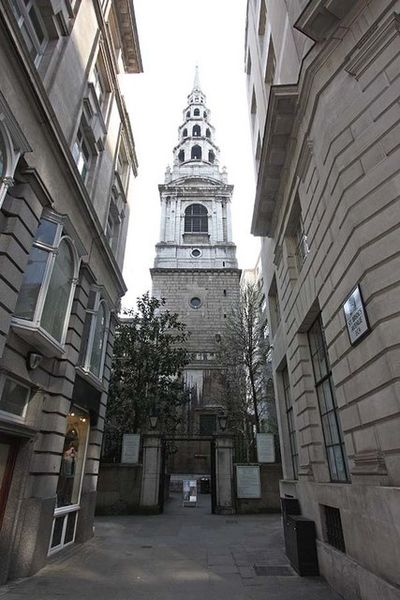
I pass the original Twinings tea store, the Royal Court of Justice, and Reuters. Behind Reuters is the Church of St. Bride’s, designed by Christopher Wren, and boasting Wren’s tallest spire. St. Bride’s tiered structure is said to have inspired the traditional wedding cake design.
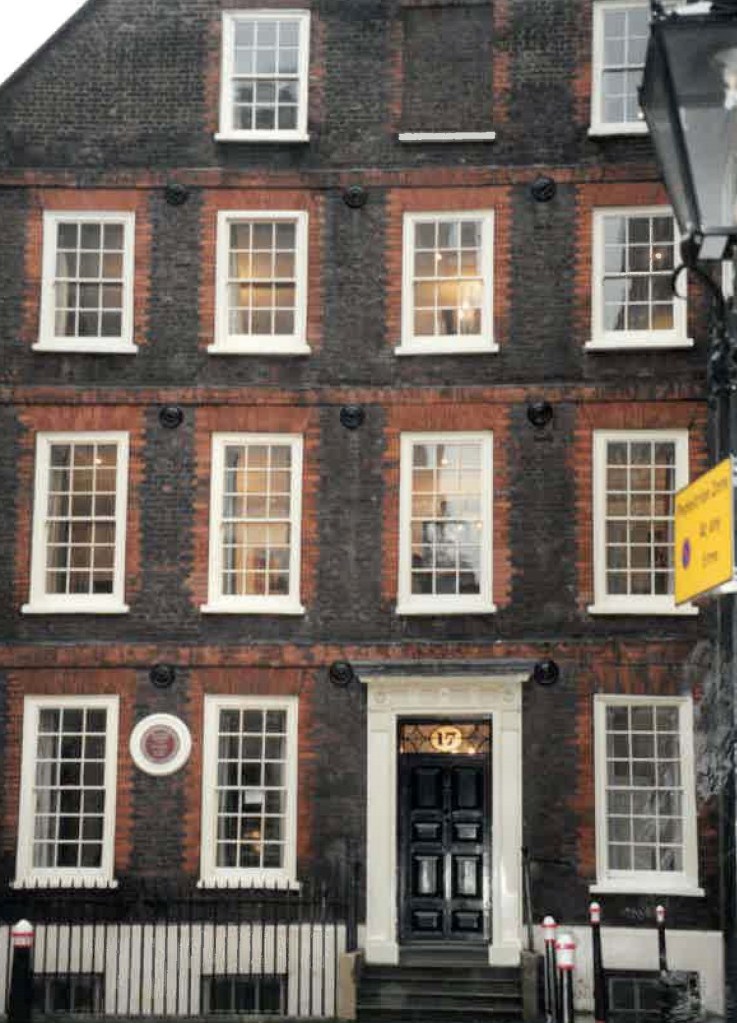
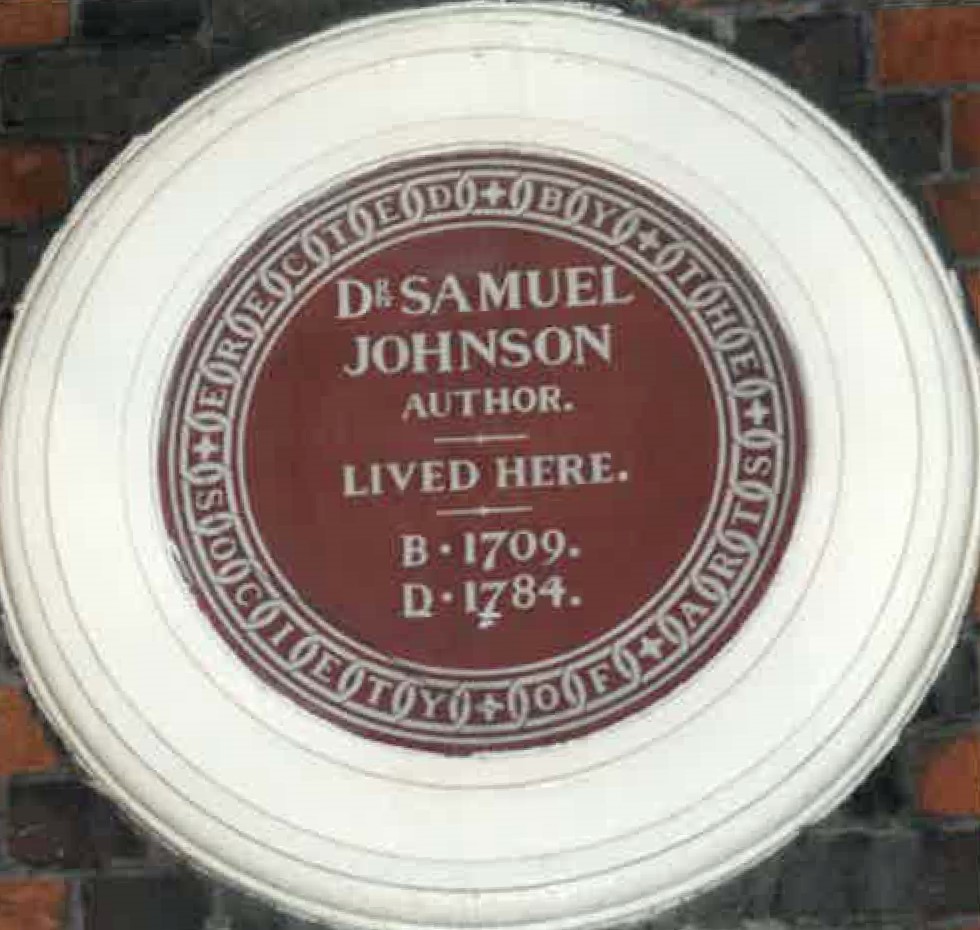
I duck through an alley to Gough Square where Dr. Samuel’s Johnson’s house is located. I couldn’t see his birth house in Lichfield, but I am in luck today, his London home is open.
Samuel Johnson House, Gough Square, London
Dr. Johnson’s wit is on display. He wrote: “Wine makes a man better pleased with himself. I do not say it makes him more pleasing to others.”
A short film tells of Johnson’s friends among whom were the painter Joshua Reynolds, the actress Mrs. Siddons, and Flora MacDonald of Bonnie-Prince-Charlie-fame who he visited with his friend and biographer, James Boswell, on their well-documented travels through Scotland.
After a brief rest, I head out again to see a movie. I choose the delightful film, Anna and the King with Jodie Foster. Besides sharing her name, we are of a similar age and I feel like I have grown up with her from the time I saw her in early Disney’s films and in Paper Moon with Ryan O’Neal in the 1970s.
In today’s news: Beatles George Harrison is in stable condition in the hospital after being stabbed by an intruder in his home. His wife heroically smashed the assailant over the head with a lamp and called the police.
It is close to noon by the time I get to Harrods. I want to buy some Stilton for Brian and have it shipped. A woman at the check-out counter assures me they will ship it and gives me information on weight, price, and all the procedures. But when I go get the Stilton and come back, a different cashier says, “Oh, we’re not shipping anything now until after January 6.” Why January 6? Why not the next business day after New Year’s? It all just seems so arbitrary. I sigh. How does Harrods stay in business? After much deliberation, I decide to buy the cheese anyway and take it home on the plane. I can store it in the refrigerator at the hotel in the meantime.
The Britain at War museum near London Bridge brings to life the air raids and bombings of London during World War II. Sitting in a pitch-black shelter in a simulated air raid, I can see nothing, but hear the sounds of bombs falling around me and sirens wailing. It is eerie and more than a little unsettling. There is also an exhibit that reproduces a bombed-out street. I walk along the smoky dark street with fires flickering and silhouette images of firemen rescuing people and putting out fires. It is all very realistic, well, except for the mannequins, which look obviously fake.
The 1940-41 Nazi bombing of London killed nearly 30,000 civilians, many more than I ever realized. To quote Churchill, or rather to paraphrase him, “If Britain still stands 1,000 years from now, men may look back and say ‘This was their finest hour.’”
I walk down by Tower Bridge, through Potters Field Park along the Thames, and have some great views.
The Bramah Tea and Coffee Museum gives an interesting history of the tea trade in England. There is also a huge collection of teapots, including one 12-foot-high ceramic Brown Betty commemorating the 60th anniversary of Queen Victoria’s accession to the throne and the world’s largest teapot that serves 800 cups of tea. Of course, I have to stop in the café for tea and cake. It is teatime after all.
I go back to my hotel to rest for a bit before heading to Stacy and Matthew’s flat in North London.
It takes me just over an hour to get there on the tube and then walking the eight blocks or so to their flat. Carolyn and Frank are already there. Stacy serves wine and cheese before we head out to the pub. Stacy tells me the delicious, dry, crumbly cheese, which I thought was Parmesan, is a farmer’s cheddar that she got at Covent Garden.
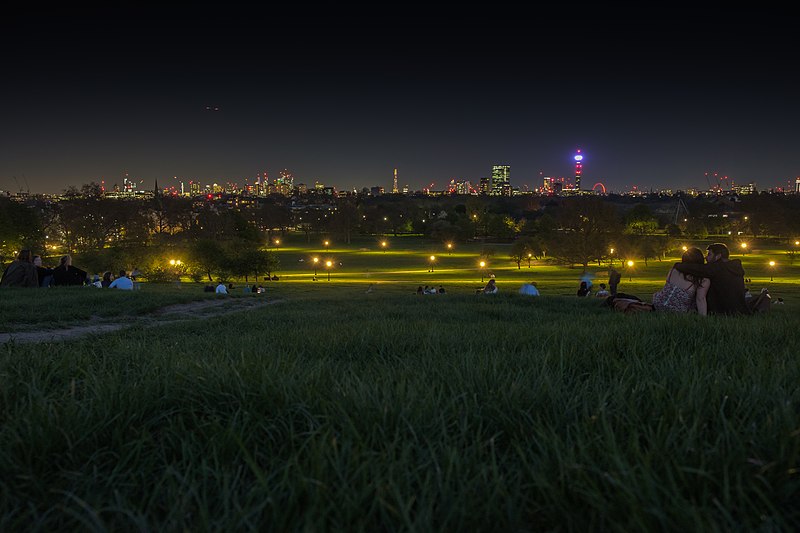
Before going to the pub, we walk up Primrose Hill. The view of the London skyline is wonderful. The BT Tower and St. Paul’s dome stand out against the night sky. It is clear, not too cold, although there is a thin layer of frost over everything that makes it slippery. Venus shines brightly in the clear night sky.
The pub, the Lansdowne, is just a few blocks away. It is excellent. I have the salmon and tarragon fish cakes, soft inside with soft lumps of mashed potato and crispy on the outside and served with a tomato coulis. The group treats me for my going away, which is so nice of them. We sit and talk until about 10:00 PM. We talk about everything from traveling, to London living, to questions for their Tony Blair meeting. The fellows have a meeting scheduled with Tony Blair in February. I am heartbroken to miss it.
Stacy’s work at the Social Exclusion Office has finally come together; she starts after the New Year. She even has a leather chair; a big step up from no chair at all. She is very happy.
Stacy teases about my paper. She says, “187 footnotes! How can we live up to that?” She takes to calling me 187.
I make plans for dinner and the fireworks with Stacy and Matthew on New Year’s Eve and plans for dinner with Carolyn and Frank on New Year’s Day. As we put on our coats to leave the pub, some people are obviously coveting our table. They are friendly but sit down quickly before we even clear the way. One chap says to me, “Bundle up, it’s cold out there.” It is actually quite balmy—in the 40s. I certainly don’t need my scarf and gloves. They have not experienced Maine in December.
I don’t sleep well. The room is hot and the bed small. At about 6:00 AM, it occurs to me that I can push the two small twin beds together and this gives me a little more room.
While eating breakfast I write a few thank you notes hoping to mail them today. Alas, it’s a public holiday and the post office is closed. Yesterday was a bank holiday. Don’t ask me the difference between the two, all I know is that the shops never seem to be open.
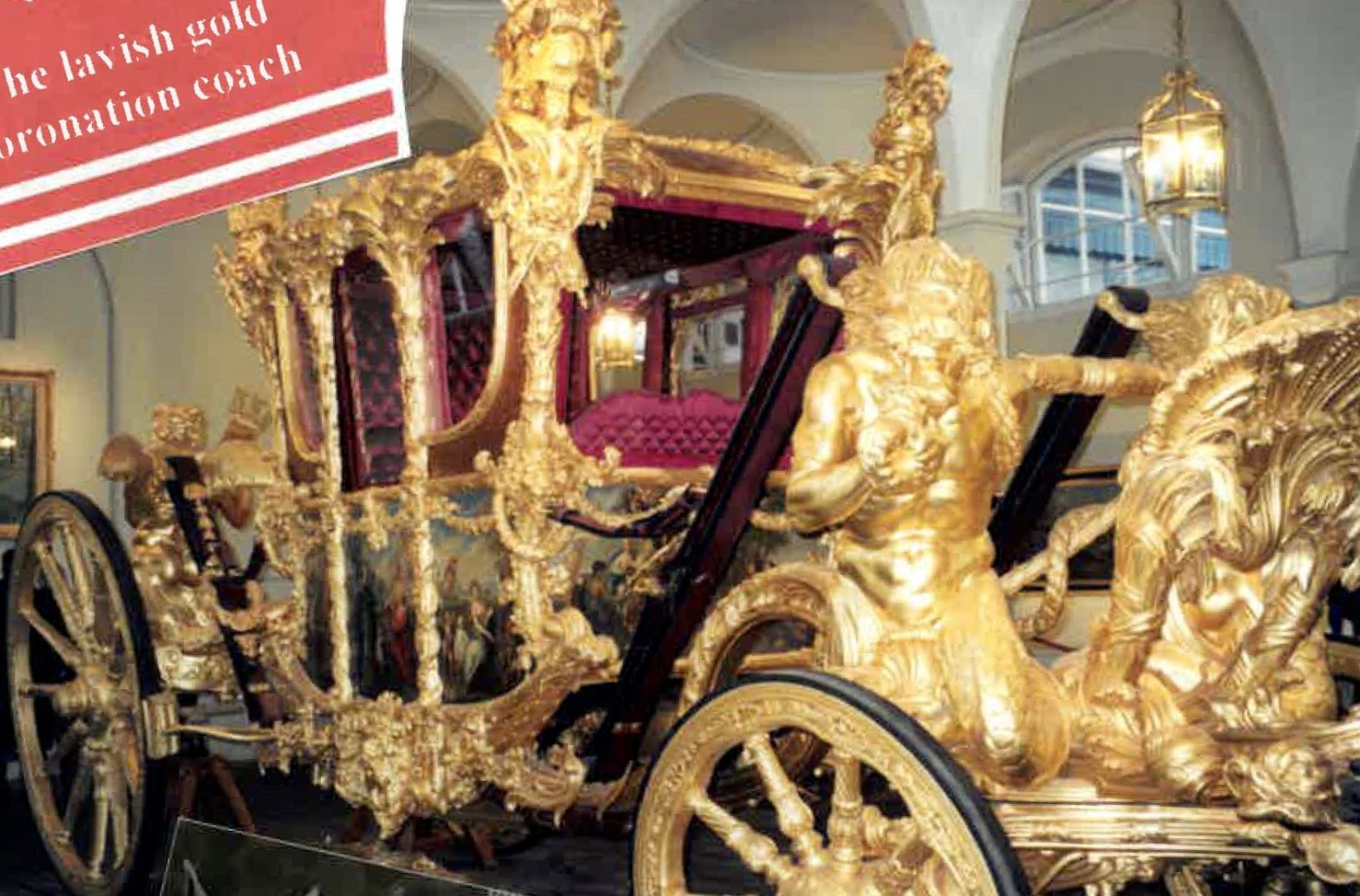
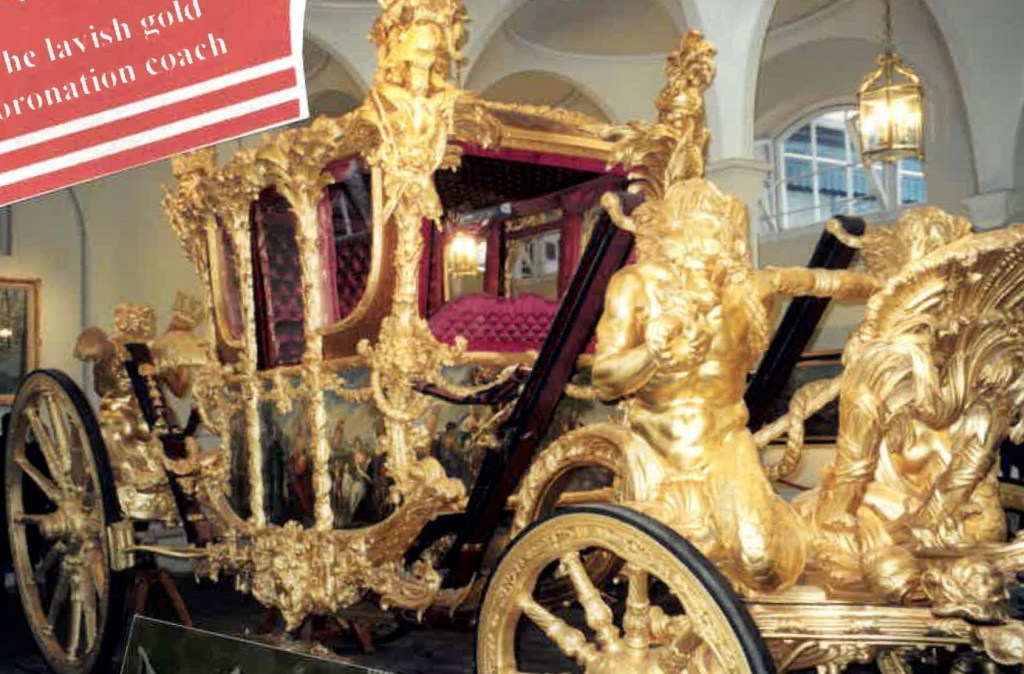
I walk down to the Royal Mews half expecting it to be closed too, but, happily, it is open. The Mews are essentially the Queen’s stables, which store the royal carriages, including the incredible 1762 Coronation Carriage. I never realized how ornate it is. Pastel paintings of an Italian design decorate the sides with heavy gold outlining the rim of the coach. Massive gold tritons (half-man, half-fish) on the front and back commemorate Britain’s seafaring heritage. A few hours later, thinking back about the coach, all I can remember of it is gold.
Coronation Coach, The Royal Mews, London
I also see the Queen Alexandra state coach, or what is also known as the Glass Coach, which carried the crown for State Opening of Parliament and is used for weddings, including to carry Diana to St Paul’s Cathedral on the day of her marriage to Prince Charles. Although it is not really glass, it does have big glass windows so people can clearly see the occupants inside as they pass.
I check out the half-price ticket offerings at Leicester Square and purchase a ticket for a new play called Battle Royal with Zoë Wanamaker. The show is about George IV and his disastrous 1795 marriage to the German Princess, Caroline of Brunswick. While waiting in line for tickets, I meet two American ladies; a little older than me who are vacationing in London for the holidays. We will be sitting next to each other at the National Theater, near Waterloo station.
After a quick lunch, I head back to see if Harrods is open. Just as I get off the train at Knightsbridge, I hear the announcer say, “Turn right to exit. The Brompton Street exit is closed. Harrods is closed today.” I turn around and get back on the train I just exited.
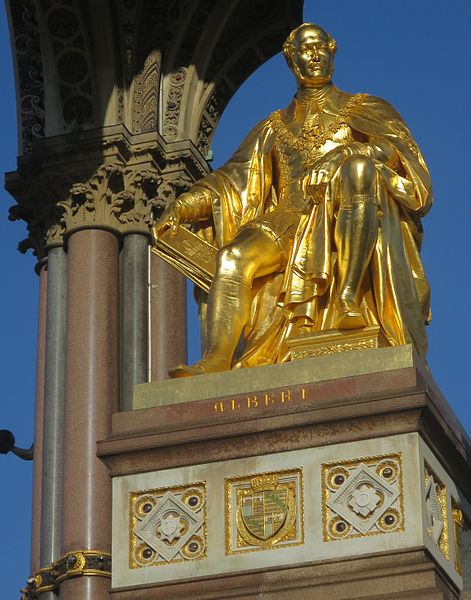
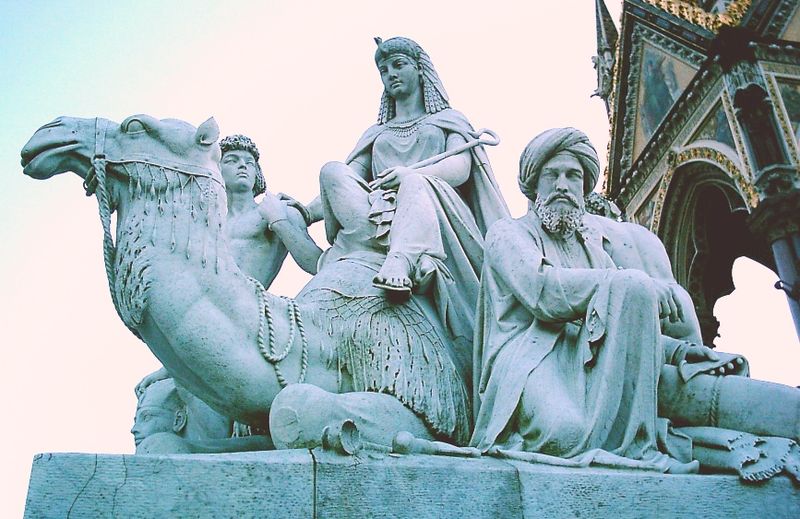
Instead, I go to Kensington High Street and do some window shopping. I stop to admire the Albert Memorial. Newly restored, the central figure of the Prince dazzles in gold. Queen Victoria’s consort is seated; he wears the robes of state and is covered by an ornate, steeple-like canopy that soars 176 feet high.
At the memorial’s base are stone sculptures of 169 composers, architects, poets, painters, and sculptors. And if all of this is not enough, the statue’s square podium has, at each corner, marble statues representing science and industry, agriculture, etc. and at the furthest outer corners of the canopy’s base are four more sculptures symbolizing four continents with groupings of native animals and ethnographic characters (source). The whole thing is well and truly over the top.
However I love the outer sculptures, which are arresting and realistic. I spend a long time looking at each one.
Across the street from the memorial is Royal Albert Hall where I am able to get a ticket for Friday’s matinee Millennium Prom—with the BBC Concert Orchestra and including the Johann Strauss Dancers. A box ticket seat at £35 is more than I want to pay. The ticket agent tells me I get champagne and refreshments in the box seat. What the heck. I tell her to charge it.
At Waterloo, I can’t even find my way out of the tube station. I follow the signs for what seems like a full block. The exit signs lead me to what looks like a back alley. I give up and decide to get a taxi. The taxi driver points and says, “But the National is just across the bridge.” He must have sensed my desperation because he quickly adds, “But I will take you if you want to go.” It is worth the £3 to me even if it is not for him.
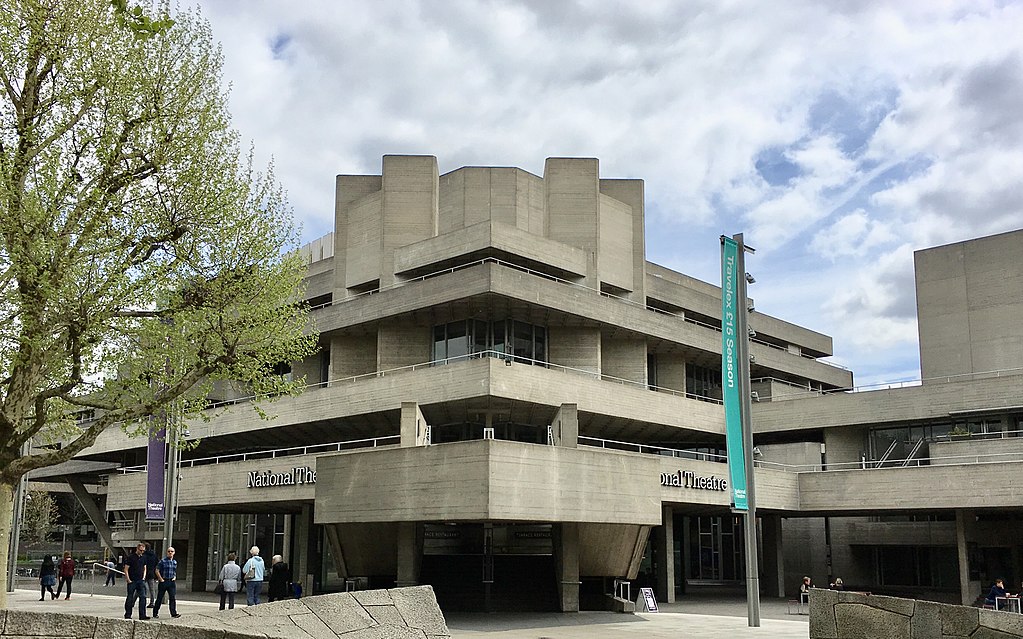
The National Theater is a huge, concrete monstrosity housing four theaters in one building including the Olivier Theater and the Lyttleton where I am going. Known to be critical of modern architecture, Prince Charles said the National Theater, “was a clever way of building a nuclear power station in the middle of London without anyone objecting”. Sadly, I have to agree with him.
I am in the first balcony. My friends from Leicester Square arrive about two minutes before the curtain. They also had a hard time finding the theater. I don’t have time to ask them if they came through Waterloo station before the lights go down and the show starts.
The play is excellent. An historically accurate account of George IV who reluctantly agrees to marry so that Parliament will pay off his debts. He takes an immediate dislike to his new bride and within months wants to divorce her, but Parliament is having none of it. After he banishes her from Court, Caroline lives in Italy where she takes up with an Italian Count. When he becomes king, George bans her from the coronation, ruthlessly placing guards at the doors to bar her from entering. His extravagant lifestyle and shabby treatment of his consort make him unpopular and Caroline has the sympathy of the British populace. She died not long after the Coronation. It is a three-hour play but goes by very quickly. Zoë Wannamaker is terrific.
I join my two new friends for a late dinner and take a taxi back to my hotel.
I eat my last breakfast at Glenelg and finish packing. Caroline pops her head in to tell me she is leaving for Wales at noon, but that Tony has a kidney stone and is staying home. Jake is going with her to Wales and Vanessa is available here if Tony needs to go to the hospital.
Caroline orders me a taxi about 10:30 AM and I bid them a weepy farewell. Caroline pretends to cry and dabs at her eyes with a white handkerchief. Tony looks very glum but I don’t know if it is at my leaving or the painful kidney stones. I am so sad to leave them both. They have made my stay here so much fun; a true home away from home. I promise to return. And I mean it.
The memory of Caroline standing at the end of their driveway waving her handkerchief at me until I am out of sight will always stay with me.
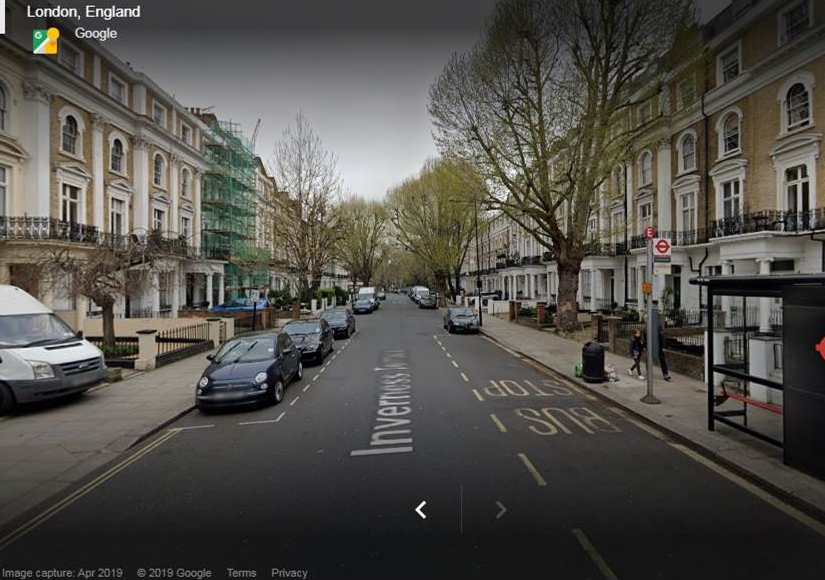
My London hotel on Inverness Terrace in Bayswater is a bit old and worn—part hotel, part hostel. But it is cheap and conveniently located two blocks from the Queensway tube stop. My room has two tiny twin beds. The bathroom is down the hall. They told me when I made my reservations that there would be no hot breakfast because they could not get workers over the holidays. But there is a kitchen downstairs where you can cook a simple meal and store refrigerated items.
Inverness Terrace, Bayswater, London Photo courtesy of Google Maps
At Bayswater station, I buy a week-long travelcard using one of the photos I had taken when Lisa was here. I stuff the card into my pocket and hop on the train to Knightsbridge. A young man sits next to me and he seems awfully close like he is leaning against me. I keep moving away but it seems like he is always there. I begin to wonder. Sure enough, I check my pocket and my travelcard is gone. I get up, check my seat, look in all my pockets, it is not there. I check my seat again. Then I ask the young man to stand up so I can check the seat between us. My travelcard is there on his other side under the armrest. He had not had time yet to get it into his own pocket. I grab it and get off at the next stop even though it is not the one I want. I am so mad I am shaking. I think I may have called him an “a**hole, under my breath.
I get the next train and resume my trip to Harrods. But Harrods is closed. Is this store ever open?
I use the last of my phone cards to call Mom and wish her a happy birthday.
I walk along Queensway until I find a mall with a movie theater. The queues are long but there are tickets left for the 18:20 showing of the new James Bond movie—The World is Not Enough. The ticket agents have fancy computer terminals that show the seating plan of the theater and the location of available seats. You must pick a seat on the screen when purchasing a ticket. It will be 15 years before the cinema in Augusta has something like this, and I don’t like it any more then than I like it now. I want to scope out the place before deciding on a seat.
The movie is fun, especially the opening scene with James Bond in a speedboat racing along the Thames whizzing past the Houses of Parliament and Big Ben. The action culminates with 007 jumping from a hot air balloon onto the roof of the Millennium Dome. In another scene, Bond visits Q’s office (played by Judy Dench) where there is an explosion in the basement. The camera pans to the outside of the building and I can hardly believe my eyes. It is the modern Disneyesque building on the Thames that Lisa and I wondered about. Apparently this building is the MI6 headquarters―now, in the movie, with a gaping hole in it.
The building would come to feature in several more James Bond movies. One travel blogger writing a few years later says:
The building gets attacked in both “The World Is Not Enough” and “Skyfall” ― and finally destroyed in “Spectre”. The real agents at MI6 loved the virtual demolition. A special premiere of “Skyfall” was held at Vauxhall Cross for the MI6 staff ― and they cheered when their headquarters was destroyed in the film.
I grab dinner at Bella Pasta but, just as I get my entrée, the kitchen loses electricity. They can’t serve any new customers, but the people already served can stay as long as they like. I do. I order another glass of wine and stay until 10:00 PM.
Today is Boxing Day, which is nearly a bigger holiday in Britain than Christmas. Its origins have to do with “boxing up” the Christmas leftovers and giving them to the poor. Tony and Caroline have a big dinner today away from Glenelg with extended family.
I am spending the day with Dean, Barbara, Ari, and Max. We are going for a short hike in the Malvern (pronounced Mouvern) Hills, about 50 miles away. There is a beacon on the high point, which will be lit for the Millennial New Year. It will be one in a chain of beacons and bonfires across Britain flaming on New Year’s Eve. According to Wikipedia, the beacon, which gives the summit its name―Worcester Beacon―comes from the use of the hill as a signaling beacon to warn of the invading Spanish Armada in 1588. A poem commemorates this:
And on, and on, without a pause, untired they bounded still All night from tower to tower they sprang; they sprang from hill to hill Till the proud Peak unfurled the flag o’er Darwin’s rocky dales Till like volcanoes flared to heaven the stormy hills of Wales, Till twelve fair counties saw the blaze on Malvern’s lonely height,Till streamed in crimson on the wind the Wrekin’s crest of light.
I love the idea of beacons of fire being simultaneously lit across the country. Why don’t we do this in the U.S.?
The Kaplans pick me up a little after 10:00 AM.
The Severn-Trent River near Worcester is flooded; in every direction an expanse of muddy brown water covers what are normally fields. The weather changes from driving rain to sunshine to clouds all morning. At one point we see a rainbow in front of us as we skirt around Worcester and travel southwest along the A449. In the distance we can see Worcester Cathedral.
The small village of Great Malvern is very picturesque—a spa town known for its bottled water. Not only does Queen Elizabeth II drink this water, apparently Queen Victoria refused to travel without it.
The 1,400-foot climb winds up the hillside; gently sloped, sometimes muddy, sometimes paved. I thought after all the walking I have been doing that I would be galloping up the hill, but I admit to being a bit winded on the steeper parts. I watch bemused as a group of 70-year-old-or-more ladies in their wellies and carrying walking sticks cheerfully stride past me up the hill.
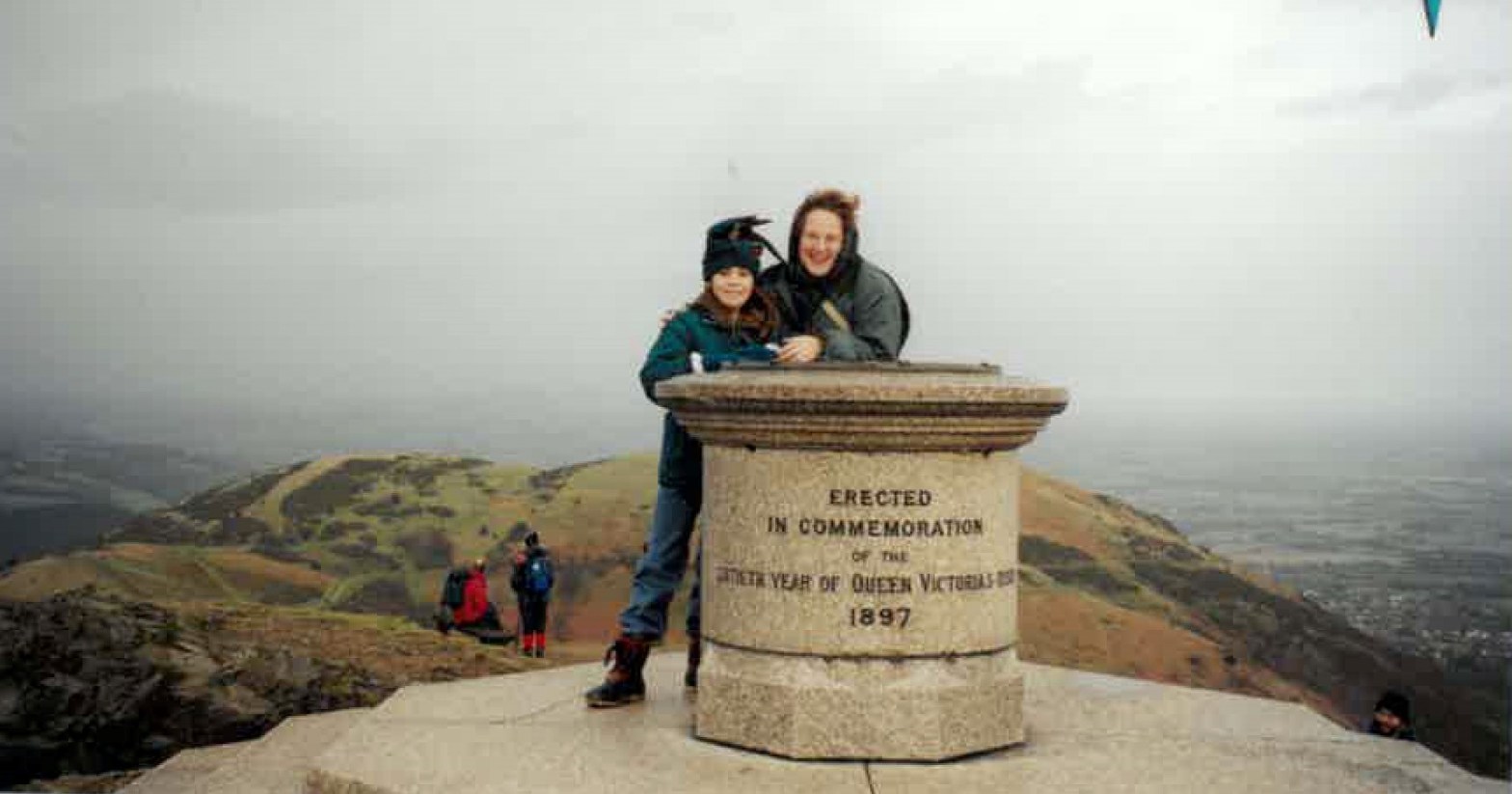
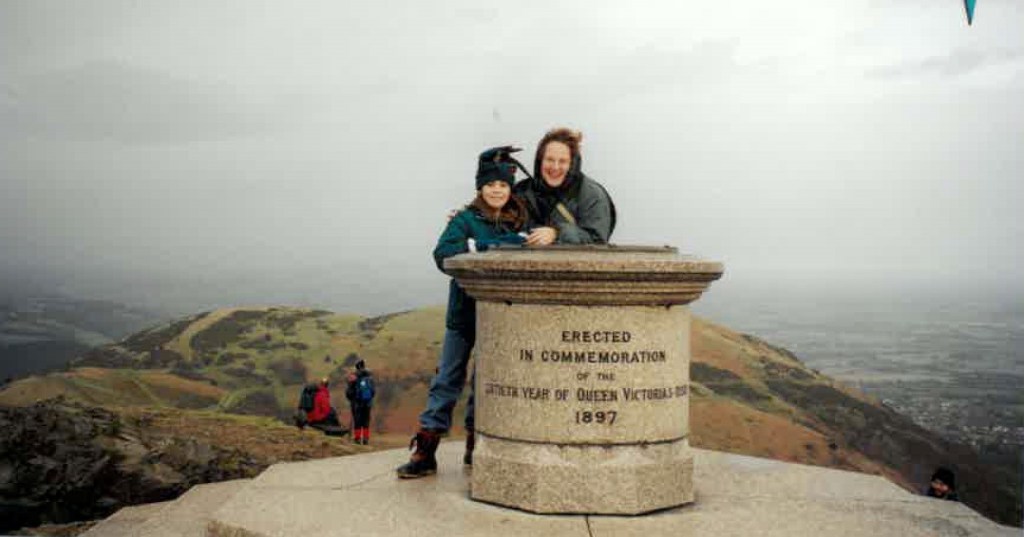
A monument marking the 60th anniversary of Queen Victoria’s reign sits at the peak. We admire the panoramic view as far as Wales, including the Wrekin of poem, the high point of the Shropshire Hills, and the Bristol Channel. We know what we are looking at from the brass topographical map engraved on the flat surface on the Victoria monument. Amazingly, the rain holds off.
Jody and Ari atop Malvern Hill
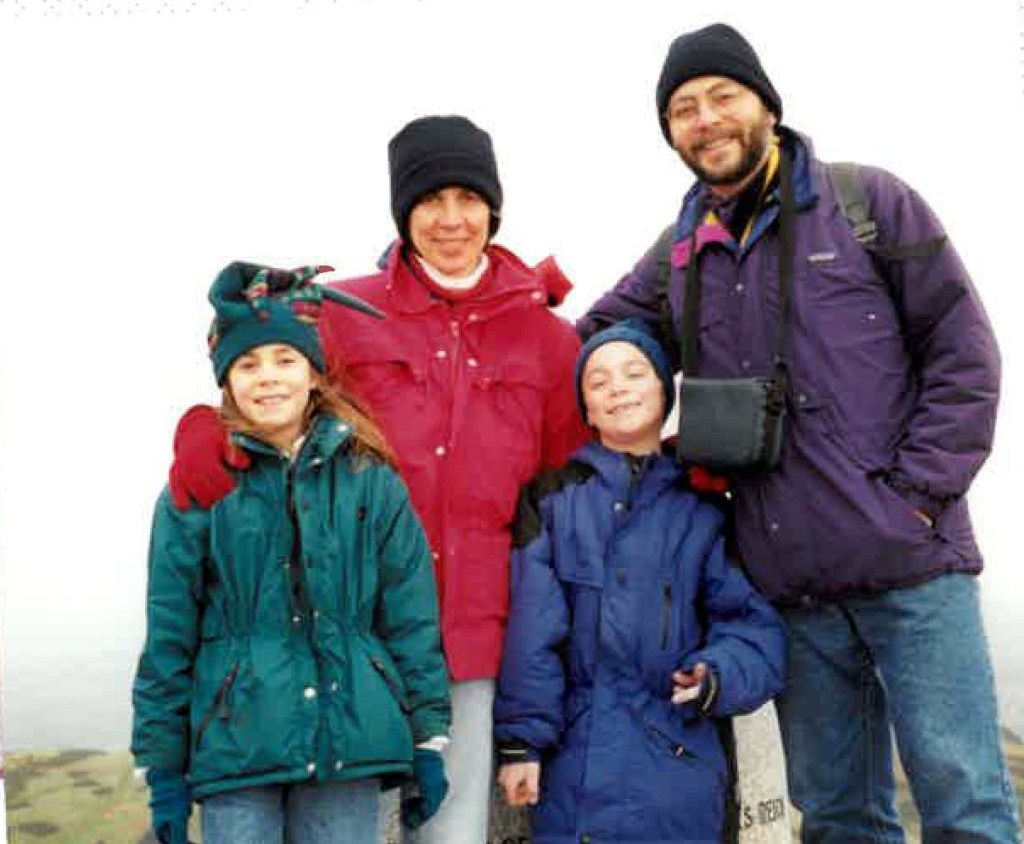
The Kaplans
We start back down the hill and suddenly without a word Ari takes off in front us and is soon out-of-sight. When we reach a turn in the path, we hope that Ari knew which way to go. Dean goes off one way to see if he can catch up to her, Barbara heads off the other way. Max and I wait at the turn. Soon I see a young couple coming up the trail and ask if they had seen a 10-year-old girl by herself on the trail. They say, “Yes, she is quite a ways down.” I call to Barbara and we make our way down catching up with Dean. When we get nearer to the car park, Dean hollers and to all our relief Ari responds. Even Max is relieved.
It begins to pour again on our drive back into Great Malvern. We stop in the town, but Woolworth’s is the only thing open on Boxing Day. I see a National Lottery booth with forms for tickets for the Millennium Dome. I fill mine out for January 1, but there are no tickets available. I get a ticket for January 2.
Back at home, Barbara makes us turkey sandwiches and we watch a movie—Matilda. Dean and Barbara break out a bottle of champagne to celebrate my project’s completion. We have champagne and cheese and crackers. They have a terribly smelly cheese, which I don’t like, but also a cheddar and a Stilton, which I eat with relish. We talk and sip champagne. Ari has made me a Millennium/Y2K card and they give me a pack of cards with the English kings and queens for a Christmas gift. I love them. We no sooner get the champagne drunk when Barbara starts making supper—pizza and a salad. I am stuffed.
I bid them all a fond farewell. It is hard to say goodbye. They have become such good friends in such a short period of time. We promise to keep in touch. I visit them in Philadelphia and we meet once in Freeport when they are on vacation in Maine. But, of course, despite all the good intentions, we lose touch after a few years.

 Jody’s UK Memories


