It is raining today, the first time since I’ve been in London. After getting coffee and checking my email at the internet café, I take the Central line from Queensway to Holburn where I walk to the Soane house/museum at Lincoln’s Inns Field.
It is a unique and perplexing museum. Sir John Soane was an architect in the early 1800s. In fact, he submitted a design for renovating Buckingham Palace but another well-known architect of the day, John Nash, won out. In the Picture Room, I see a drawing of Soane’s proposed design. It is much lighter and airier and more Victorian than the rather gray and staid palace of today.
More than a talented architect, the Guardian calls Sir John obsessive, eccentric, and brilliant.
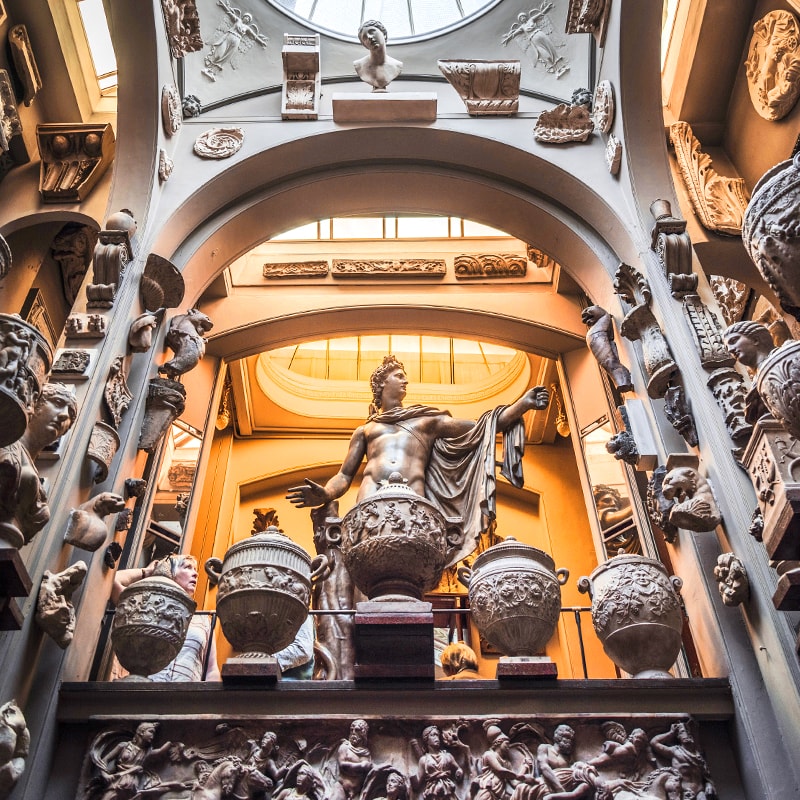
The museum consists of three houses that Soane bought separately having to add more buildings to hold his ever-growing collection. They are now connected and filled with tens of thousands of pieces of art and antiquity, including an Egyptian sarcophagus. Even while he lived there, Soane envisioned his house as a museum and the route through the house recommended by him is laid out for me in the visitor’s brochure. It winds through rooms and passageways and up and down stairs all arranged around a central, light-filled courtyard.
© Sir John Soane’s Museum, London
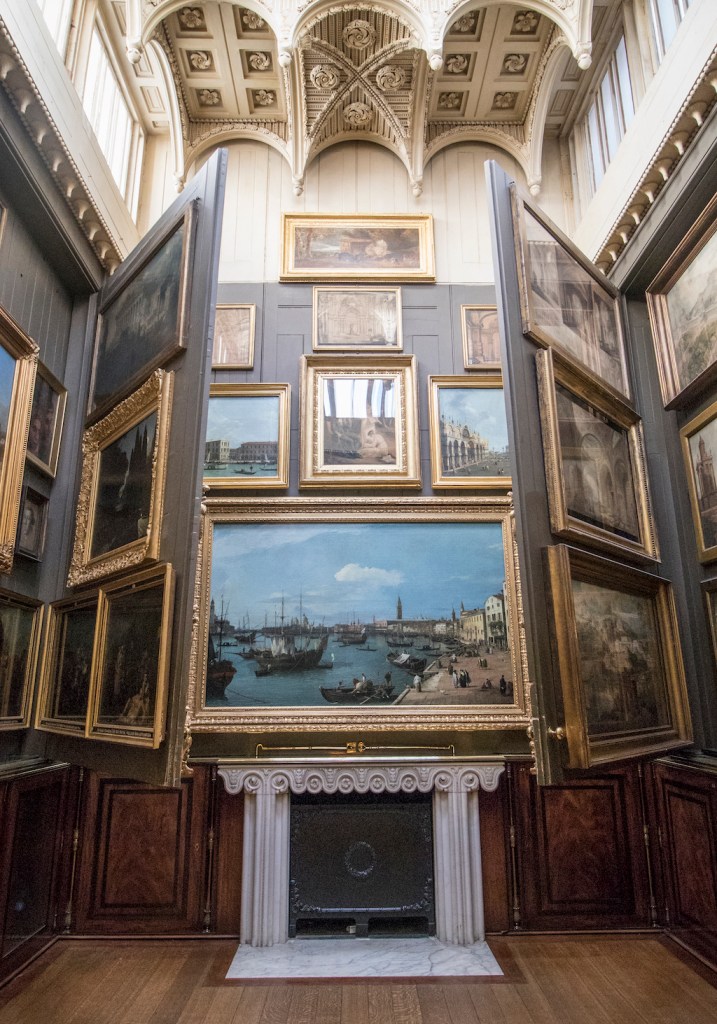
There is so much crammed in—every surface is covered—it is hard to take it all in. In the tiny Picture Room, more than 100 paintings and drawings cover every inch and with walls behind walls there are more paintings are hidden behind the first ones. There are masterpieces by Hogarth, Canaletto, and Turner; the latter two, Soane’s friends.
© Sir John Soane’s Museum, London
There are Greek vases, Chinese ceramics, Peruvian pottery, Roman bronzes from Pompeii, and stained glass from the fire-razed Palace of Westminster. The collection is not only eclectic but contains items considered to be some of the world’s greatest treasures. The sarcophagus of Pharaoh Seti I is one of the most important Egyptian antiquities ever discovered. Canaletto’s painting of the bell tower of St. Mark’s Square in Venice is considered one of his greatest works while Soane also acquired original architectural designs by Christopher Wren and a copy of Shakespeare’s First Folio. Every nook and cranny are rife with history.
It is like a fun house too. Once inside you immediately lose all sense of direction in a labyrinth of rooms. Varied ceilings heights, multi-level floors, and mirrors create the illusion of space in the narrow townhouses (there are 100 mirrors in the breakfast room alone). There are secret passageways. Shadowy corridors open up unexpectedly into light-filled rooms. Another of Canaletto’s painting is positioned to look like a view of the famous promenade of Venice out the window. The rooms themselves evoke a sense of time and place―from the Roman arches in the rich Pompeian-red dining room, to the Mediterranean sun-dappled Dome Area and Colonnade, to the eerie gothic-ness of the cryptlike Sepulchral Chamber. There is so much going on here, it would take days or weeks to explore it all. I leave feeling like I have barely scratched the surface.
Back at Holburn tube station, I take a circuitous route from Bank to Monument to Blackfriars station and ascend onto Fleet Street. My plan to eat at Ye Old Cheshire Cheese―a famous pub frequented by editors and reporters―is thwarted. Closed. I walk a little further to a pub aptly called the Wine Press. The small pub is housed in what used to be a wine press. I have an eggplant pizza.
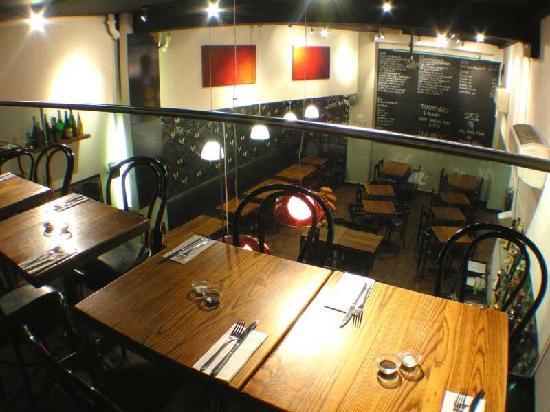
Photo courtesy of TripAdvisor
Fleet Street was traditionally the headquarters of most of England’s major newspapers thus the reference to the national press generally as “Fleet Street.” Whitehall refers to the British civil service and government, while Westminster means Parliament, all similar to how in the U.S. we use “Houston” to refer to NASA and the space program.
I pass the original Twinings tea store, the Royal Court of Justice, and Reuters. Behind Reuters is the Church of St. Bride’s, designed by Christopher Wren, and boasting Wren’s tallest spire. St. Bride’s tiered structure is said to have inspired the traditional wedding cake design.
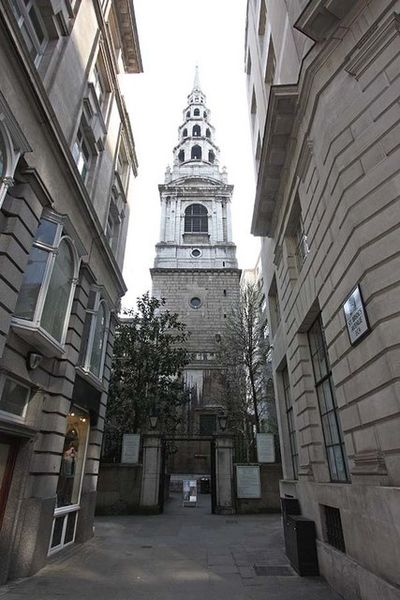
Photo by John Salmon, Wikimedia Commons
I duck through an alley to Gough Square where Dr. Samuel’s Johnson’s house is located. I couldn’t see his birth house in Lichfield, but I am in luck today, his London home is open.
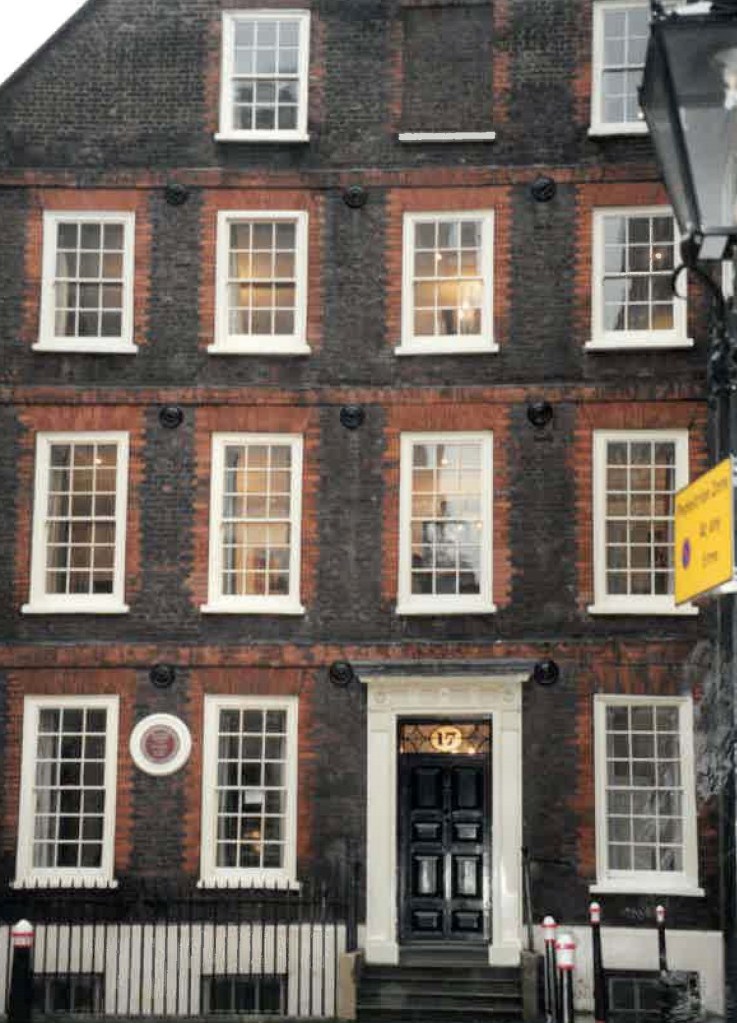
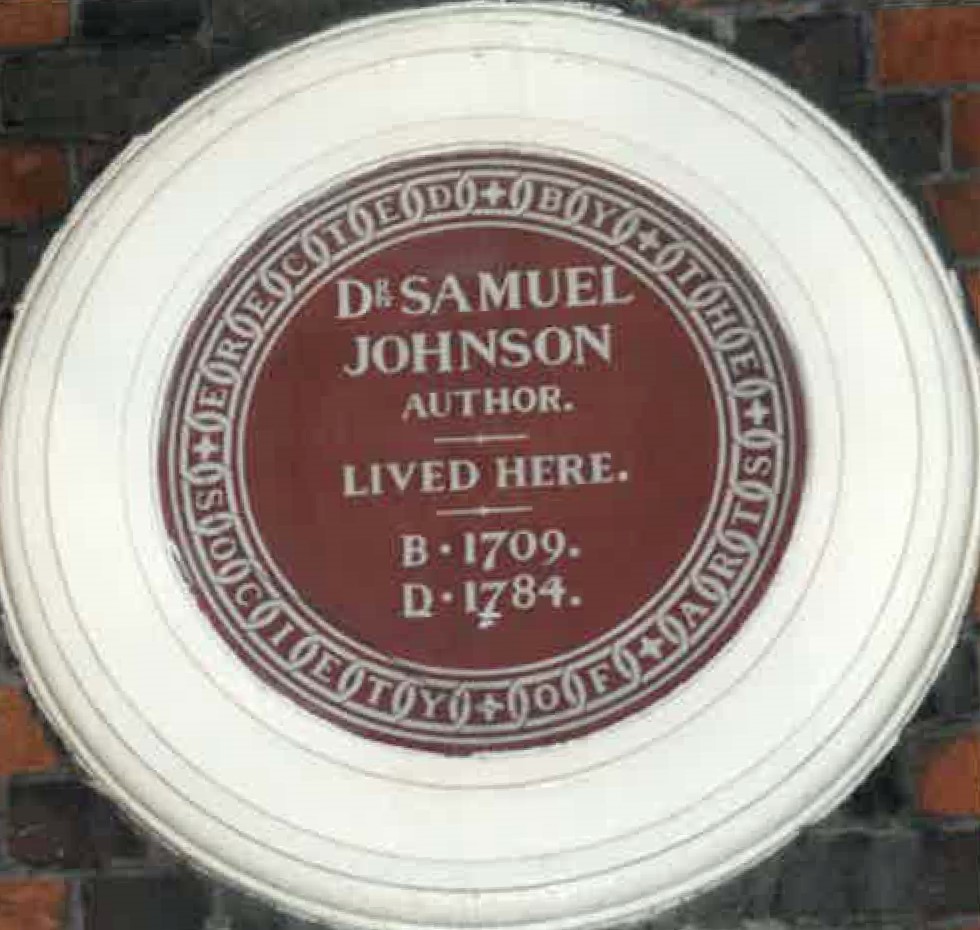
Dr. Johnson’s wit is on display. He wrote: “Wine makes a man better pleased with himself. I do not say it makes him more pleasing to others.”
A short film tells of Johnson’s friends among whom were the painter Joshua Reynolds, the actress Mrs. Siddons, and Flora MacDonald of Bonnie-Prince-Charlie-fame who he visited with his friend and biographer, James Boswell, on their well-documented travels through Scotland.
After a brief rest, I head out again to see a movie. I choose the delightful film, Anna and the King with Jodie Foster. Besides sharing her name, we are of a similar age and I feel like I have grown up with her from the time I saw her in early Disney’s films and in Paper Moon with Ryan O’Neal in the 1970s.
- In today’s news: Beatles George Harrison is in stable condition in the hospital after being stabbed by an intruder in his home. His wife heroically smashed the assailant over the head with a lamp and called the police.
Good for her.
 Jody’s UK Memories


