Today, my last day in the UK, I am on a walking tour of London’s affluent Mayfair district. It is not raining as we start out but, by the time we are half-way through the tour, it is pouring and the deluge continues for the rest of the day.
The tour, London Walks, starts out at Green Park tube station, near the Ritz Hotel. Green Park got its name because it is…well, green. Some say, Queen Henrietta had all the flowers removed when she saw King Charles II picking flowers in the park for his mistresses leaving just the green grass. Whether its King Charles’ dalliances or the lime that was spread on leper’s graves, it is green.
King Charles’ flower-picking escapades may also be the reason for the name for the next street we turn onto—Piccadilly—as in Pick-a-lily. But it is more likely that it was named for the ruffled lace collars that Queen Elizabeth I and her courtiers wore, known as picadillos, which merchants sold on this street.
Mayfair is so called because in the 1600s, it was the site of a fair, held in May.
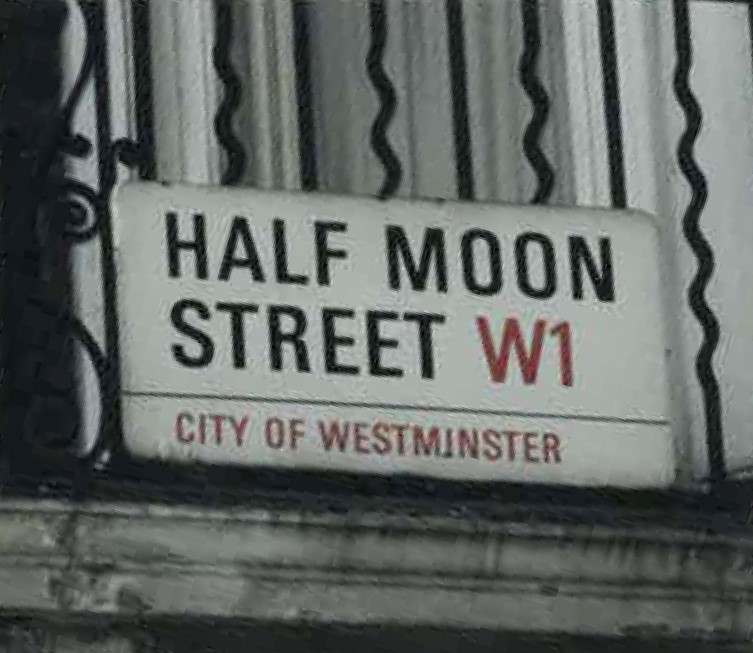
Many of the streets have been used in popular literature. One—Half Moon Street—is the address of Dorothy Sayers’ upper crust detective, Lord Peter Whimsey, not to mention the location of Algernon’s flat in Oscar Wilde’s The Importance of Being Earnest. While P.G. Wodehouse’s Bertie Wooster and his valet, Jeeves, live in a flat near Berkeley Square.
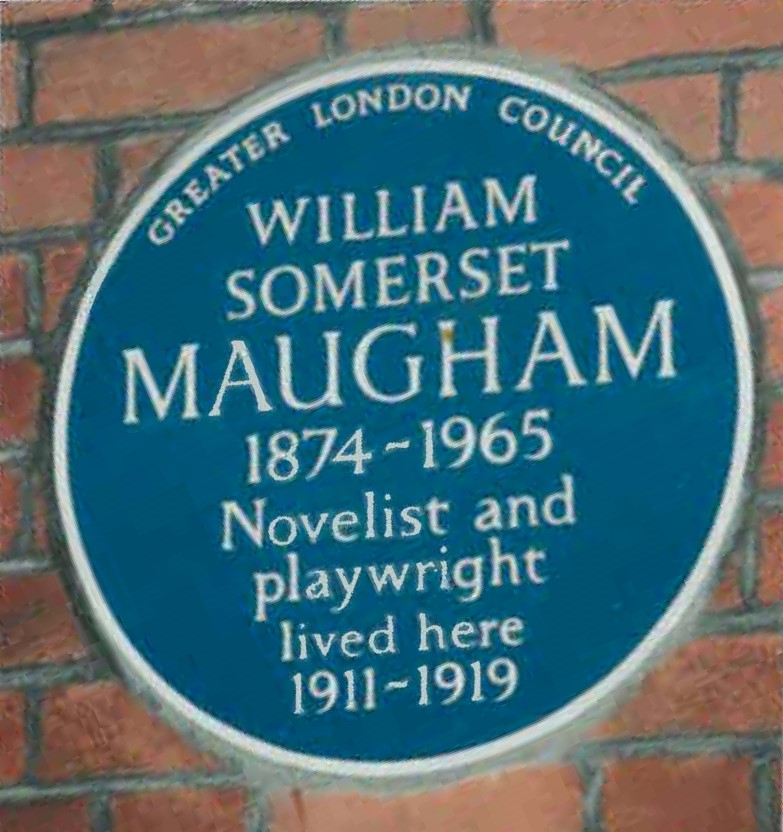
London’s recognizable blue plaques mark the residences of famous people and some of the ones we see include:
- Playwright Somerset Maugham (the Andrew Lloyd Webber of his day with multiple plays at a time running on the West End)
- King William IV (where he lived with his actress mistress, Mrs. Jordan, and their 10 children, before becoming king and dismissing her)
- Benjamin Disraeli (Conservative Prime Minister, 1874 – 1880)
- The composer Handel and Jimmy Hendrix (who both lived in the same house two centuries apart).
We walk from one posh square to another: from Green Park to Berkeley Square, to Grosvenor Square, to Hanover Square. In Grosvenor Square, home of the U.S. embassy, are statues of Eisenhower and FDR. The statue of FDR, erected at the end of World War II, was paid for by subscription by individual British people who contributed and raised enough money to build the statue in just four days. It shows in what high regard FDR was held by the people of war-torn London.
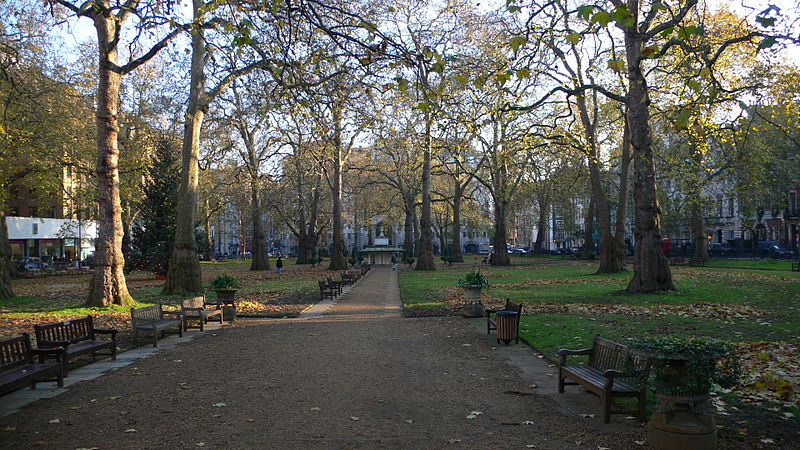
Photo: Wikimedia Commons
Bing Crosby sang of Berkeley Square:
That certain night The night we met There was magic abroad in the air There were angels dining at the Ritz And a nightingale sang in Berkeley square
Lyrics, A Nightingale Sang in Berkeley Square
We end our tour on Oxford Street, an upscale shopping district which I take advantage of.
My movie tonight—in Leicester Square—is The Clandestine Marriage, the movie that was filmed at the Stanton Manor House in the Cotswolds. I wanted to see the movie just to see the house and it is just as I remember it. The movie was fun too. It stars Nigel Hawthorne and Joan Collins.
I go back to my hotel to pack.
More Musings
It is my final day in London and my last day in Britain and I ponder what I have learned.
- I have learned that I can travel on my own in another country under sometimes strange conditions. I learned how to use public transportation to get to where I want to go, although I did not develop a sense of direction and, when faced with a choice of turning left or right, always picked the wrong way.
- That people in England are polite but not necessarily warm. People in Ireland and Scotland are genuinely warm and friendly.
- That, unexpectedly, I loved Scotland. I had always thought my heart would be in Ireland where my ancestors were; or England where I knew the history. But Scotland won my heart for its beauty, its independence of spirit, and generosity of heart.
- I learned that Paris is perhaps lovely in the springtime, but not when it rains and you are lost in the dark.
- That as much as things are different, they are the same. This is particularly true with my project. The UK is struggling with the same issues related to performance measurement as we are at home.
- I learned that Britain is modernizing and not perhaps for the good. Centuries-old traditions are being done away with at the stroke of a pen. As relieved as people were to see the Conservative government go, the Labor government is wreaking just as much havoc but in a different way.
- That Britain is civilized and refined and understated. Ostentatiousness doesn’t play here. That Americans are loud, annoying, and demanding. They expect everything to be the same as it is in the U.S. and are disgusted when it is not.
- That sometimes you just can’t get good customer service no matter how polite people are.
- I learn the 24-hour clock; the military system for telling time―and it may be a better system.
- It doesn’t matter if you wear jeans to the theater. Elgar’s Pomp and Circumstance march has words. They don’t sell Cool Britannia Ben and Jerry’s ice cream in Britain. The best fish for fish and chips is cod, not plaice.
- If you walk straight ahead with purpose, people will get out of your way and you won’t be constantly jostled, especially if you are carrying an open umbrella.
- That it is good to go home. But, that you can probably never go home. Frank told me, “You leave expecting things to be different. You go home thinking things will be the same. In either case, they won’t be.”
Am I ready to go home? Yes, it is time. I very much want to see family and friends.
 Jody’s UK Memories
