December 15, 1999 – Tower of London, Harrods, and Aldwych Theater

On our second day in London, Lisa and I are woken at 8:00 AM by the intercom in our room when a man announces that breakfast is being served. There is no phone in the room, only a speaker on the wall relaying messages and wake-up calls. It’s a strange system. The hotel apparently thinks everyone needs to know about breakfast whether they want to or not―our own, un-asked-for alarm clock. We drag ourselves out of bed and go down to breakfast. Lisa experiences her first English breakfast. I am tired of eggs and flabby bacon and choose the Wheatabix this morning, which is quite good—until it gets too soggy, then it is like mush.

We are off to the Tower of London this morning, but first stop at Victoria station to buy our travel cards, which give us unlimited use of the underground for seven days. After waiting in the ticket line for 15 minutes, the agent tells we need a passport-sized photo. So we go to a nearby photo booth. It is a pain to work and requires £3.00 each in exact change, which we cobbled together between the two of us. We waste an hour getting all of this done. But it is worth it; we use the tube for three return trips in one day, which pays for half the week-long travel card.

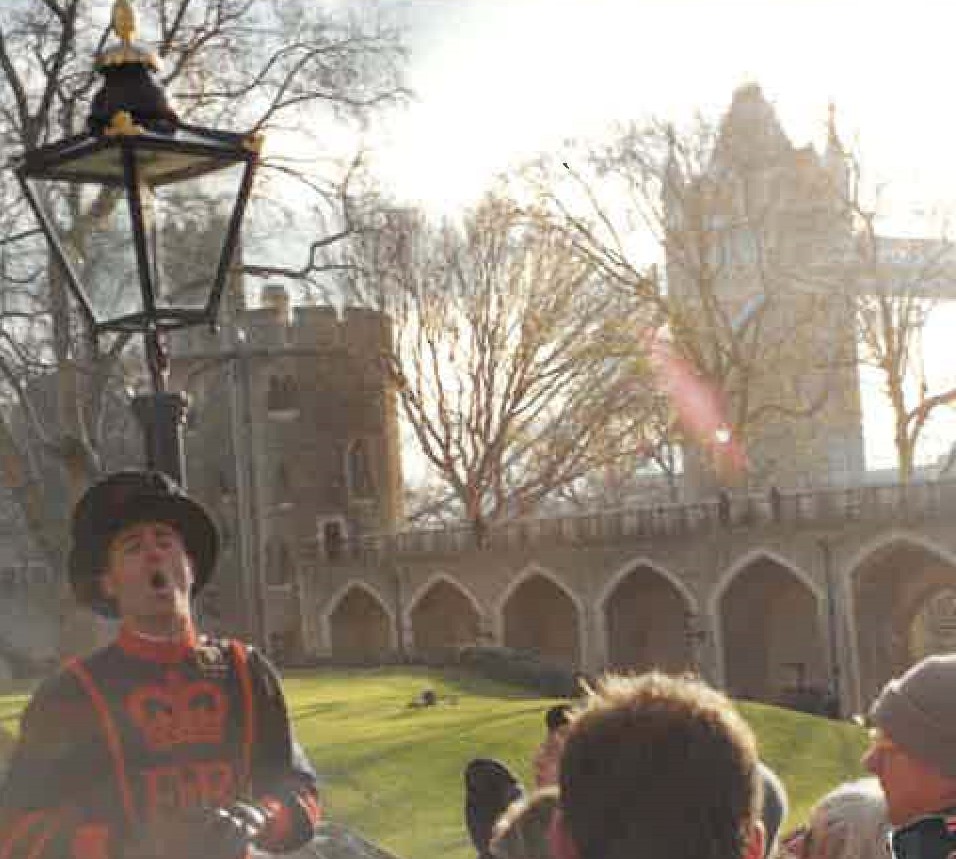
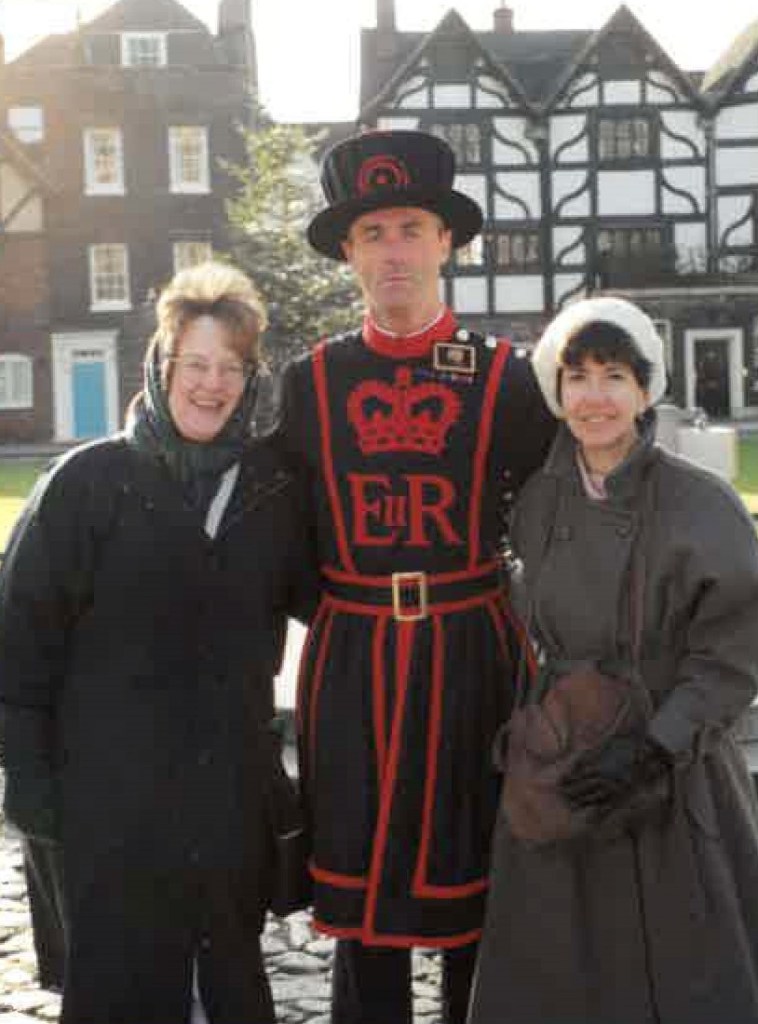
We finally get to the Tower of London. Our Yeoman Warder tour guide is a Scotsman and he is wonderfully animated, as I have found they all are. He tells us the gory details of the Tower’s history and shows us the spot where Royal executioners beheaded Anne Boleyn. Lisa says the Tower makes English history come alive.
Even though I have seen them before, I still can’t help but be overwhelmed by the Crown Jewels. They are stunning as light glints off the brilliant diamond-, ruby-, and sapphire-encrusted gold crowns and coronation regalia. There are dozens of crowns and tiaras with tens of thousands of precious gems.  A conveyor carries us along to keep the crowds moving.

One of the crowns―the Imperial Crown―is the Crown of State that the Queen wears for state openings of Parliament. It contains 2,901 gems including a 170-carat, irregular-shaped ruby that dates back to the middle of the 14th century.
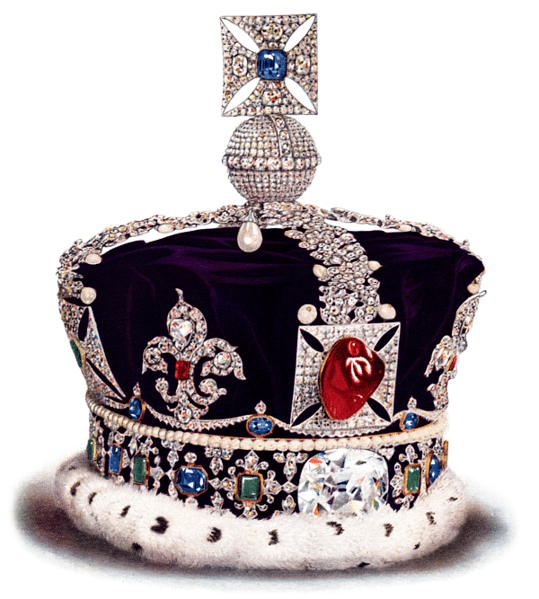
Imperial State Crown

Lisa is surprisingly well up on her British monarchs, but she doesn’t get the part about the monarch being crowned Emperor(ess) of India. I tell her nobody does.

In addition, there is a brilliant collection of gold plates and cups and the exhibit contains a stunning gold punch bowl shaped like a seashell. Over a quarter of a ton of silver with gold gilt, it can hold 144 bottles of wine on ice. There is so much gold in the display case, it is hard to take it all in.

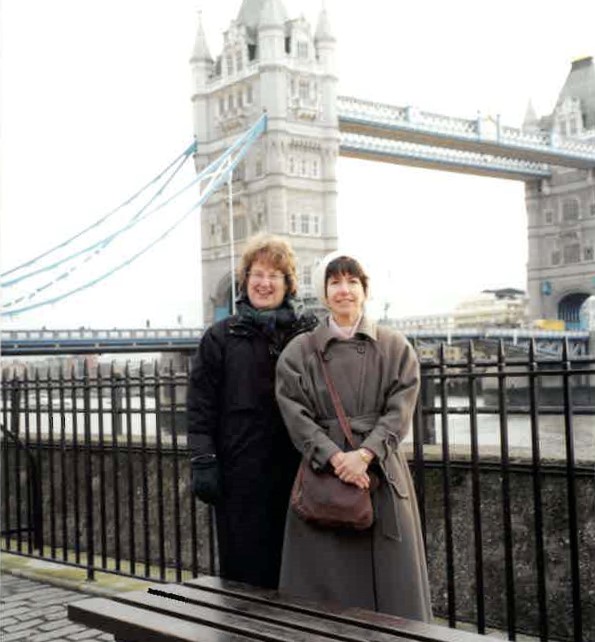
We walk along the banks of the Thames and take pictures of Tower Bridge before taking the tube, once again, to Leicester Square where we are able to get half-price tickets for Andrew Lloyd Webber’s new musical—Whistle Down the Wind. We go into a little Middle Eastern deli for lunch. Lisa has lamb kabobs and I have falafel. It is delicious.
After lunch, we go to Harrods, which Lisa thinks is truly amazing, with over 300 departments taking up five acres. I keep telling Lisa their catchphrase, “If you can’t find it at Harrods, you don’t need it.” We are, however, unable to find pancake mix to go with the maple syrup I have for Tony for Christmas. I get him some Duchy of Cornwall marmalade and tea.

The Harrods Food Halls are amazing. The four Edwardian halls―where the staff dress in period costume―are beautifully decorated with painted tiles and chandeliers. There are shops and display cases of every type of food you can imagine―a butcher, fish monger, and florist; a cheese shop, French patisserie, wine shops, bakeries, and dozens of restaurants. One whole hall is dedicated to tea, coffee, and chocolate. The halls are famous for stocking both local and exotic foods. We see Devon crab, Jersey Royal potatoes, artichokes from France, New Zealand honey, Italian olives, English cheddars, Stiltons, and ports, and, of course, venison from Oxford.

Lisa wants to see Mohamed Al-Fayed’s memorial fountain to Diana and Dodi. Dodi Fayed, the Harrod owner’s son, was killed in the same crash as Diana. We find it at the bottom of the escalator. It is a tacky display of a wine glass said to be from their last dinner and a supposed engagement ring in a plexi-glass pyramid-shaped case. Their oval photos are awful, one of Diana with her chin resting on her hands, which is a lovely photo for a magazine cover, but not for a memorial. Dodi’s photo looks like a candid snapshot, off-center and with tousled hair. The whole thing is horrid. I toss in a penny, but I refuse to read the tribute.

The escalator however is impressive. Sitting between the stairs is a gold, two-story-high sphinx with the face of the boy King Tut. As we descend, the walls and ceilings are all decorated with Egyptian motives—a proud testament to Mr. Fayed’s heritage.
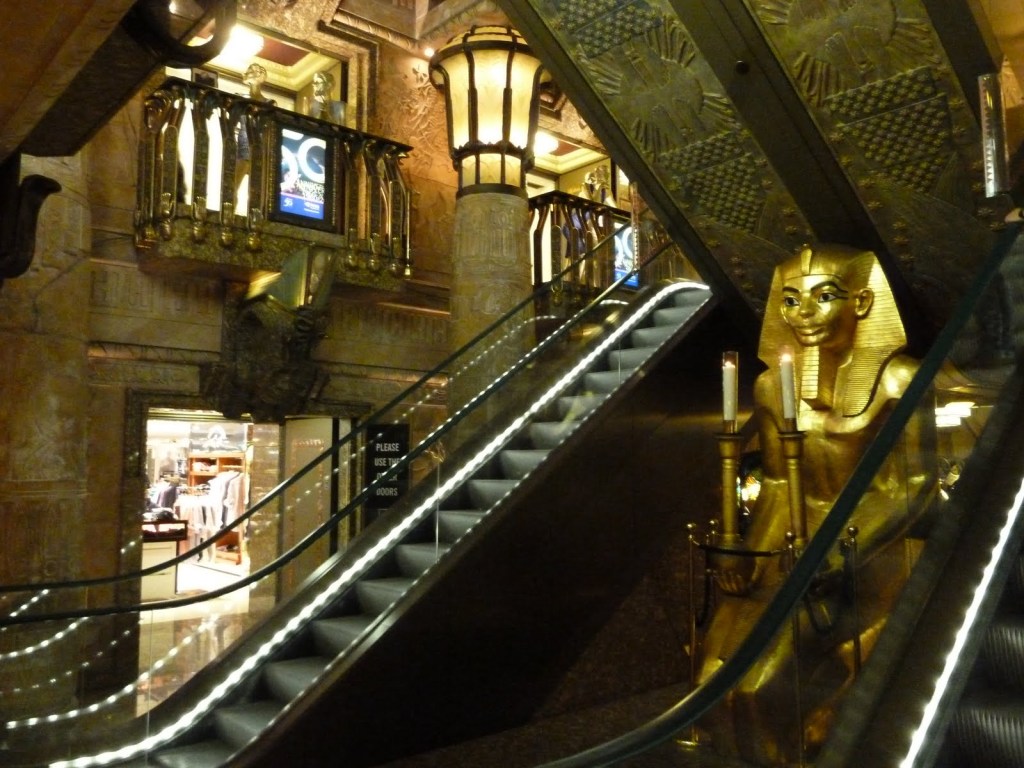
Harrods Egyptian Elevator
Photo: D Sheppard

We take the tube to Temple station on the Circle and District line and walk up the Strand, cross over Aldwich, and down to the theater. There are a lot of embassies in this area―Australia House, India House―and the Bush Building, BBC’s home. The Aldwich Theater is an older one. We are in the second row.

I am not too sure about this show. It is not one of Andrew Lloyd Webber’s biggest hits. It starts out with an announcement of the understudy playing the lead role. But he is excellent (his West End debut). The story takes place in the Bible Belt of Louisiana where three children find an escaped felon hiding in their barn and they think he is Jesus. It is a powerful story and the music is great. In the end we both enjoy it.
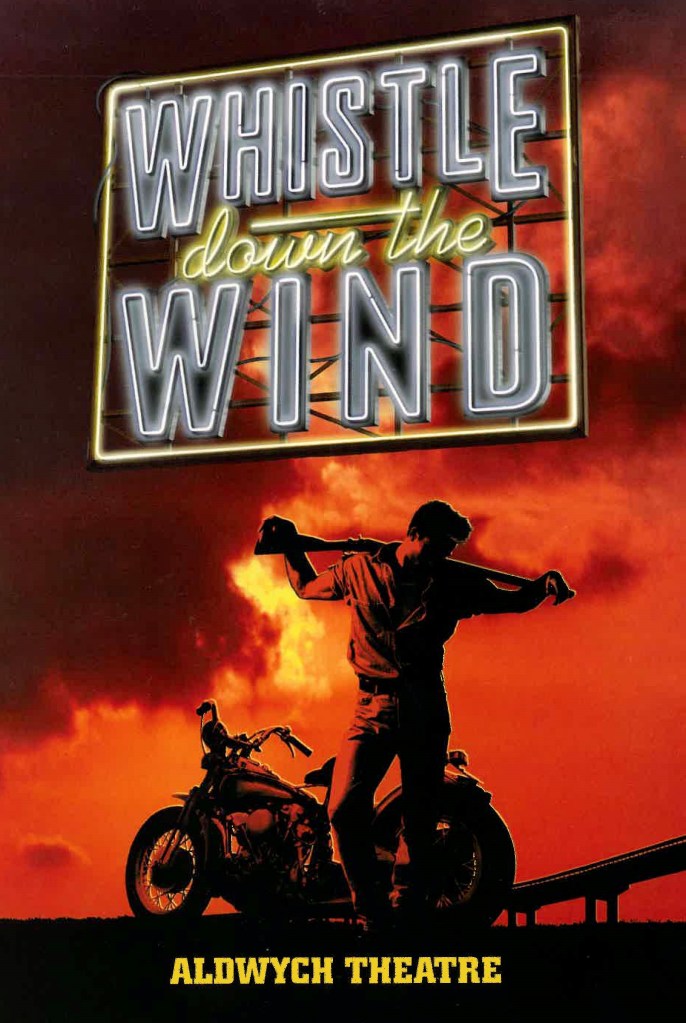
My theater program

The staging is amazing. Brian would love it. There are actually two stages, one above the other, that are raised and lowered by hydraulics so there can be two scenes going on at the same time. The set designer effectively uses them for contrast. The barn scene is played on the lower level with the innocent, trusting children singing with the person they think is the son of God. At the same time, on the upper level, is the angry, gun-carrying mob of townspeople on a manhunt. In one heart-stopping scene, a monster-sized steam train comes raging from the back of the stage blowing its horn like it is going to run over the play’s heroine and plunge straight into the audience. Of course, it doesn’t, but everyone screams.

We have dinner at an Italian restaurant on the Strand. I have mushroom risotto and Lisa has spinach raviolis in a cream sauce.

The internet café next to Victoria station is free after midnight, so we wait seven minutes before logging on. Lisa has a dozen emails to send and it is close to 1:00 AM before we leave. When we get back to the hotel, it is locked up for the night. There are handwritten instructions tacked to the front door about how to get in the back door—which seems to me to defeat the purpose of locking up in the first place.
December 14, 1999 – Lisa Arrives in London and We See Prince Andrew

Today, I am to meet Lisa at Victoria station where she will come in from Gatwick. I slept fitfully; waking at 6:00 AM, then again at 6:30. I finally get up at 7:20 and go down to breakfast. I am uncertain what time Lisa will arrive. Her flight lands at 7:50, but by the time she goes through customs, gets her luggage, finds the train, and gets into Victoria, I think it can’t be before 10:00 AM. But as I walk into the station just after 9:00 AM, she is already there waiting. We hug. I am so excited that she is here.

We walk back to the hotel. Lisa unpacks and gets settled in, and then we are off on our London adventure.

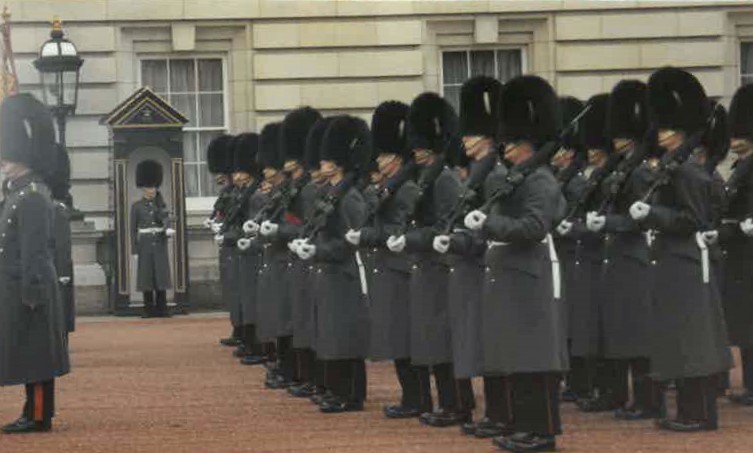
First up is Buckingham Palace, not far from Victoria station, for the Changing of the Guard. It is a small crowd today. We have a great spot at the main gate with only a few other tourists in front of us. The new regiment of the Queen’s guard relieves the old. They go through the ceremony with much ritual. We watch for about 40 minutes. When the Queen’s band strikes up music from A Chorus Line, Lisa and I look at each in amazement. We can’t believe the Queen knows about this! Her standard is flying this morning, so she must have arrived back in London last night. It is quite cold and we leave before the band finishes.

Changing of the Guard, Buckingham Palace
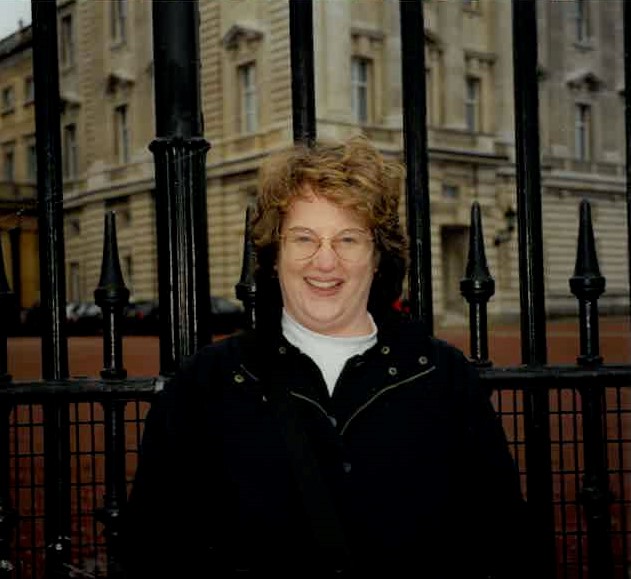
Jody, in front of Buckingham Palace

We next walk to Westminster Abbey where a lovely choir is singing. We look at the tombs of kings and queens—Queen Elizabeth I, Mary Queen of Scots, Henry VII—and poets and novelists—Chaucer, Byron, Dickens, Austen.

Some of the tombs are quite elaborate—especially those for Royalty—marble pillars support massive arched, stone canopies that cover carved effigies of the monarchs with black iron ornamental railings enclosing them. I am surprised that Mary Queen of Scots’ tomb is grander and more ornate than that of Queen Elizabeth I until I read that King James I erected them both. Although he was Elizabeth’s heir, Mary was his mother. Deadly rivals in life, Elizabeth and Mary now rest near to each other for eternity.

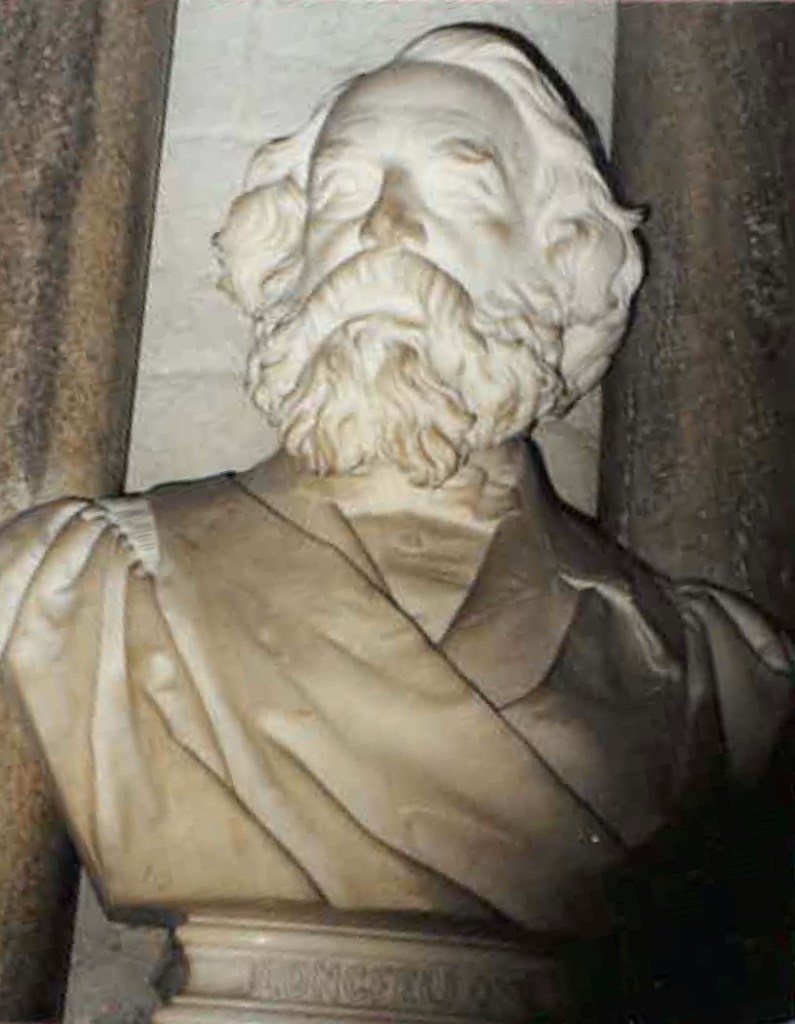
Lisa tells me that Longfellow is buried here, which I did not know. I ask a group of guides where he is. “Who?” Two of them have never heard of him, but the third says, “Yes, he is buried here.” He looks up the Maine poet’s location in a big reference book only to discover that Longfellow is actually buried in Cambridge MA. But there is a memorial statue of him here at Westminster.

Longfellow bust at Westminster Abbey

The engraved commemoration at the base of Longfellow’s statue says, “This bust was placed amongst the memorials of the poets of England by the English admirers of the American poet.” Apparently, the British loved Longfellow; in his day, he was second only to Tennyson in popularity. The guide takes us to his memorial—a white marble bust with his handsome beard—and kindly asks if we want a picture, even though photography is not allowed.

Lisa loves Westminster Abbey. She’s says it is very gothic and impressive.

As we walk towards Whitehall Street, I tell Lisa to prepare herself for a spectacular view—Big Ben and the Houses of Parliament light up the night and reflect a warm, watery glow on the Thames like a Monet painting. I never get tired of this view! Tonight, there is a lighted Christmas tree in front of Big Ben.

Lisa says out of the blue, “Let’s go to Chinatown for dinner.” We take the tube to Leicester Square, and just one block away from the theater district, we stroll into the maze of exotic shops and restaurants. It is fun. I have not been here before. We go into the Chinese specialty food stores and look at all the unusual products; like whole dried ducks on a stick. At random, we pick one of the many Chinese restaurants lining the streets—Kowloon—and have a tasty noodle dish and a chicken and mushroom one.

After dinner, walking back to Leicester Square, I notice a large black Rolls Royce with the Queen’s standard on top. It is a Royal car! It is parked in front of the Warner Brothers Theater where a sign announces the charity premiere of “The Iron Man” attended by HRH Duke of York. We wait for more than hour for him to come out.

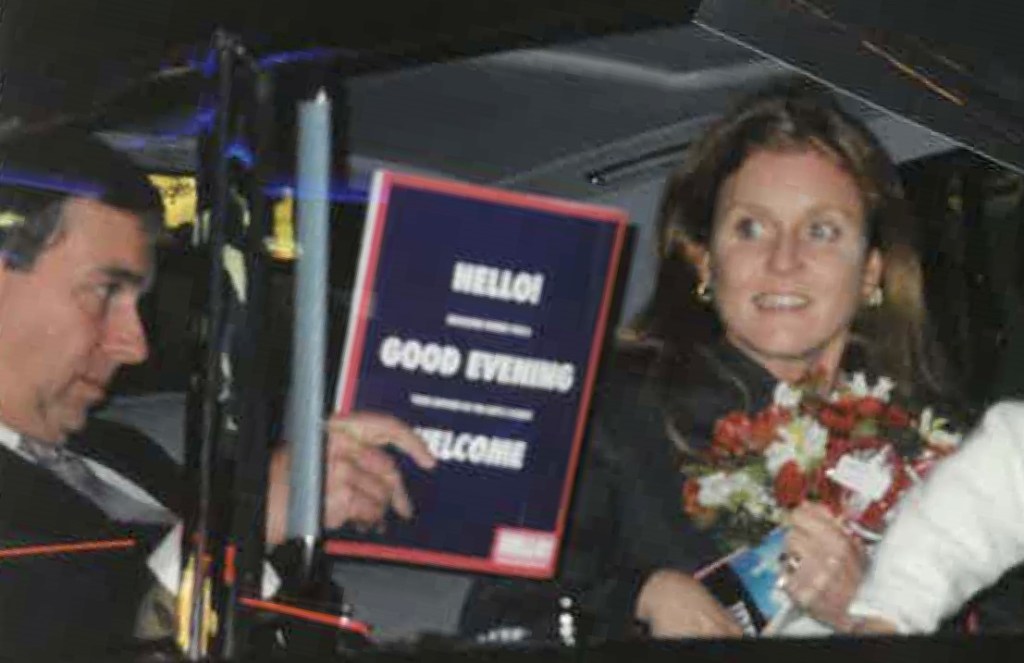
Suddenly, from what seems like nowhere, the paparazzi appear and the Rolls pulls right up to the curb in front of the theater about five feet from where we stand. Prince Andrew emerges from the theater followed by his young daughters, Beatrice and Eugenie, and behind them, Sarah, their mother.

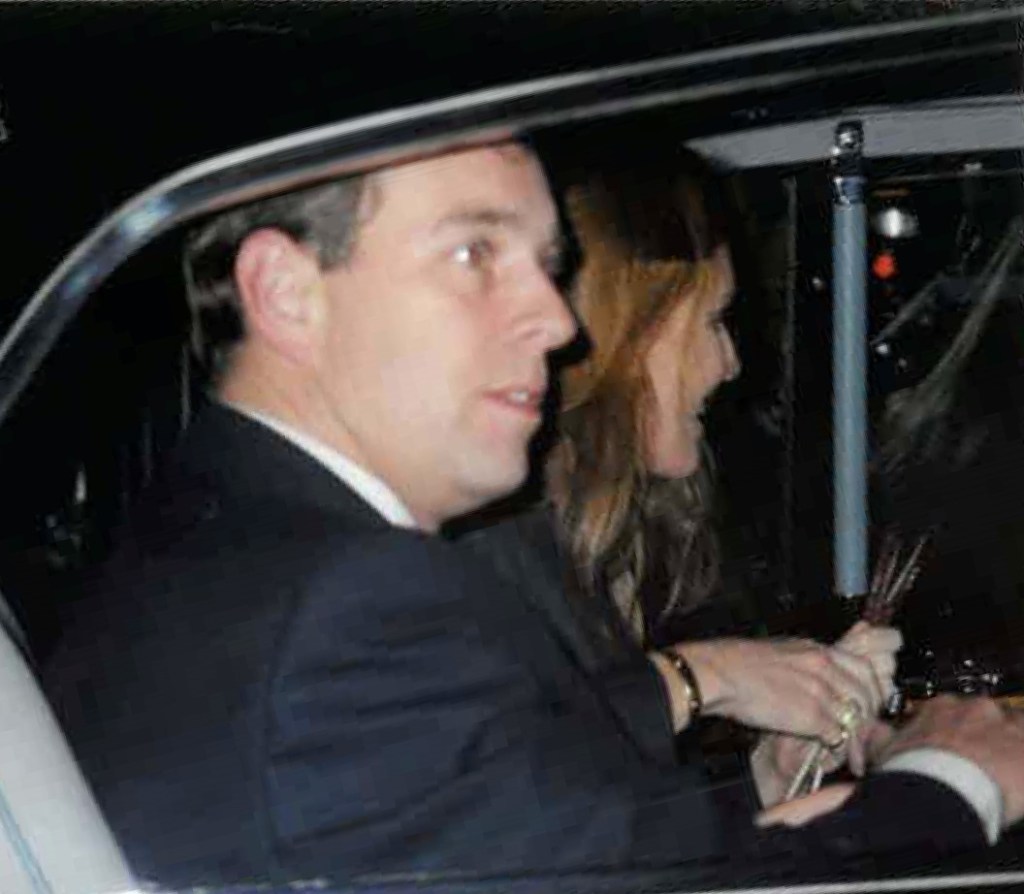
Everything becomes animated all at once as the photographers jostle for better angles and call out the children’s names to try and get them to look up. I am right in the mix. First Andrew, then the others climb into the car on the opposite side from me and, as they slide over on the seats in my direction, I snap pictures of them through the backseat windows. I snap off about seven pictures in about 45 seconds without taking time to frame them. I hope they come out. And then, the car glides away and the photographers melt into the side streets and it is as if nothing had happened. The street is quiet once again with a few tourists and late-night night diners.

Prince Andrew and Sarah, Duchess of York
Prince Andrew

I am thrilled. Even Lisa is excited. It is very cool.

Lisa is still going strong—seemingly not jetlagged at all. Just outside of Victoria station we find an internet café and Lisa sends some emails. A man, seeing how fast Lisa types, asks her to type and send a letter for him and she agrees. It is a letter to the Canadian Counsel about his being deported. He is denying charges that he abused his wife and is asking to see his kids. Lisa, a lawyer, can actually help him and she handles him like a pro. It takes nearly an hour. We finally walk back to our room. Lisa, still not tired, takes a shower and we write in our journals. It is midnight before we turn off the light.

December 13, 1999 – The British Library and London’s Magical Christmas Lights

It snowed in Birmingham today. While waiting for my bus to London, I see it start to gently fall in soft, wet flakes. Later, on the bus traveling south, the wet snow sticks to everything. It looks like the snow in my Christmas postcard.

The taxi dispatcher isn’t quite sure what I am talking about when I call for a ride to Birmingham’s Digby bus station. “Do you mean the “coach” station?” she asks.   

The bus station is not really a station. It looks like a big garage; open to the air on both ends where the buses enter and exit. The buses unload passengers at bays lettered A-M. It is cold and damp and the snow delays the London bus. Visibility looks bad as we get on the highway; the speed limit signs blink 30 kph. I sleep and doze most of the way. After one stop at Golding Green station, we arrive at Victoria station a little before 4:00 PM. A porter helps me with my luggage and I get a taxi to the BC offices. The taxi waits while I take two bags in. The BC staff assures me they will be open on January 4 so I can pick them up again before heading to the airport.

When we drive by Buckingham Palace, the taxi driver tells me that because it is the Union Jack flying over the palace, not the Queen’s standard, the Queen is not in residence. I know that traditionally no flag flies when the Queen is away. But he says all that changed after Princess Diana’s death and the furor over the flag.

At the Winchester Hotel on Belgrave Road near Victoria Station, I am not sure what to expect because when I called to reserve a room last week, the proprietor was quite rude. But a friendly Irishman checks me in. But then a scruffy, curmudgeonly man comes to get luggage my and I know he is the grumpy fellow who took my reservation. He grabs my bag and tells the Irish receptionist to carry my box. I say, “No, it’s not that heavy, I can get it.” He says, “You’re right, I wouldn’t trust the looks of him either.” To which I reply honestly, “Actually, he looks more trustworthy than you!” I think I get a grudging smirk.

After a rest and change of clothing, I make my way to the British Library where the Harkness Fellows, a health care policy fellowship program, have graciously invited the Atlantic Fellows to their Christmas party.

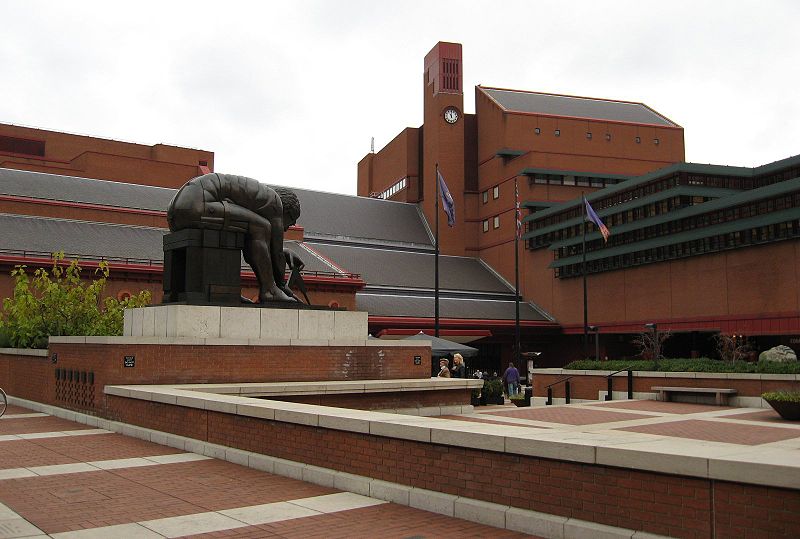
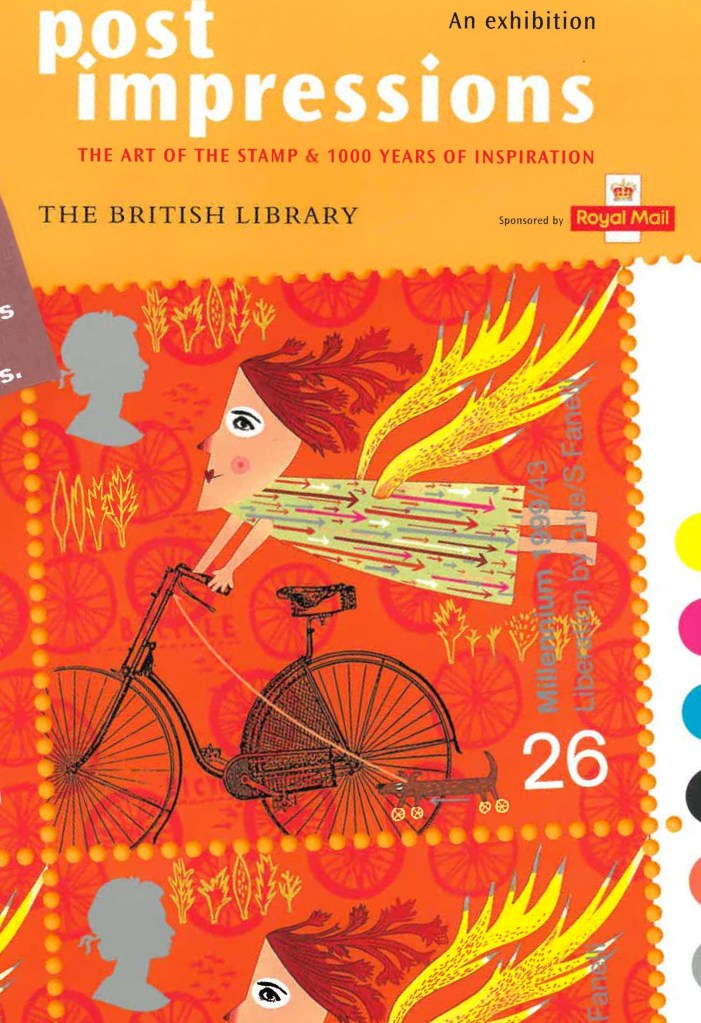
The British Library’s massive building is located on Euston Street. The party is in the Pearson Gallery where there is currently an exhibit on British postage stamps. The library’s philatelic collection comprises eighty million stamps.

British Library with statue of Isaac Newton in the courtyard

I run into Andy and Rebecca and Dean as I walk in. We make our way to the Pearson Gallery where William Plowden greets us and gets us some wine. A very attentive waiter never lets my wineglass get more than half empty. Only white wine is being served because, William tells us, red wine, if spilled, would stain the costly marble floor. There are 50-60 people there. Frank and Carolyn are there. Stacy and Matthew arrive a few minutes later with Stacy’s mom. Stacy is planning a going-away dinner for me on December 29 when I am in London. That is so nice of her.

The British Library is the depository for all of Britain’s recorded history. Among its countless treasures are: The first Gutenberg bible, Chaucer’s Canterbury Tales, Magna Carta (two copies), Leonardo da Vinci’s notebook, Shakespeare’s First Folio, explorers’ original map of New Amsterdam in the New World, Captain Cook’s journal, Charles Darwin’s natural selection letter, Jane Austen’s Jane Eyre manuscript, Handel’s musical score for the Messiah, oral histories of Jewish survivors of the Holocaust, a recording of Gandhi’s Spiritual Message to the World, and sheet music from the Beatles. I know the Library of Congress has a similar astounding collection and it boggles the mind to think of all these important works assembled in one place. I am happy they are preserved. At the party, of course, we don’t get to see any of these things, except the stamps. I must come back here if only to see the Magna Carta.
When I traveled to London for my senior class trip, I desperately wanted to see the Magna Carta. I dragged my travel companion, a high school friend, Donna Bennett, to the British Museum. We moved quickly past the Rosetta Stone, the Elgin Marbles, the Egyptian mummies, directly to the case that contained the Magna Carta. Only when we got there, there was a little sign in the place where the transformational historical document should have been saying the Magna Carta was on loan to the U.S. as part of a traveling exhibit celebrating our nation’s bicentennial.

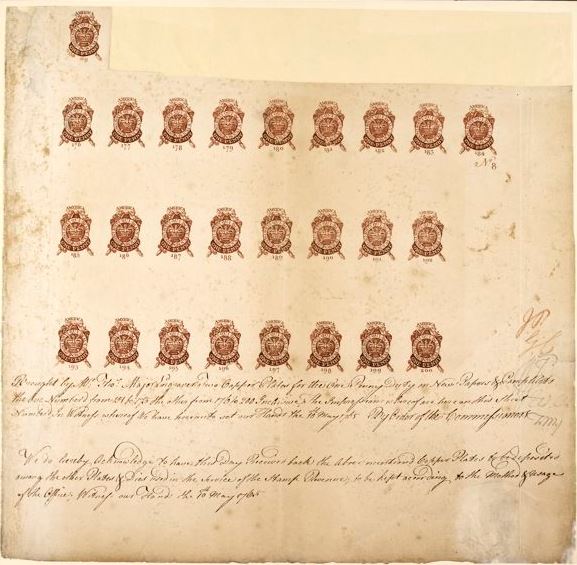
Tax stamps issued for the 1765 Stamp Act that led to the American War for Independence
Photo: The British Library

There are a few speeches and toasts and enough canapés that I don’t need dinner.

I take a taxi back to my hotel. The city is brilliant—all lit up with twinkling Christmas lights. I am mesmerized as my taxi hurdles down Piccadilly and rounds Wellington Arch in front of Buckingham Palace and onto Grovesnor Place.  It is magical.
The Christmas lights in London are elaborate with over-sized decorations—angels, stars, snowflakes, even peacock feathers—looping across the streets overhead and millions of lights draping trees, buildings, and lamp posts. The best-known lights are on Oxford and Regent streets, chic shopping areas, where there are splashy events with celebrities turning on the lights in mid-November.

December 9-12, 1999 – I Finish My Fellowship Paper

Thursday, December 9, 1999

The head of the British Council, Paul Faircloth, emails me and asks me to write a two-page summary for the Foreign Office about my paper’s application in the U.S. It is easy enough to write, but I wish I had known about it sooner. Hopefully, I can get it done tomorrow as I leave for London on Monday.

I attend my last Thursday lecture. A woman from the London Borough of Merton speaks on…what else? Best Value; a practitioner’s perspective. I skip going to the pub and work my paper! I work until 11:00 PM.

  • In today’s news: The French government has enraged ministers and farmers in Britain by ruling that a ban on the import of British beef is to stay in force, flouting an EU ruling. The crisis, which has united British farmers, consumers, and politicians in anger, has dragged on for nearly five months. Tony Blair has condemned France as “completely and totally wrong” for refusing to lift the ban on British beef. Mr. Blair said France would “suffer the consequences” of its decision. “British beef is as safe as beef from anywhere else in Europe. That is not just my view, that is the unanimous view of the EU’’s senior scientific advisors,” he concluded.

Tony said to me this morning, “We are at war with France.” He has not bought any French products since this whole thing started this summer. He said when I go to Paris, I should ask for British beef.

Friday, December 10, 1999

I spend the day writing my piece for the foreign office and working on my footnotes. The footnotes are taking more time than the writing.

I have dinner with Saroj at a Tandoori restaurant in Hall Green. Saroj explains that traditional Tandoori is done in Indian clay pots. The pots are always hot and you continually add whatever meat or vegetables you have with spices. For the Naan, which you use to scoop up the food in the place of utensils, the cook rolls out the dough and sticks it to the outside of the pot, which is so hot the bread cooks very quickly.

Saroj who is from Scotland (she is second generation British) tells me the real way to make shortbread. Take a pound of butter, not cut up. Pile your flour/sugar mixture beside the butter. Slowly and gently work the whole pound of butter into the flour. She says it will melt in your mouth. Of course, too, she says, “It’s very fattening.” I need to check this out with Aunt Liz who was born in Scotland and makes shortbread from a traditional recipe.

We have a wonderful meal. Saroj orders for us. The Butter Chicken Tikki and a spinach and cheese Balti dish are delicious. But I adore the Prawn Puri—so many spices and flavors―not hot. I have never had anything like it, and I won’t again until a trip to Ireland many years later. It is not anything I can find in Indian restaurants in the U.S. or at least not in Maine. Saroj brings me home and I bid her farewell. I wish I could have gotten to know her better. She is a lovely person.

Tony is out with Lutchford when I come in and we chat. He tells me about one very demanding guest. Tony said he wouldn’t have him again. When the guy called again later and asked to book a room, Tony said, “Sorry we’re full.” They guy said, “But I haven’t told you the dates yet.” Tony says, “Yes, I know and we’re still full.” He laughs and says he enjoyed that. But he says most people are very nice and, then, “There are a very small few who are like you— ‘lovely.

I am truly lucky to have found this family.

Saturday, December 11, 1999

I finish writing the two-page summary for the foreign office and do another edit of the research paper. I have lunch with Tony who gives me some vegetable soup to go with my prawn sandwich.

About 7:00 PM, I take my computer downstairs to the breakfast room. Caroline heats my cheese and onion pasty, which I eat with my salad. I eat and work on my footnotes and watch Jonathan Creek.

  • In today’s news: George Mitchell has been nominated for the Nobel Peace Prize. The news says the Irish and the English welcomed the nomination.

I am proud to be from Maine.

Sunday, December 12, 1999

I spend one last day polishing the executive summary of my paper and drafting emails to send to it everyone tomorrow and I am done my fellowship project!

Here’s a bit of my introduction:

Like most governments today, the state of Maine is struggling with new demands placed upon it by its citizens. Taxpayers want a government that is modern, responsive, and cost-effective. In a world of 24-hour-services, next-day delivery of mail, and a vast internet marketplace at one’s fingertips, government seems inaccessible, slow, and outdated. Yet, we cannot abandon these seemingly bureaucratic institutions. They play a vital role in protecting our people and our public assets.

Government is not a business. Democratic decisions take time. The money government spends is not its own. The services it provides help the most vulnerable of our society. Government cannot change its strategic direction at a stroke; it cannot make spending decisions on a word from the CEO; and it cannot rely solely on the “bottom line” as its measure of success.

Government provides intangible services that would be considered an unacceptable drain on private-sector productivity. Yet, no one can doubt their value. Consider the dustman who picks up bins day-in and day-out. And for those residents he knows to be infirm, the observant worker will check to make sure the occupant is not ill or incapacitated on a day when a bin is not in its regular place on the curb. We have to ask ourselves, “How can we capture a government’s full value in assessing the efficiency and effectiveness of public services?”

We cannot run our governments like a business. We cannot provide services that always make commercial sense. But we can use modern business practices to better satisfy a sophisticated and ever-changing set of public expectations. Performance measurement is a tool to help inform government decision-making. However, the process of measuring government efficiency and effectiveness is more than identifying sterile measures, interpreting raw data, or judging the success or failure of a program. It is, most importantly, a process where we learn by asking questions about the data, where we make incremental improvements, and where we tell our citizens what we are doing so that they can determine for themselves whether they are getting value for their money.

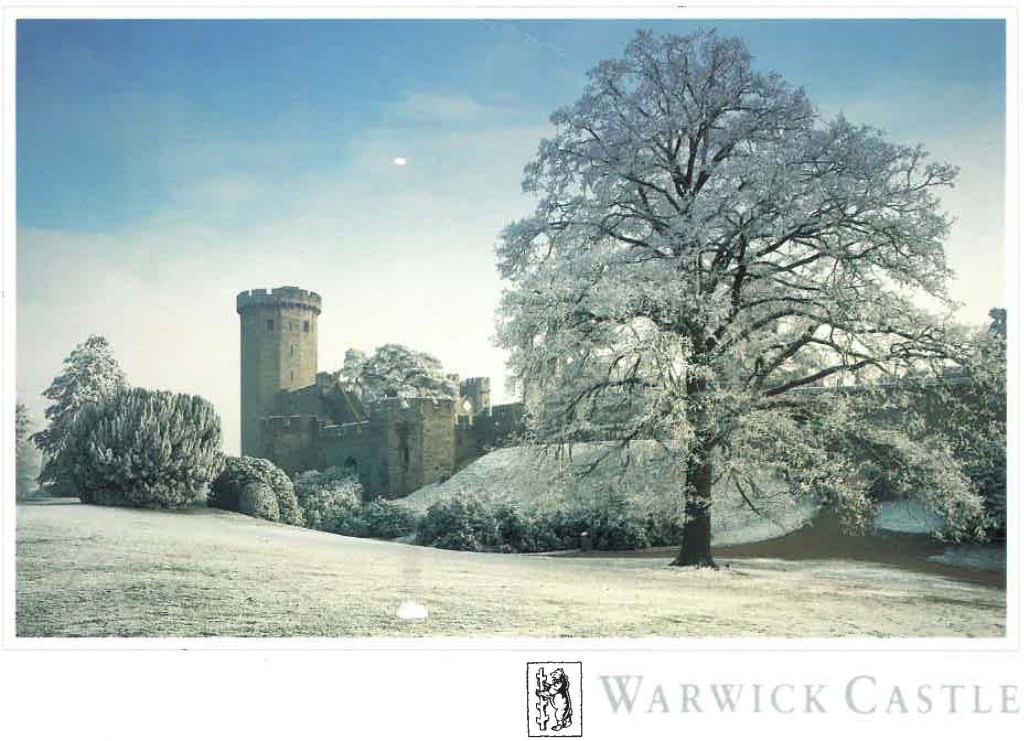
As I write out my Christmas cards—a postcard with a snowy winter scene of Warwick Castle—and box up gifts to ship home, Caroline decorates and puts up her Christmas tree. She comes into my room looking for candles that are stored in the closets here.

My Christmas Card

My friend Lisa is scheduled to arrive on Tuesday morning and we will spend a week touring London and Paris. I email her to confirm her arrival time and finish making my hotel arrangements. Here is my travel/accommodation schedule for the rest of the year:

  • Dec 13-17 – Winchester Hotel, 17 Belgrave Road, London, near Victoria station
  • Dec 18-21 – Louis 2nd Hotel, Saint-Germain-des-Près district, Paris
  • Dec 21-22 – Winchester Hotel – Lisa departs
  • Dec 23-27 – Christmas at Glenelg
  • Dec 27-Jan 4 – Millennium New Year in London – Dean’s Court Hotel, London, Bayswater

December 5-8, 1999 – The Public Art of Birmingham

Sunday, December 5, 1999

Caroline joins me for breakfast. Tony has a cold so she prepares my grapefruit and toast and coffee this morning. I accompany her on Lutchford’s walk and while we meander around Selly Park she tells me all the gossip of the people in the neighborhood.

I attend a Christmas craft show with Barbara in Edgbaston then Barbara drops me at the bus station and I take the bus to city center to do some shopping. The driver is new and doesn’t know the route. He asks his passengers to tell him where to stop.

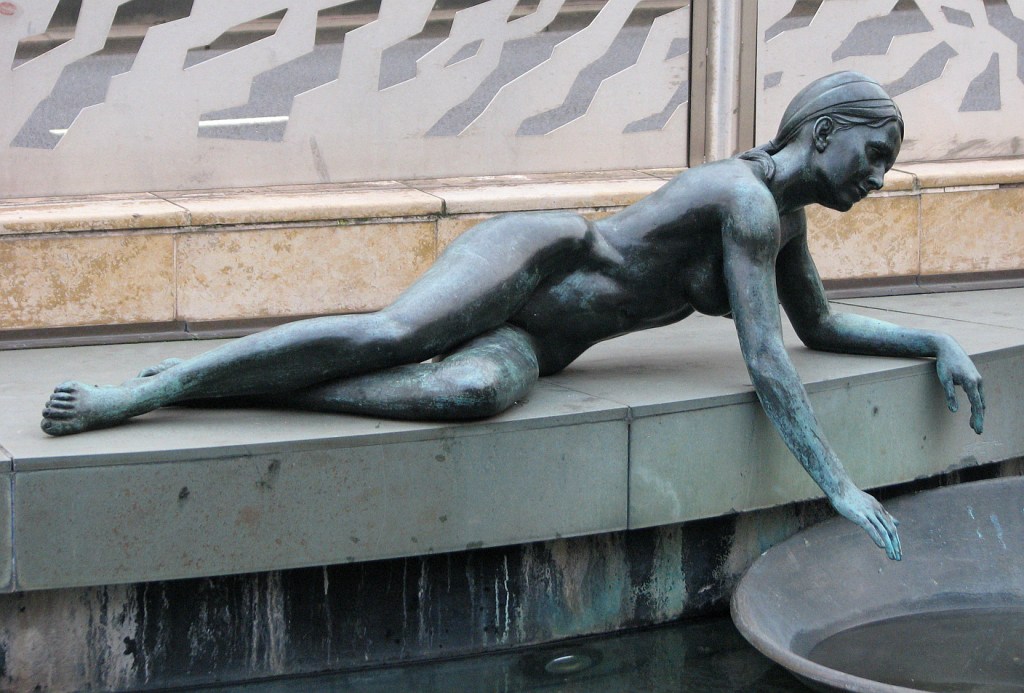
There is a lot of traffic and we get stuck in a roundabout for two rotations. In the center amongst whizzing traffic is a pretty little garden that I had not noticed before. There is a bronze statue of a reclining, young, nude girl dipping her hand in the pond. It must look lovely when the flowers are in bloom.

Reclining Hebe, Greek Goddess of Youthfulness
Photo: Bob Speel

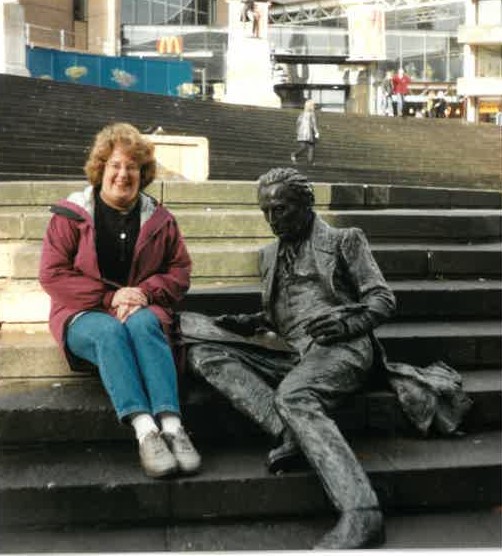
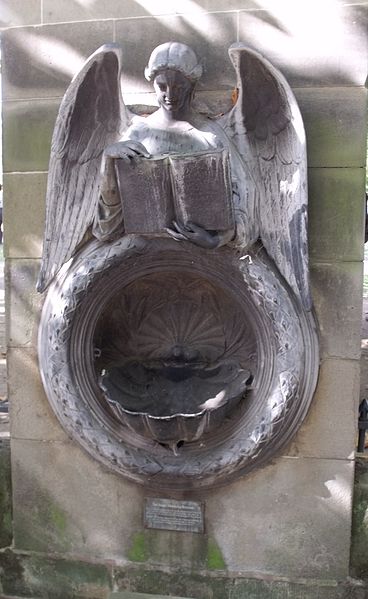
I love Birmingham’s public art and see a lot of it today as I walk. While the little mermaid at the University’s student guild is my all-time favorite, I also love pieces such as: the Guardian Sphinx in Victoria Square, the reclining statue of 19th century MP Thomas Atwood on the steps of Chamberlain Square, the Angel Drinking Fountain outside of St. Phillip’s Cathedral, and the Commuter at Snow Hill station.

Guardian Sphinx, Victoria Square, Birmingham
Photo: Wikimedia Commons
Thomas Atwood, Chamberlain Square, Birmingham
The Angel Drinking Fountain, St. Philip’s Cathedral, Birmingham
Photo: Wikimedia Commons
The Commuter, Snow Hill Station, Birmingham
Photo: Wikimedia Commons

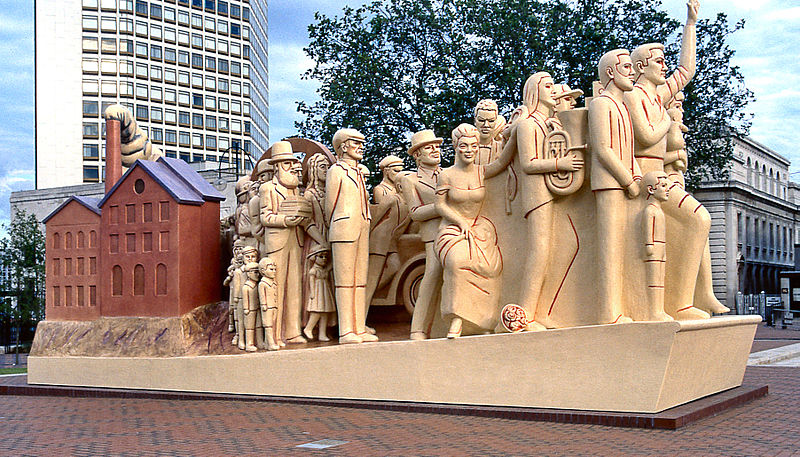
There is also some artwork that I really dislike. “Forward” is one of these. I get the idea that it represents a city looking to its future. But its cartoonish fiberglass figures fall flat for me. Editor’s note: An arsonist destroyed the sculpture in 2003. Although I feel bad for the artist and the city that is out a £200,00 piece of art, I can’t mourn its loss.

“Forward” sculpture, Centenary Square, Birmingham
Photo: Wikimedia Commons

Everyone is out doing their Christmas shopping; the streets crowded and the stores packed. I have lunch at a Chinese restaurant and then try to find the Jewelry Quarter. I walk and walk but never find it. I finally backtrack from St. Paul’s Square to St Philip’s Square to Snow Hill station where I get a taxi home.

I watch Antiques Road Show and Ballykissangel, write a few letters, and balance my checkbook. Just like Sunday at home.

Monday, December 6, 1999

Dean and Barbara have read my paper. Dean gives me some broad comments that are helpful. Barbara is editing for punctuation and grammar. Peter looked at it too, but didn’t have anything of substance to add. He gave me a couple of references and corrected a fact or two on the British system of government.

I attend an interesting lecture by an American professor who is at Stuttgart University in Germany. He has been working on performance measurement in public sector organizations devising different measures depending on the type of service the organization performs.

I walk to Sainsbury’s about 25 minutes down Bristol Road instead of my normal Tesco’s mini mart. Sainsbury’s is a mega grocery store (or market, as it is called here). They have salad—not the mayonnaisey kind—but real green salad. I buy a big bag (for 2) and eat the whole thing for supper. They haven’t quite got the concept of croutons here, but there are crusty little things they call croutons and I eat them with relish.

  • In today’s news: BBC 4 Radio reported this morning that Prince William is again on the front page of the Express, which earlier accused him of being arrogant for going fox hunting. “Who’s looking after William?” the paper’s headline asks. Another report says palace aides have held a crisis meeting to discuss the advice being given the Prince. In an editorial, the Express says no one wants the charming, intelligent, independently minded young man embroiled in controversy, that’s why it is more important than ever that he receives good advice.

Tuesday, December 7, 1999

There is a new guest at the B&B—a studious young man in his 20s from southern coastal England. He is here taking a course for his accountant’s exam about which he is very worried. He gets up at 6:00 in the morning to review his material and, he says, he studies until 11:00 at night.

I myself stay up until midnight rewriting and editing.

  • In today’s news: The Telegraph tells of a six-year-old girl in Wiltshire who won a competition to turn on the Christmas lights in her home town. Jenny Owen, from Caine, had been cast as a sheep in this year’s nativity play. She wrote to the mayor explaining, “I’m never a fairy, an angel, or Mary, a wise man, a shepherd, or a king. But always a helper, a singer, or an extra, and this year, a grumpy old sheep. Jenny told the paper, “I have a new dress for the day.”

Wednesday, December 8, 1999

I am bleary-eyed this morning.

I have lunch with Chris who is helping me with arrangements to store my luggage at the BC offices in London over New Year’s. He tells me about the new James Bond movie, which he says is good. Chris apparently is an avid James Bond fan. He tells me how once he went on holiday in Corfu after seeing the locale in one of the early James Bond movies. He encourages me to see the Millennium Dome in London as the whole opening scene of the new movie is in and around the Dome.

Chris went to a friend’s house for Christmas dinner last night and they served turkey with cranberry sauce. He asks, “That’s very American, isn’t it?”

I have dinner at Dean and Barbara’s. Barbara is not feeling well, still she has cooked a chicken and made moussaka and baked pumpkin bread for dessert. We have the red wine that I brought; a Peter Lehman Shiraz from Australia. When I was in London for William’s party, I stopped at a wine store to get them a bottle. The storeowner told me that anything from Peter Lehman is great.

After dinner, we light Hanukkah candles. Ari and Max each have their own menorah that they made and they take turns lighting the candles each night. This night was Ari’s turn. I got them all gifts—books on tape and Cadbury heroes for the kids. I give Dean and Barbara Maine maple syrup and Green Mountain coffee that I had brought with me from home.

I look at their Paris photos. Ari shows me some sketches she had done in the Louvre. She has a sketchpad with a dozen or so drawings. She is quite talented. Max shows me his Escher coloring book too.

Ari told Dean that she was going to miss me when I left. It is so sweet.

When I get home, Caroline and Tony greet me. We sit in the TV room and talk. They show me some pictures of their holidays. Some friends they had met in Madeira are coming here on Friday. They show pictures of them.

It was a day for sweet things. Caroline says to me, “You enrich our lives, like a friend.” And I get kisses from Lutchford. I am very touched.

December 4, 1999 – Wales: Cardiff, Chepstow, and Tintern

A woman on the train to Cardiff is wearing a Maine/New England jacket. I tell her I am from Maine and we marvel at the coincidence. Her mother asks me what I am doing here and assures me Cardiff Castle will not disappoint. I learn that their brother/son lives in Salt Lake City, but I never do discover how she came to have a Maine jacket.

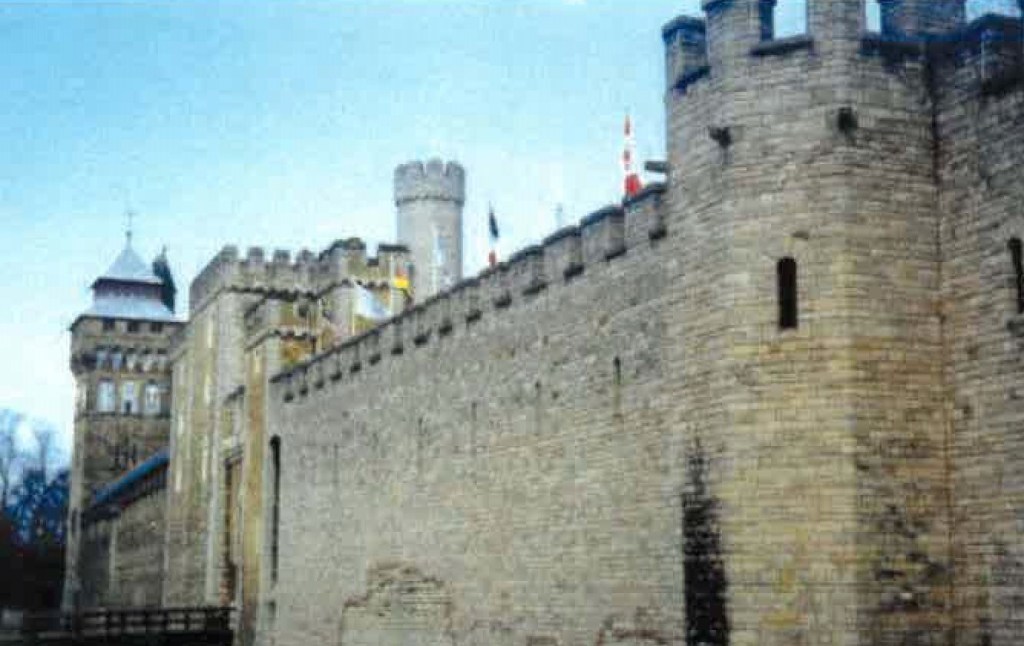
Except for the Welsh street signs, Cardiff looks just like any other English town—especially the High Street. I walk along the block-long castle wall, dotted with colorful fluttering pennants, to the entrance to Cardiff Castle.

Cardiff Castle, Cardiff, Wales

The Romans conquered Wales too―a section of ancient wall attests to it. One thousand years later, Britain’s other unstoppable conquerors, the Normans, swept across Wales. The Norman builders as intent on fortifying their holdings as their Roman cousins, built the thick-walled, 12-sided “keep,” the tower up on a hill inside the castle’s protective outer walls. It is this tower which gives Cardiff its name. “Caerdydd” is Welsh coming from the word “caer” meaning “fortress.”

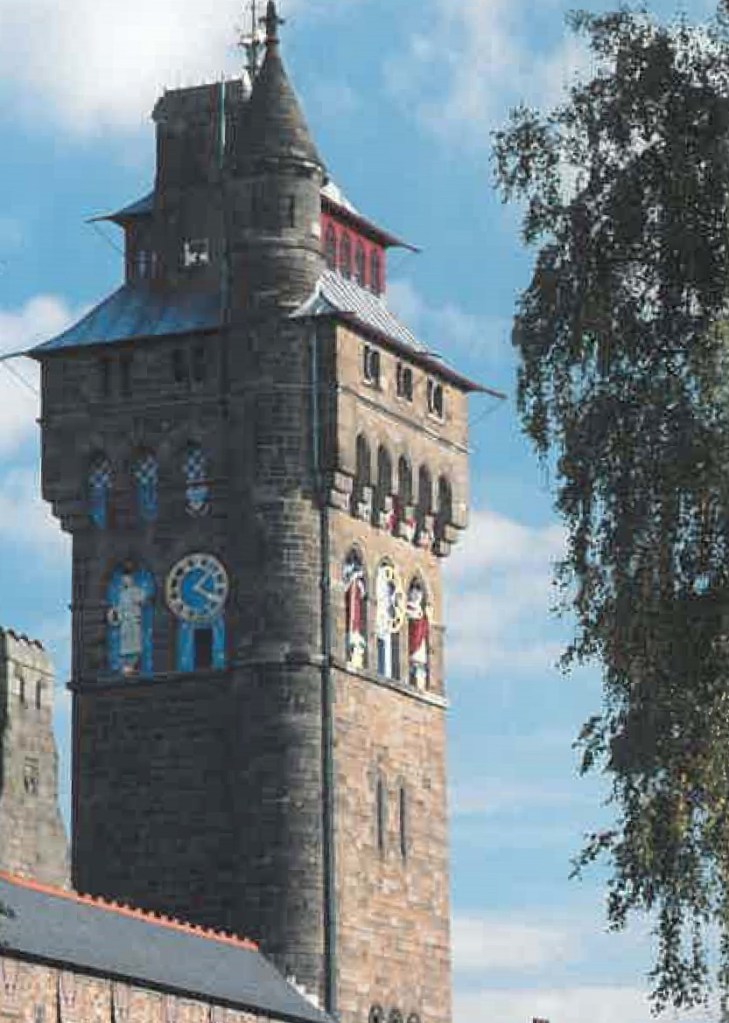
Two thousand years after the Romans and one thousand following the Normans, the Victorians got a hold of Cardiff Castle. The 3rd Marquess of Bute had more money than he knew what to do with, so he added a series of Gothic towers to Cardiff Castle. The main tower, an ornate, fairy-tale, clock tower, contains 101 steps spiraling to the top. At the bottom of the tower is the Marquess’s winter smoking room because, well, the top of the tower is reserved for his summer smoking room.

Cardiff Castle Clock Tower

Lord Bute’s fantasy extended to inside the castle too, which is decorated with gold leaf and carved oak. There are massive fireplaces, lush Indian rugs, and glittering stained-glass windows. Instead of Rubens and Titians, like many British castles, the Marquess’s tastes ran to frescoes, murals, and painted tiles. Signs of the zodiac intersperse with Greek gods and goddesses depicting mythical tales of love and war. One author wrote that Cardiff Castle’s Victorian rooms are “three dimensional passports to fairy kingdoms and realms of gold.”

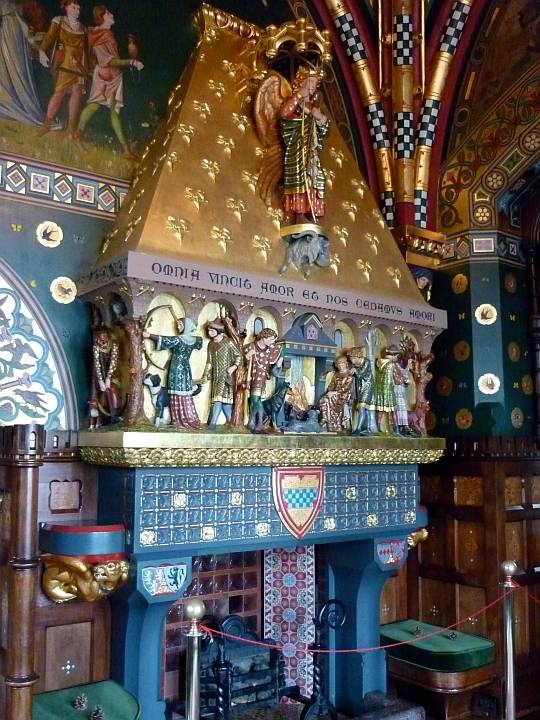
The Winter Smoking Room contains an elaborately decorated fireplace inscribed with Virgil’s quote, “Love conquers all, Let us yield to love.”

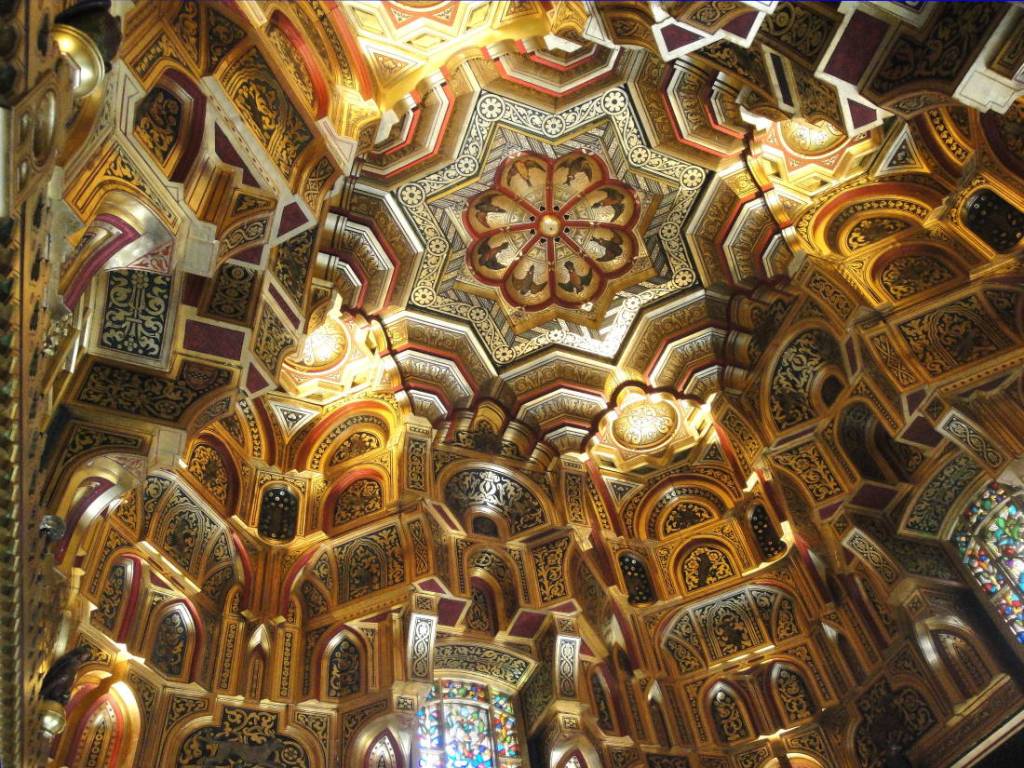
The Arab Room is stunning. It’s intricate honeycomb-patterned ceiling is an interior design masterpiece unlike anything I have ever seen. Lord Bute built the Arab Room as a drawing room for the ladies.

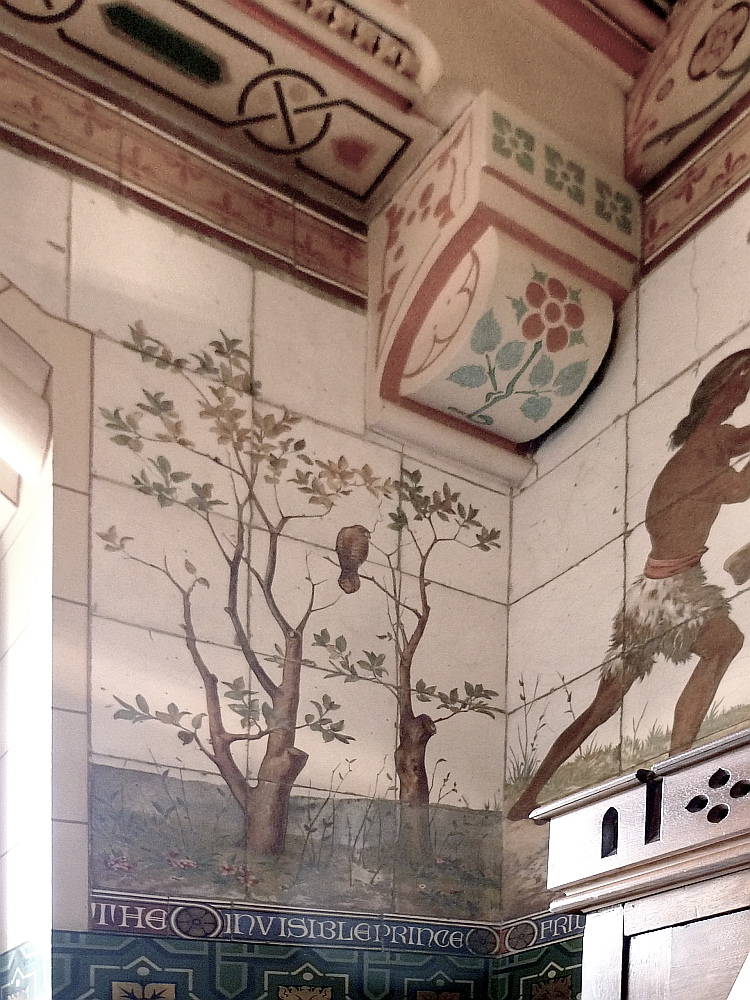
Moving along the passageway to the nursery (decorated now for Christmas), the walls contain frescoes of children’s fairy tales. My favorite is the invisible prince. At first glance, it looks like a lonely partridge sitting among the branches of winter-bare trees. But it is an optical illusion much like the better-known two-faced, old woman/young woman drawing. As you look carefully at the trees, the figure of a man emerges who is holding the bird on his arm.

Cardiff Castle Nursery, The Invisible Prince
Photo: Jacqueline Banerjee, The Victoria Web

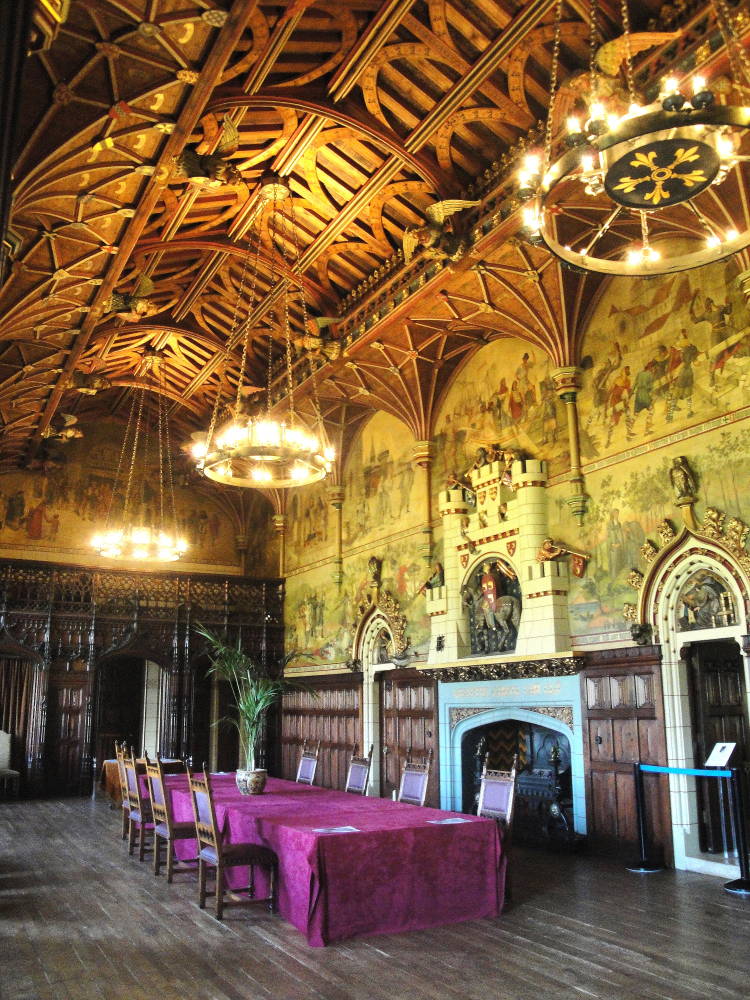
The large banquet hall is decorated with scenes of ferocious battles from the time of King Stephen, who vied for the throne with his cousin, the Empress Matilda. Robert of Gloucester, Matilda’s brother, who owned Shrewsbury Castle, once owned Cardiff Castle. Again, Brother Cadfael gives me my history. The mystery book by Ellis Peters that I just finished contains a sub-plot about Gloucester, without whom Matilda would not have had the successes she did. He was her army’s commander and a keen military strategist.

Cardiff Castle Banqueting Hall
Photo: Jacqueline Banerjee and Robert Friedus, The Victorian Web

The last room we tour, the library, has shelves of books from the Cardiff City Council. The city, now owning the building, filled the shelves with old city records books to make the room look like the well-stocked library it once was when it contained the Marquess’s collection, now gone.

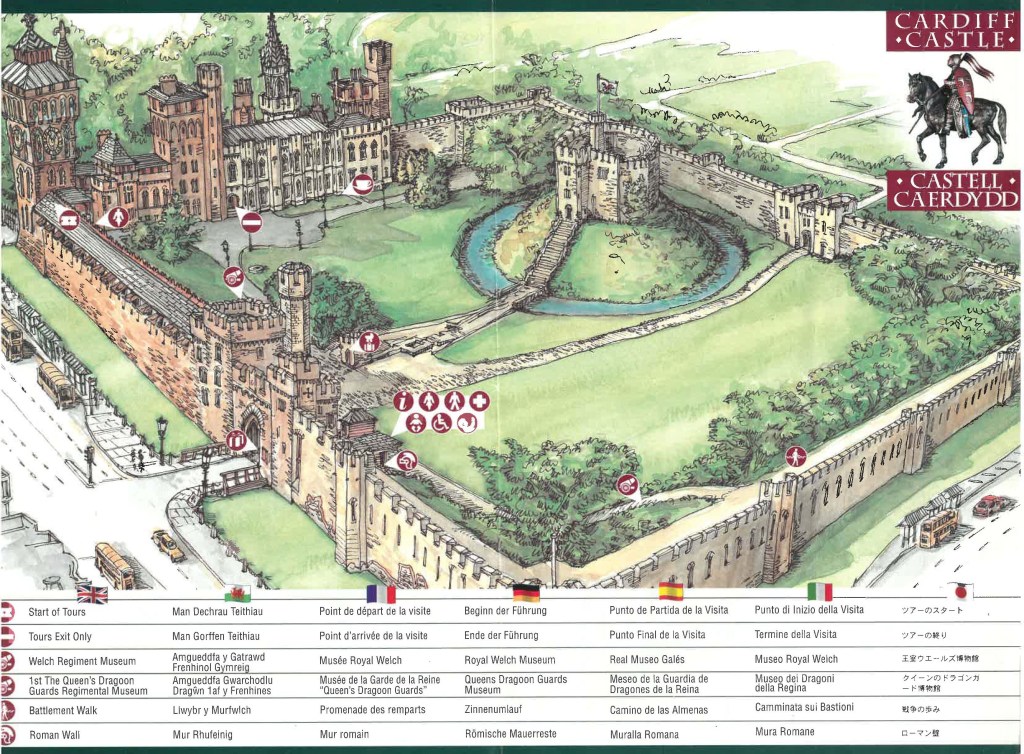
Tour Guide Map of Cardiff Castle

I have a sandwich in the Castle tearoom and, of course, browse the gift shop. I buy a carved, wooden Welsh lovespoon. The spoons’ designs each have their own meaning―a heart signifies steadfast love, a horseshoe is for luck, a keyhole means “my house is yours”―and are meant to be given as tokens of affection.

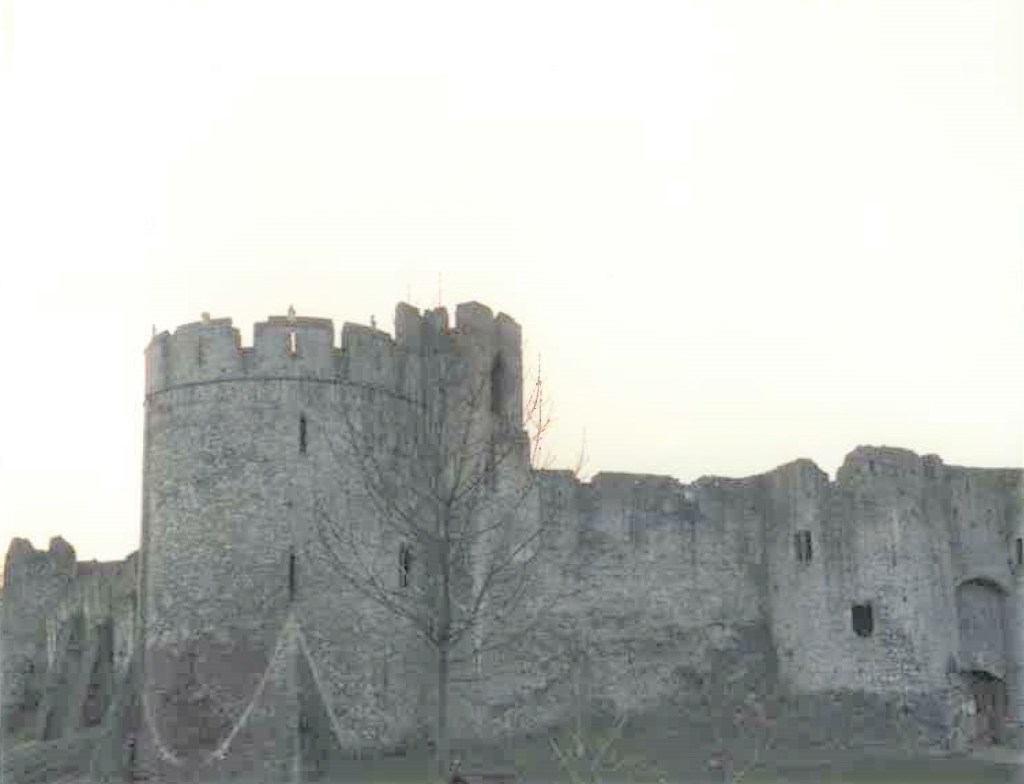
I catch the 14:00 train out of Cardiff to Chepstow to catch a bus to Tintern Abbey. Chepstow is a small cute market town. Its narrow streets lead to Chepstow Castle; one of the first stone castles built in Wales. Those great builders, the Normans, put up the sturdy tower in 1067 to subdue the restless Welsh.

Chepstow Castle, Chepstow, Wales

The 12-mile bus ride to Tintern is quick. The bus passes by the abbey ruins and sets us down in the center of the tiny village. I walk back to the abbey and snap some pictures—it is already getting dark.

Tintern’s location on the banks of the River Wye inspired the romantics—artists and poets—of the 19th century. Wordsworth’s poem, Lines Written a Few Miles above Tintern Abbey, is the most famous

Five years have past, five summers, with the length
Of five long winters! and again I hear
These waters, rolling from their mountain springs
With a soft inland murmur
Once again
Do I behold these steep and lofty cliffs,
That on a wild secluded scene impress Thoughts of more deep seclusion; and connect The landscape with the quiet of the sky.

William Wordsworth, July 13, 1798
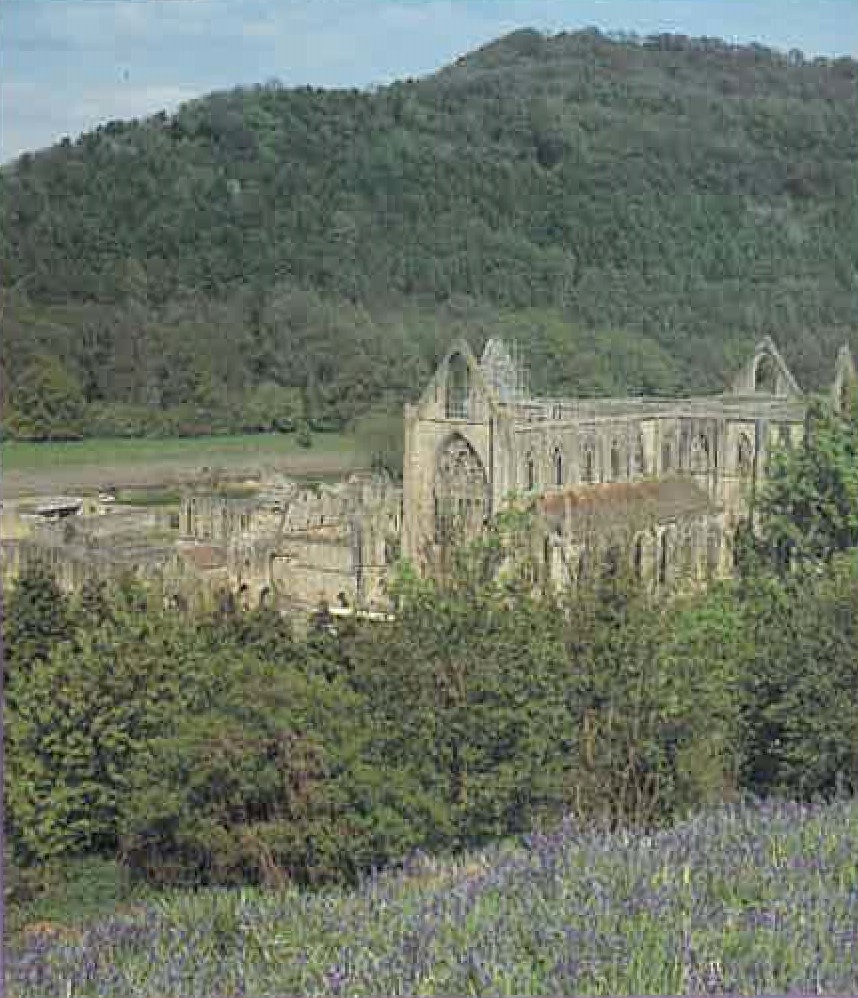
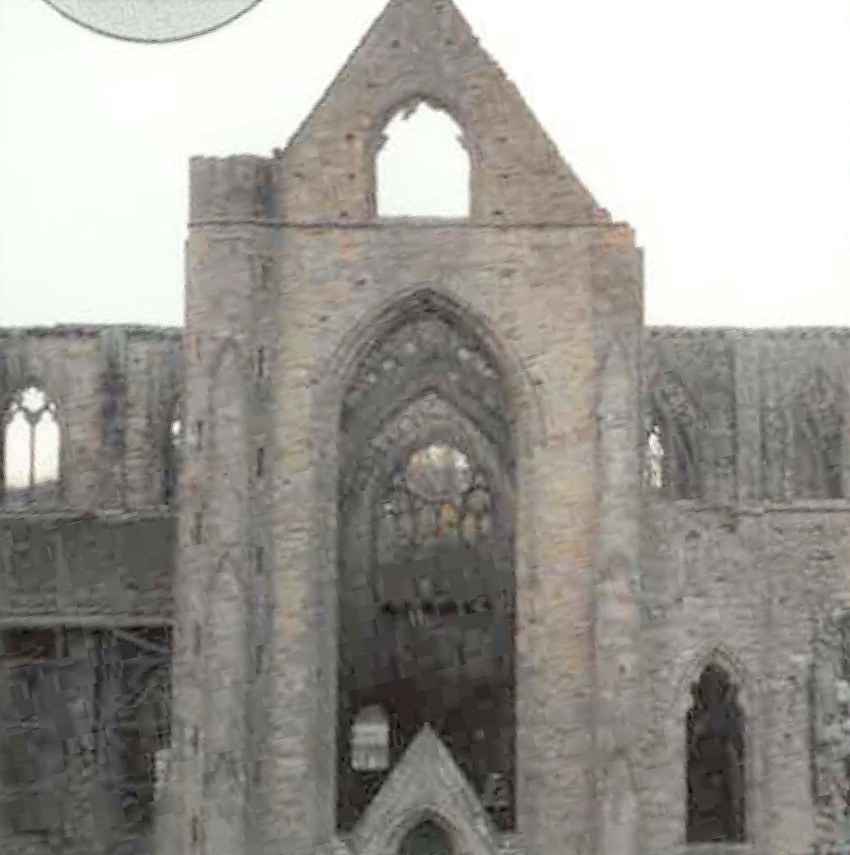
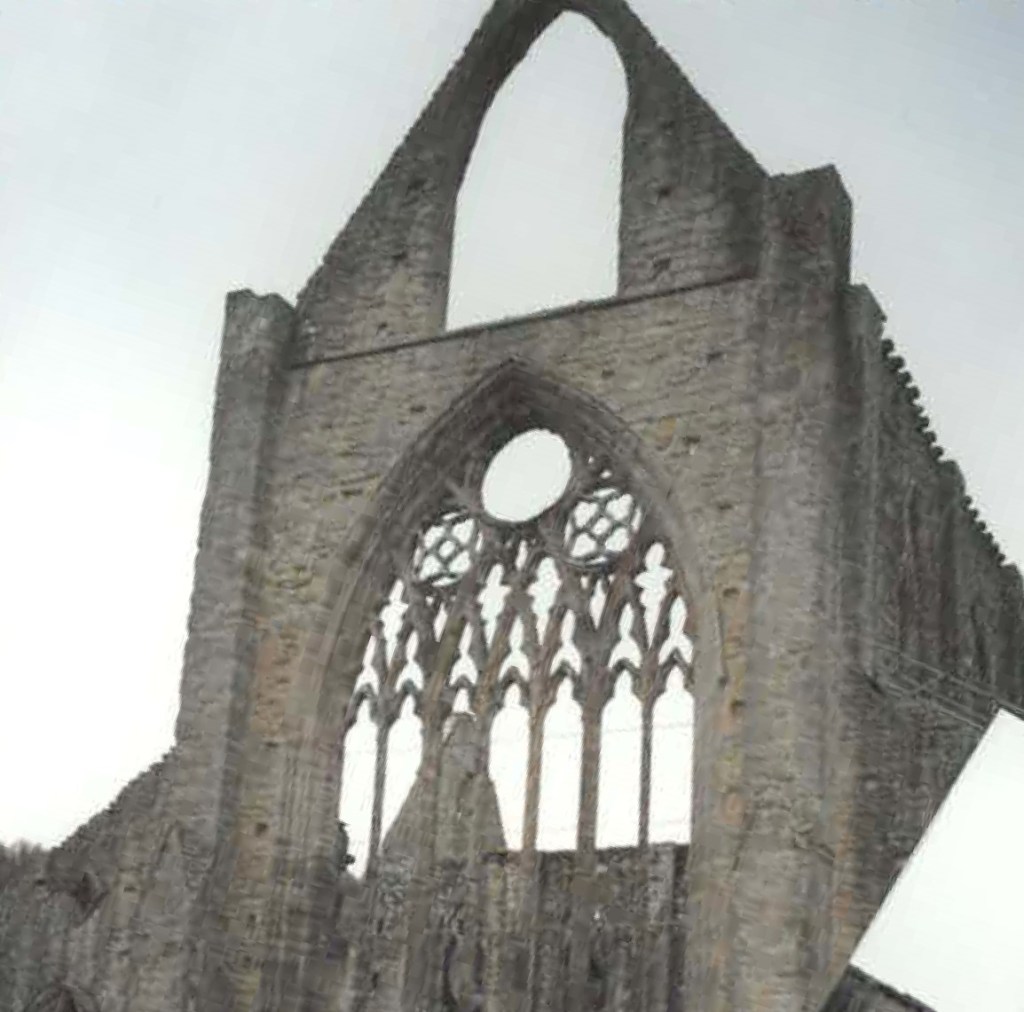
Tintern Abbey, Tintern, Wales

The ruins are impressive. A Cistercian abbey dating to 1131, it began its decay under Henry VIII when its valuable lead roofs were stripped and scavenged. Still, its lofty transepts and high vaulted arches transcend its crumbling, lichen-covered walls. The past is palpable.

All of these abbey ruins I have visited―Tintern, Glastonbury, Holyrood―fill me with wonder. Their sheer size is impressive, but more, the devotion of the builders who erected these megaliths, not completing the building even in their own lifetimes, but over four or five generations. Still they persevered knowing they would never see it completed. It boggles the mind.

I hurry back to the bus stop, but the 16:08 bus never comes. I know I didn’t miss it because two other ladies have been waiting for it longer than me. By 4:40 PM, we know it is well and truly not coming and it was the last bus on the schedule. We agree to share a taxi back to Chepstow. Thelma and Elizabeth are very nice. One lives in Chepstow; the other is a Londoner who is visiting for the weekend. Our taxi arrives back at Chepstow just as my 16:50 train is pulling away. I must wait for the next one at 17:40. Thelma and Elizabeth head back to their warm abode and I pace up and down on the cold platform to keep warm.

A fellow traveler, a man carrying a box accordion, makes an offhand remark about waiting for the train. I said it would be fine if it were a little warmer. He says, “You’re an American, aren’t you? He is from Ireland and tells me he is going to Newport, the platform for which is on the other side of the track. But he is waiting on this side because, “It’s too bleak over there.” He plays When Irish Eyes are Smiling. I hum along.

Of course, the train is late. It’s been one of those days. There is a speaker box that instructs passengers to press a button for information on the trains’ timetable. It speaks in Welsh first, then English. Everyone that comes by presses it. “Don’t waste your time,” the Irishman tells them. It basically says look at the board posted on the station wall or call for information. Three men joke that trains that don’t arrive at all don’t count as late. I am thinking that will make Tony Blair’s efficiency measures look better.

The Irishman finally decides to move over to his platform and bids me a friendly, “Cheerio, love.” I continue pacing. One of the three men uses a mobile phone to call the information number and reports that the train will be 11 minutes late. When it finally arrives, it is crowded and I stand from Chepstow to Gloucester before a seat opens up. I decide I am tired of all this traveling and think, regrettably, it will be good to go home at the end of the month.

It is just after 8:00 PM when the taxi driver drops me off at Glenelg. It smells like a brand-new taxi so I give him a £1.50 tip thinking that he has a new vehicle to pay off. He is very appreciative.

November 28-December 3, 1999 – In Which I Work on My Fellowship Paper while the Midlands Flood

We have a new guest—Elsie from Belfast—who is here visiting her grandson at the university. I tell her Elsie is my grandmother’s name. She says it’s a very old-fashioned name that you only see now in the memorials, by which I take it she means the obituaries. She is an interesting lady. She studied in Birmingham in the 1930s—English literature, philosophy, and Latin—at a time when women could attend university but often were not granted a degree.

I work on my paper all this week often well into the evenings. I complete the introduction. Then I work on the central analysis with my observations about how the UK’s Best Value regime could help Maine’s implementation of performance measurement and vice versa. By the end of the week, I am able to give Peter a rough draft and a copy to Barbara who has generously offered to edit it for me. Now, I have to pull it into shape, clean up all the footnotes, and write the conclusion.

On Monday night when I get home, Tony tells me that the Queen is in Birmingham tonight. Apparently, no one knew she was coming. Her diary only said she was attending a performance “north of London.” She is attending a Royal variety gala with Barry Manilow and other pop singers at the Hippodrome in Birmingham. My engraved invitation from Her Majesty must have gotten lost in the mail.

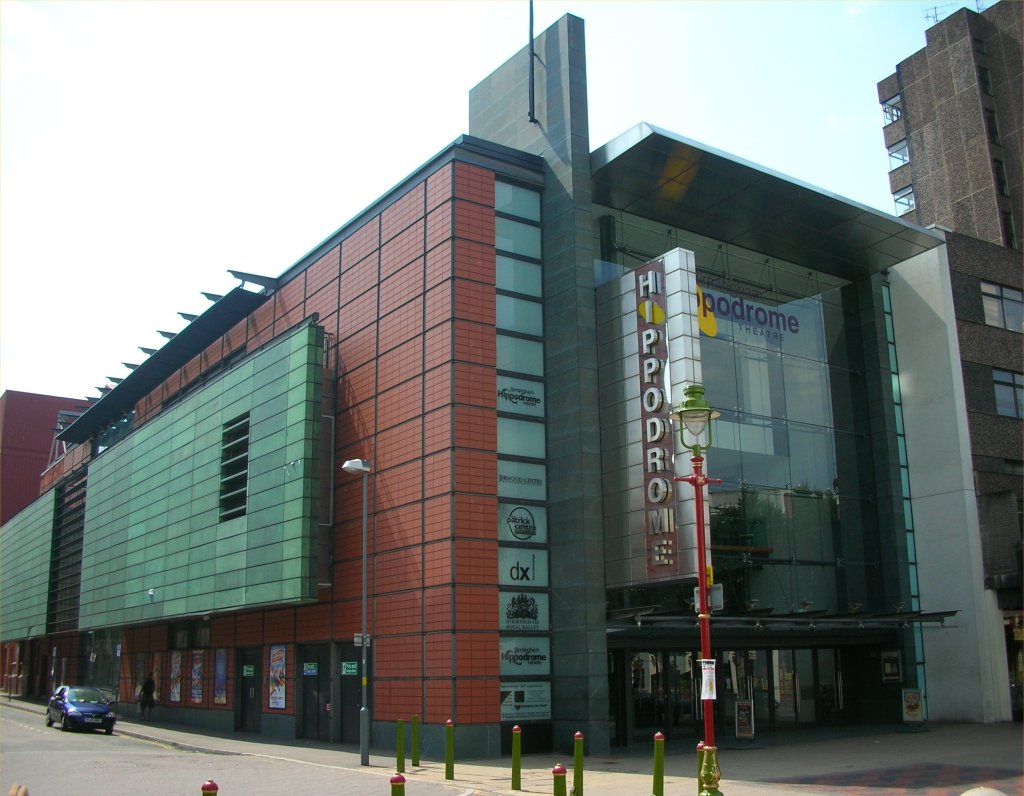
A week later I watch the gala on TV. The Hippodrome is Hollywood-glamourous; spotlights swing back and forth with powerful light beams that reach far into the night sky. Sure enough, the Queen is there. Every performer bows to her before leaving the stage—even the Americans. Leann Rhines, a young, country and western singer, executes a little curtsey, not too overstated, but very nice. Afterwards, the Queen greets all the performers in a reception line.

Birmingham Hippodrome
Photo: Wikimedia Commons

On Wednesday night, Dean invites me to dinner. After work, we walk to his bus stop and take the bus to their house. The kids are working on their homework. Max is absorbed in making a paper clock. Barbara tells me that he is a perfectionist. Ari has a “maths” problem about soccer for extra credit. “If the score at the end of the game was 6-4, how many points were scored in the second half?” I have no idea. There must be more to it, mustn’t there?

Dean has invited Peter Watt for dinner tonight too. Peter arrives late and everyone is starving waiting for him. He apparently walked from his house. We have salmon, roasted potatoes, and salad with the French wine that Peter brings. Peter is very funny with a dry sense of humor. He has three helpings of everything and two pieces of cake; yet he is stick-thin.

Dean and Barbara

Dean drives me home late, about 10:45 PM. Tony says with a grin that I need a late pass to get in.

On Friday, I have a hair appointment—my first since I have been in the UK. My shaggy hair must be noticeable. One morning last week, Tony says to me, out of the blue, “A lady came to the house to cut Caroline’s hair last night. If you want, I can make an appointment for you.” I agree immediately.

As I head out to the hairdressers, I debate taking a big box I have ready to mail as it is beginning to rain. I take a chance as it is only raining slightly. I am about half way to the post office when the floodgates open. The wind turns my umbrella inside out like the nannies lined up on Cherry Tree Lane in Mary Poppins and it is useless in fending off the rain. I get soaked—my glasses are fogged, my hair is dripping, the box is sodden, and my legs and feet are drenched. I stagger into the post office dripping all over the counter, the floor, and the other patrons. When I step outside again—no rain. Five minutes after I enter the hairdresser’s shop, the sun comes out. I sigh. You gotta love England.

The hairdresser is very nice. She takes one look at my hair and, in her Birmingham accent, says, “It’s a bit thick, in’t it?” This makes me laugh, not because my hair isn’t thick, but I love her turn of phrase. She trims off about an inch taking the last of the highlights. But it feels good not to be hanging down in my face. Later, I show off my new hair style to Caroline and she admires it. Even Jake, Tony and Caroline’s sweet and friendly twenty-something son, says it looks good.
I watch Coronation Street, a milquetoast soap opera. Its opening credits feature a chocolate street made by Cadbury. I have been watching a Ruth Rendall mystery series. A new Jonathan Creek mystery series will be airing on Saturday nights in December. Jonathan Creek is one of my favorite shows. Alan Davies plays a magician who lives in a windmill and solves murders.

I am reading a new book about the first Lady Diana Spencer (1710-1735) by Victoria Massey. The similarities between the two Dianas—distance cousins—are remarkable. The 18th century Lady Diana Spencer of Althrop, sometimes called “Lady Die” or “Lady Dye,” was tall, fair, and slender and earmarked for marriage to the Prince of Wales. She had a brother named Charles and lost her mother at age six. She also died tragically young.
  • In today’s news: Last night and today, the weather is horrible in the Midlands. It knocked out power for 200,000 people. A tree was uprooted by the wind falling across a Birmingham road hitting cars and killing three people. I can’t believe this was going on around me. In Inverness, they got a foot of snow!
  • In today’s news: An historic Irish power-sharing agreement took effect today following a close vote on Saturday by the Ulster Union Party accepting the latest negotiated agreement. Nominees were named for various government positions, such as education minister. Some comment on the irony that a Sinn Fein member, a former IRA captain, will be the education minister.

November 27, 1999 – Shambling through York

I leave for York before breakfast, but Tony kindly makes me some toast anyway. I meet their new Swedish guest as I am going out the door. He is an officer in the Royal Swedish Army here for a war studies course, which he says is very interesting.

The trip to York is about 2-1/2 hours north of Birmingham and as the train pulls into the Victorian train station, I am surprised how big it is…and beautiful. An on-line description says of the York station

Designed by William Peachey and Thos. Prosser, the station opened in 1877. It became the largest railway station in the world with thirteen platforms all excepting three being under a wondrous glass roof. A further innovation was the construction of an hotel within the station to become known as the Royal Station Hotel in honour of Queen Victoria who is known to have frequented the establishment whilst en route to Balmoral. (source)

I climb aboard the Guide Friday hop-on-hop-off bus and it takes me inside the city walls.

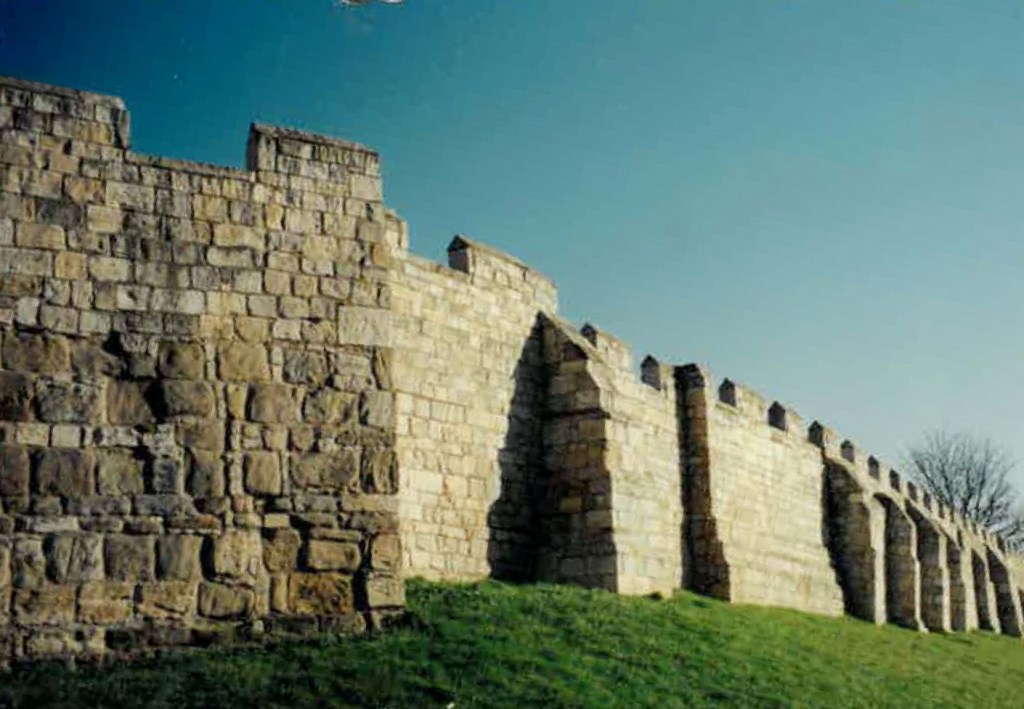
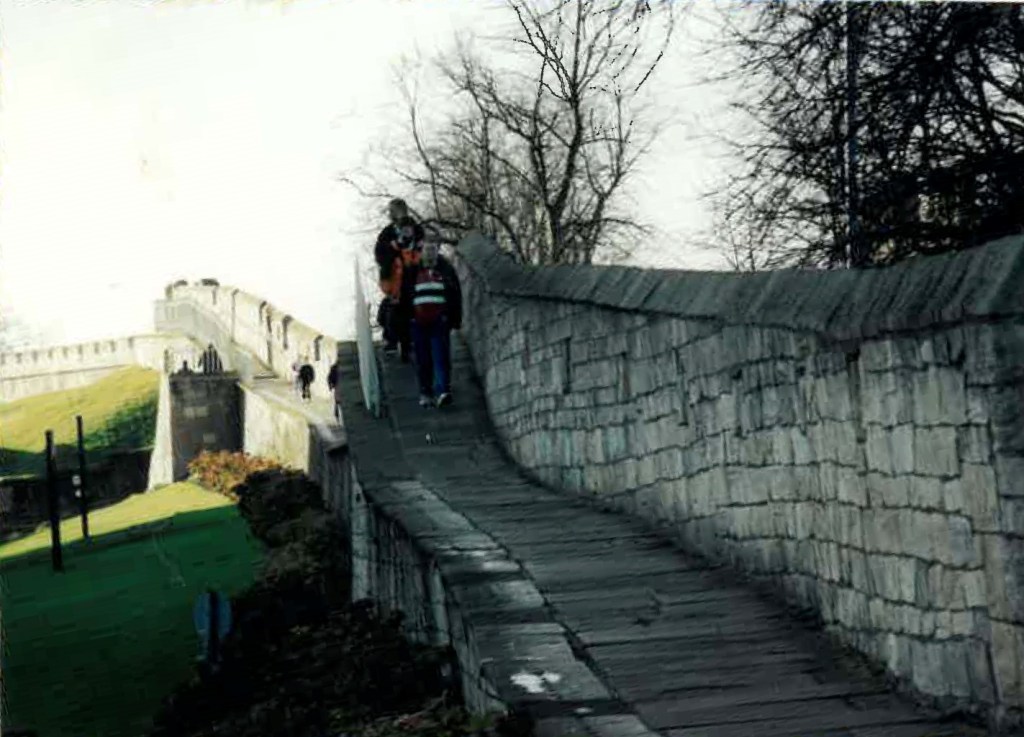
I am immediately charmed by the walled city. The old section of York is surrounded by a massive, 13-foot-high, six-foot-wide, stone wall. While the wall was constructed mostly in the 14th century, there still remain some sections built by the Norman invaders in the 11th century, and the whole thing is aligned along the original Roman ramparts. You can walk along the top of the wall for miles.

York City Wall

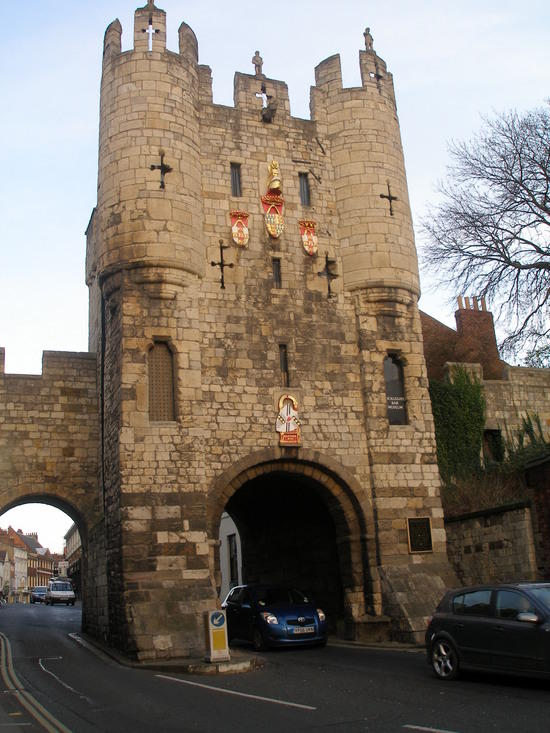
Towering gatehouses punctuate the wall at four locations with huge round-arched passageways providing entry into the old city. We enter through the four-story Micklegate Bar where the head of Richard Plantagenet (father of King Richard III) was displayed after his defeat in a battle of the War of the Roses in 1460.

Micklegate Bar, York
Photo: Friends of York Walls

Many of York’s street names are Danish in origin reflecting the city’s Viking heritage—Coppergate, Petergate, Monkgate—“gate” or “gata” being the Danish word for “street.”

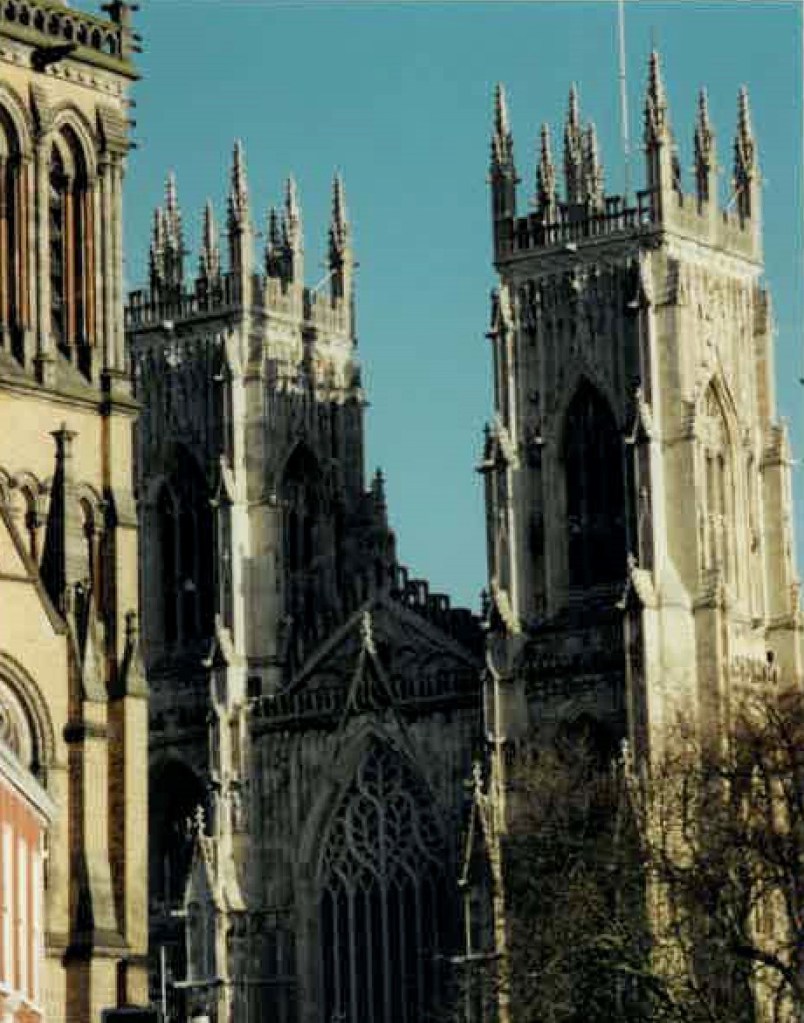
York’s colossal Gothic church, the York Minster, is the seat of the Archbishop of York. The Archbishop of York is second only to the Archbishop of Canterbury in the church hierarchy, who himself is just below Her Majesty, the Supreme Governor of the English Church.

Although resting on a foundation centuries older, the Minster with its amazing stained-glass windows dates from the 13th and 14th centuries. My guidebook says the Minster has, “The largest expanse of medieval stained glass in the world.” A magnificent rose window commemorates the 1486 marriage of Henry VII and Elizabeth of York that ended the War of the Roses.

York Minster

The Minster also contains the celebrated Five Sisters Window. Each of the five narrow stained-glass windows is over 50 feet high. They are made from “a distinctive frosted, silvery-gray glass.” I find it hard to see the illustrations in the grey, dark glass.

York Minster’s Five Sisters Window is the only memorial in the country dedicated to all women of the British Empire who lost their lives during the First World War. The window, which dates from the mid-1200s, was restored and rededicated between 1923 and 1925 after it was removed during the First World War to protect it during Zeppelin raids.

yorkminster.org
Five Sisters Windows, York Minster
Photo: © John Scurr (WMR-30648)

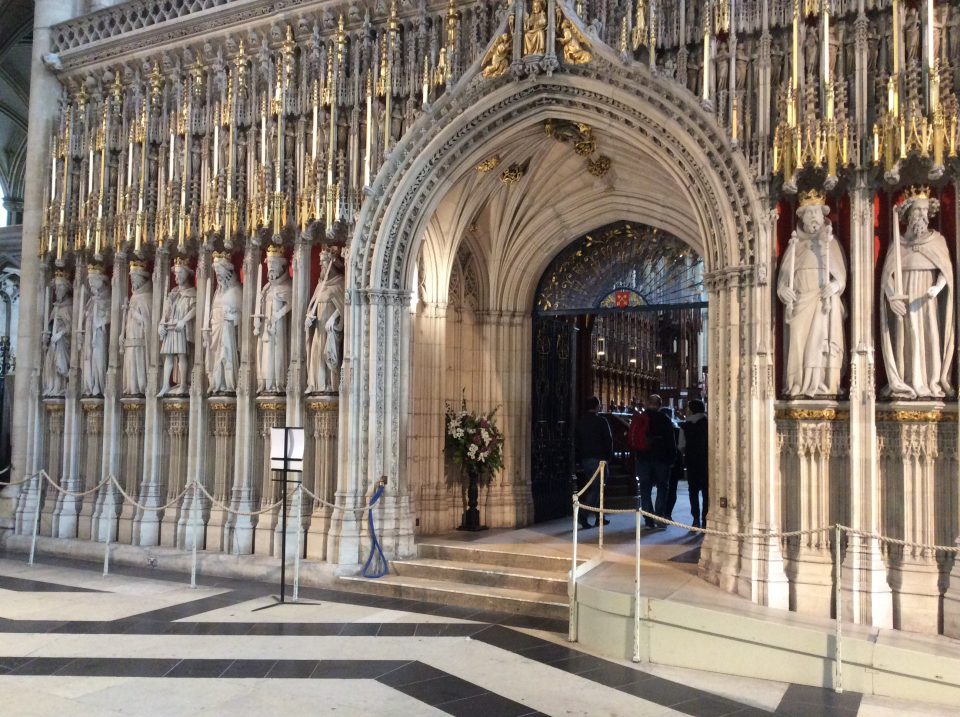
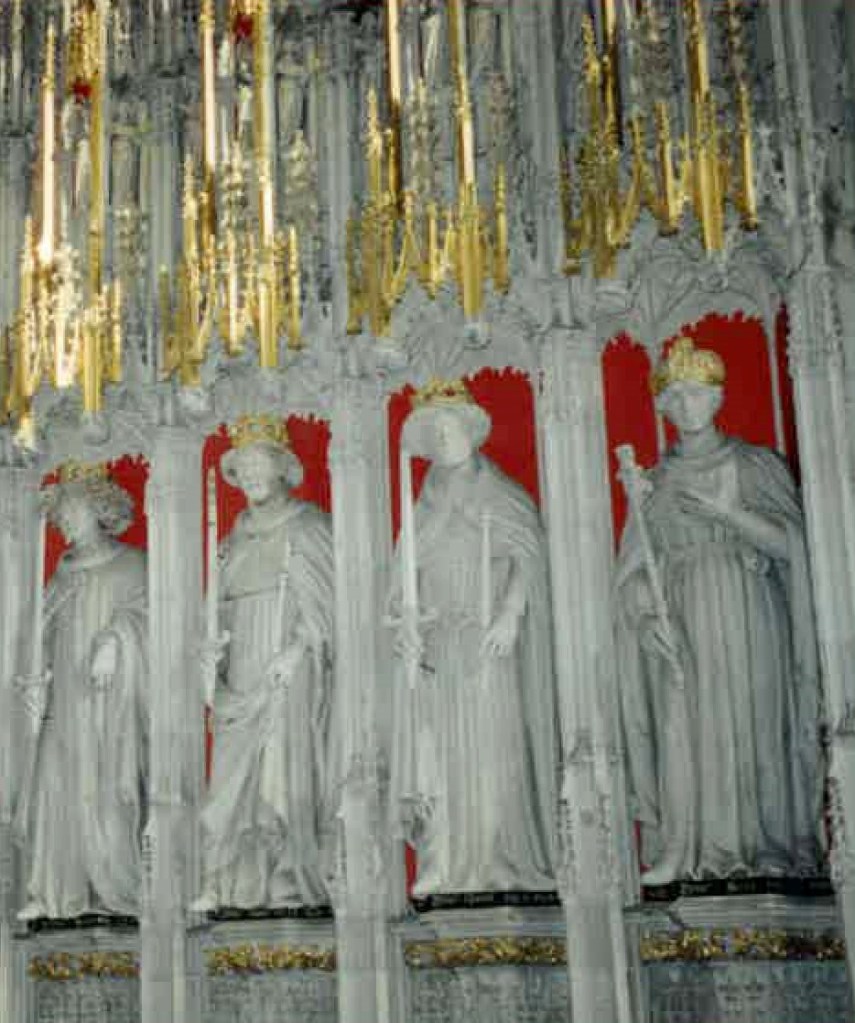
The Minster’s most arresting feature to me is the ornate 15th century Kings Screen; a stone half-wall that separates the choir from the nave. It has 15 intricately carved stone statues of English kings, from William the Conqueror to Henry VI on pedestals each wearing a golden crown.

Kings Screen, York Minster
Photo: henrysixth.com
Kings Screen, York Minster

I also take delight in Gog and Magog, the two 400-year-old oak figures who use their iron pikes to strike the bell to sound the “Striking Clock’s” chime. Indeed, the little wooden men go into action at 12:45 PM while I am looking at it.

I exit the church in the rear and find the Roman Emperor Constantine, his statue marking a solitary stone pillar put there two thousand years ago by his Legions as part of his efforts to fortify this northernmost outpost of the empire.

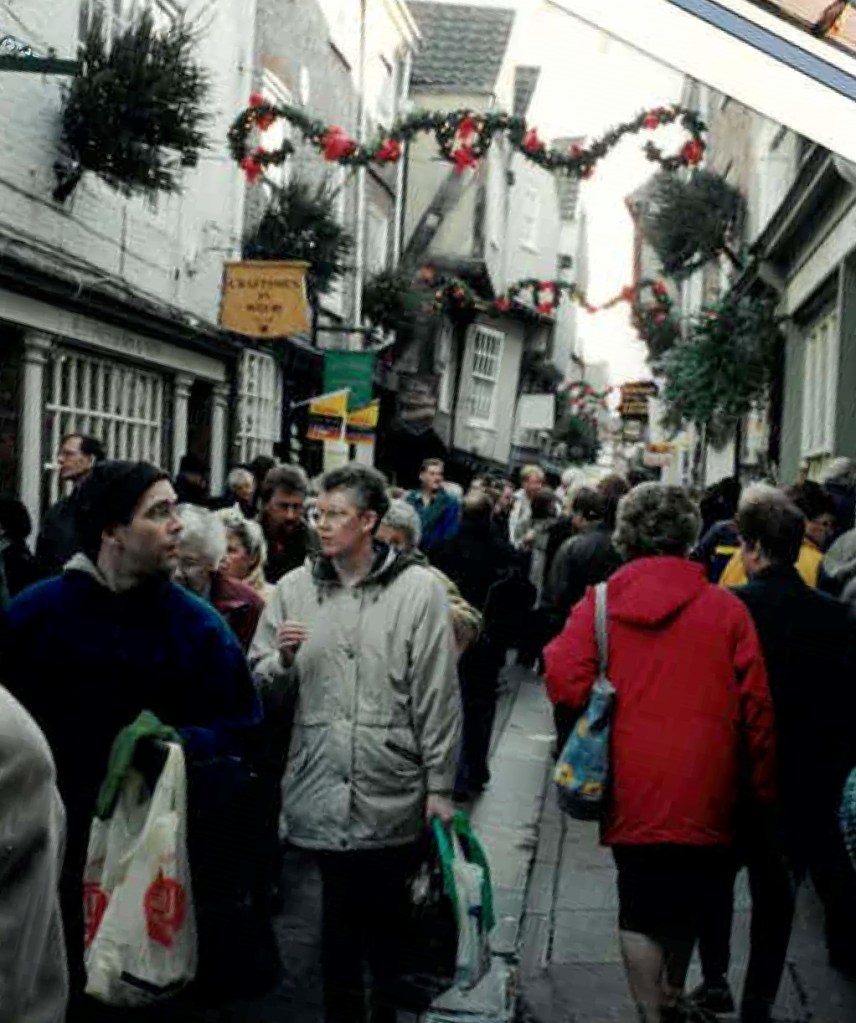
I leave the emperor to history and walk through the heart of the city known as the Shambles where the upper stories of old timber-framed buildings lean precariously over the narrow, cobble-lined, medieval street. It feels like I am stepping back in time or perhaps into Diagon Alley in the wizarding world of Harry Potter. I look to see if I can buy a wand or invisible cloak in some dark, misshapen little shop.

The Shambles, medieval street, York

In medieval times, the street was home to the city’s butchers and bakers. Shambles is taken from the Anglo-Saxon word for “shelves” on which the butchers displayed their mutton chops and bacon. The butchers are gone, but there are several bakeries along with boutiques, souvenir shops, and fast food restaurants.

People mob the street so that I can hardly pass through, let alone look in the shop windows. I find out later that the city is celebrating St. Nicholas’ Day with a festival today.

I am looking forward to the Jorvik Viking Center with its “back-through-history” ride from present day to a Viking-age York. I wait 25 minutes in line for tickets which is nearly three times as long as the ride itself.

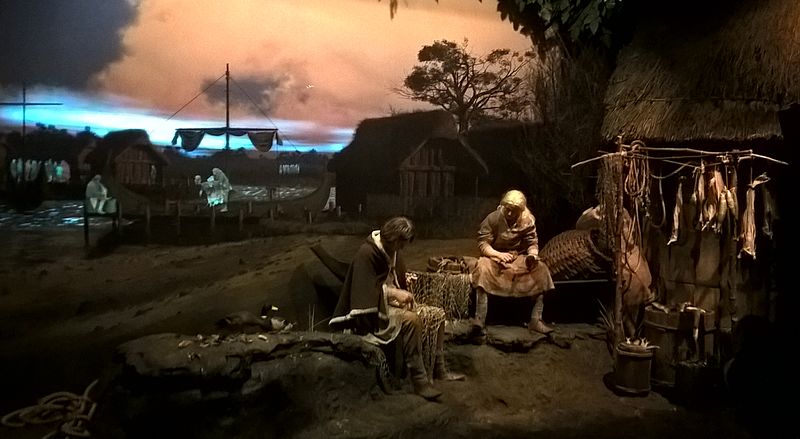
In 866 AD, the Vikings sailed their longships up the River Ouse and named their conquered city Jorvik or York, where they ruled for 200 years, even fairly peaceably for a few decades. A “time car” facing backwards takes us back through the decades and centuries for a show of life-sized dioramas of previous historical eras.

We time travelers ride past a group of 1960 swingers and then a man in a bowler hat from the 1940s, past a young woman in a turn-of-the-century, mutton-sleeved dress, and on past Cavaliers, Elizabethans, and medieval English villagers. We come to 1066 and can smell the burning buildings of the conquering Normans as they finally expel the Vikings.

Then the time car turns and faces forward and we proceed through the peaceful settled Viking village of 948 AD with its squawking chickens, roaring hearths, and busy market stalls. The life-like plaster figures are reconstructed from actual skulls unearthed in York’s archaeological excavations. The end of the ride gives us an overview of the earthworks and archaeological digs of the Viking village beneath the streets of modern York.

Jorvick fishermen, Jorvick Viking Center
Photo: Wikimedia Commons

After having my fill of the marauding Vikings, I make my way back to the Minster and to another of the city gates—Monkgate—and walk a bit on top of the wall and take in the view. I rejoin the tour bus, which circles the rest of the city, past York Castle, and returns us to the train station.

York City Wall

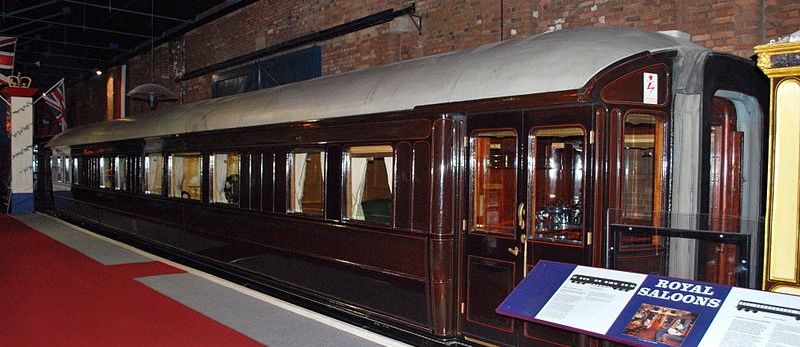
I leave the tour and walk to the National Rail Museum. I make my way past the big steam locomotives and miniature model trains, to the Royal carriages. There, amidst flagpoles of fluttering Union Jacks and speakers ringing out “God Save the Queen,” are the Royal trains of Victoria, Edward VII, George V and Mary, and George VI and Elizabeth (the Queen Mother). The Victorian and Edwardian trains are resplendent with polished oak and brocade fabrics. In contrast, the Queen Mother’s recently retired train, much like Britannia, is plain and seemingly passé. The current Royal train is still in use. Tony Blair hasn’t gotten wind of it yet, I suppose.

King Edward VIII Royal Train, National Railway Museum, York
Photo: Wikimedia Commons

Back in Birmingham city center, I have dinner and walk through the squares admiring the Christmas lights. There are so many lights—much more than typical American cities. They are lovely.

November 25-26, 1999 – University of Birmingham’s Fascinating Architecture and a Thanksgiving without Turkey

It seems strange to think that today is Thanksgiving. In the UK, they don’t celebrate Thanksgiving. In fact, most people here don’t know what Thanksgiving is. My first day in Birmingham, Chris, my fellowship coordinator, asked me, “What is that holiday in November that Americans celebrate by eating turkey? And just what does it commemorate?”

Mom emails me and describes the holiday menu she is cooking at home. I am missing all that lovely turkey and gravy and mashed potato.

But, it’s just another workday for me. I spend a couple of days writing my paper. Peter Watt, my fellowship mentor, when I ask him, willingly agrees to review it for me.

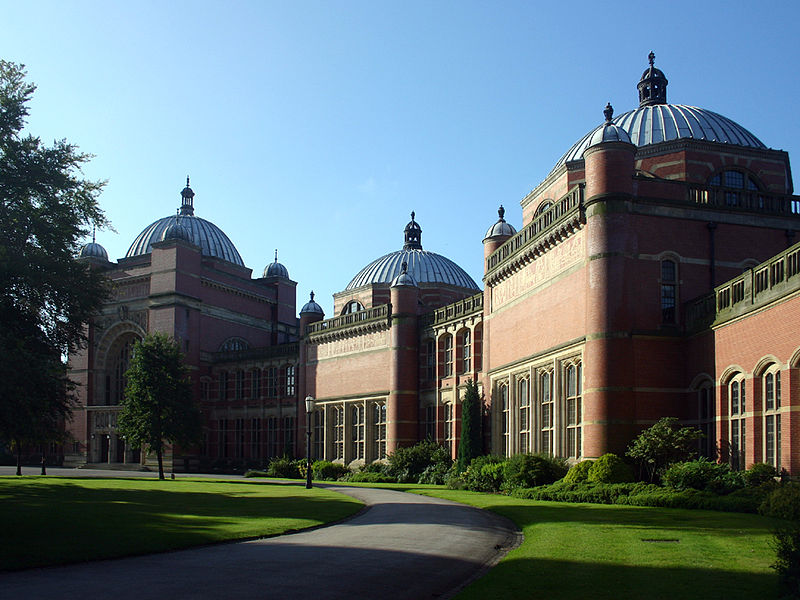
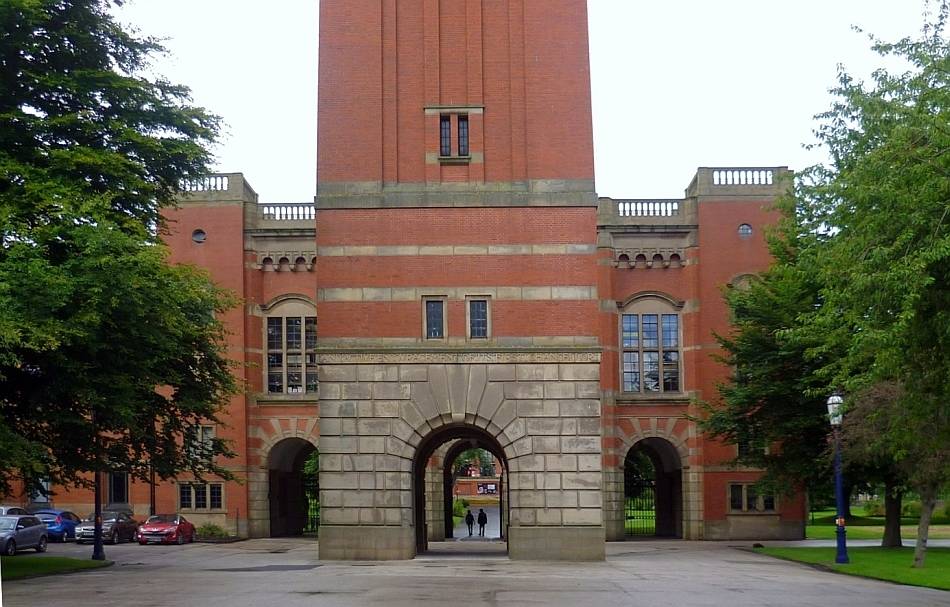
I love the old Victorian brick buildings on Birmingham’s campus. I take a few minutes on my way to lunch to admire the central Aston Webb building; the science building. The huge five-domed building, named after its architect, forms a semicircle around the clock tower. Constructed in fashionable red brick, it looks like several buildings linked together by galleries with tiers of arched windows two stories high.

Aston Webb Science Building, University of Birmingham

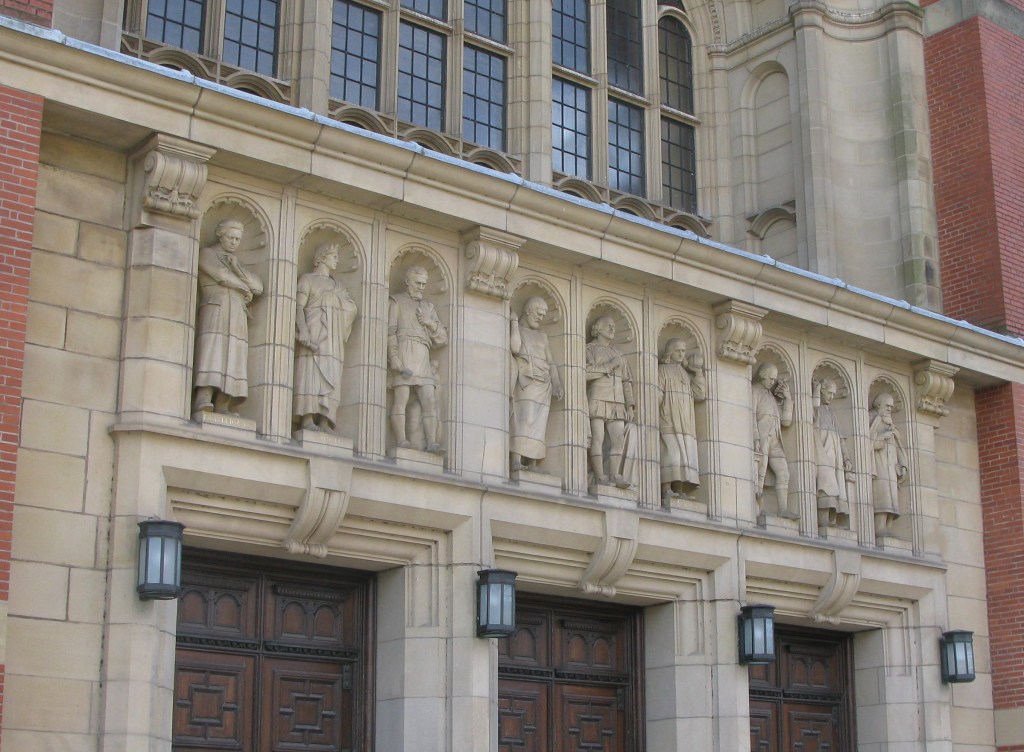
Its Byzantine style reminds me of the Kora Shrine Temple in Lewiston. The main hall’s entrance has a neat row of three doorways, above which are life-sized, cream-colored, stone statues of the world’s greatest minds: Plato, Michelangelo, Shakespeare, Newton, Darwin….and above these is a large round stone arch also carved from the light beige stone enclosing rows of small windows.

Aston Webb building entrance statues
Photo: Wikimedia Commons

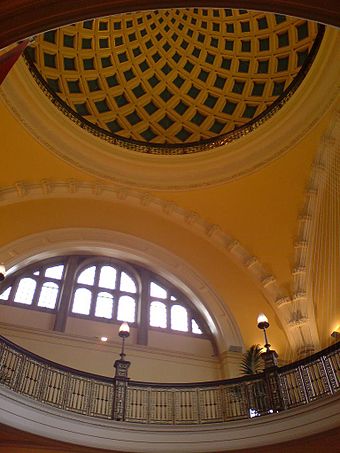
Mr. Webb’s interior is equally impressive. Greeting visitors is an ornate, circular, oak reception desk punctuated by four tall Victorian-style lamps. The checkered, marbled-floor lobby looks up into the huge, round, butter-colored dome decorated with plaster embellishments that resemble icing on a cake. Like Kensington Palace’s Cupola Room, the dome’s inside diamond pattern is smooth, only painted to look three dimensional. Second- and third-floor railed balconies encircle the room.

Ceiling of Aston Webb lobby
Photo: University of Birmingham Wikiwand

The building contains the university’s Great Hall where they hold graduation ceremonies. With its lofty ceiling and stained-glass windows, one particularly florid Victorian writer says of the ceremonial hall, “The Great Hall…marks the university out as a cathedral of learning.” (Source)

Looking from Aston Webb building through the base of the clock tower into Chancellor’s Court
Photo: The Victorian Web

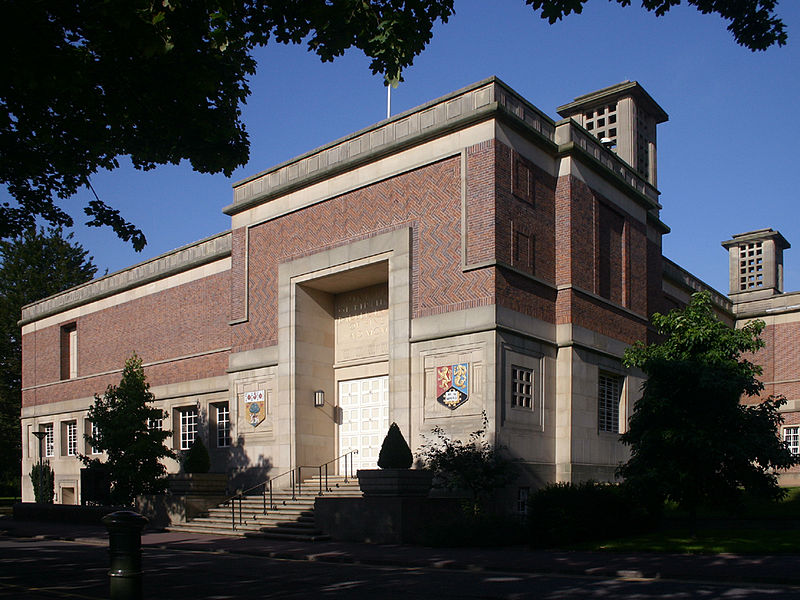
Very different than the Victorian science building, the Barber arts building is in the 1930s Art Deco style. Opened in 1939 by Queen Mary, it was “The first building to be purpose-built for the study of art history in the United Kingdom.” (source)

Barber Institute of Fine Arts, University of Birmingham

On Friday, after work, I attend a reception at the Barber Institute, which hosts a lecture by Michael Lyons, chief executive of the city of Birmingham. I talk with two city councilors from Birmingham. They tell me there are 110 councilors for Birmingham. I can’t believe the system actually works. Apparently, they manage based on a committee system, much as the U.S. Congress does.

They have a huge buffet for us. I suppose each country has its own typical buffet. In the U.S., it is potato salad, lasagna, and finger rolls. In England, or in Birmingham at least, it’s cold pizza, a spicy potato-filled Indian pastry, and egg mayonnaise sandwiches. I love the little potato pastries and eat enough to make up my dinner for tonight.

They tell me that the fine arts building has a Van Gogh, Picasso, and Monet. Sadly, I don’t get to see them and never make it back here.

Someone actually says, “Cheerio” to me tonight. It sounds strange. I wonder if he thinks the same when I reply, “Good night.”

  • A word about a word: “Cheers” seems to be Britain’s all-purpose word. It is used in the traditional way that we know, as a toast. It is also used for “thanks,” “good-bye,” and “hello.” I have even heard it used as sort of an acknowledgement, like “OK.”
  • In today’s news: The Birmingham Post reports that archaeologists have found new remains at a Roman site near University station, which prove that Birmingham has been around a lot longer than anyone imagined. This site, archaeologists speculate, may have had ties to the ancient Celtic Warrior Queen, Boudicea, and witness to her efforts to drive the Romans out of Britain in 60-61 AD.

November 22-24, 1999 – Train Travel: The Only Way to Go

London is a wonderful city to move around in if you are a tourist with a relatively flexible schedule, but if you need to be in a specific place by a set time, forget it. This morning on the tube, it takes me 1-1/2 hours to travel from Bayswater to Euston to drop off my luggage and then ride to Bond Street arriving at our Best Value conference in posh Grovesnor Square 15 minutes late.

The conference is quite good. We hear from the central government’s minister for local government and I pick up a lot of material that I can use for my paper. Now, I have to get busy and write the darn thing.

I get to Euston and run to catch the 17:50 PM train, making it with one minute to spare. I drop into my seat, sit back, and relax.

For as much as navigating the tube system is a hassle and time-consuming, I find train travel to be a luxury. With more than 2,500 rail stations across the length and breadth of the UK, it is easy, convenient, and reliable. There are 158 trains daily from Birmingham to London alone. The regular run from London Euston to Birmingham takes under two hours and I have made the trip so many times now, I feel like a regular.

Euston Station, London
Photo: Wikimedia Commons

Traveling by train did not become fashionable until Queen Victoria took a fancy to that mode of travel—at Albert’s instigation. She seemed to set the style for everything, didn’t she?

Generally, Euston station to the north is the terminal for trains going to Birmingham and north-northwest. Victoria is for southbound trains including routes to Gatwick and Dover while trains departing to Heathrow and points west—Bath, Cornwall, and Wales—leave from Paddington. And Kings Cross trains go north-northeast to Yorkshire and Scotland and, of course, to Hogwarts.

There are a few little quirks in UK train travel. First, train schedules run on military time. It has taken me time to learn it without counting on my fingers every time. But now, three months into my fellowship, I have mastered the 24-hour clock―and it may be a better system for telling time.

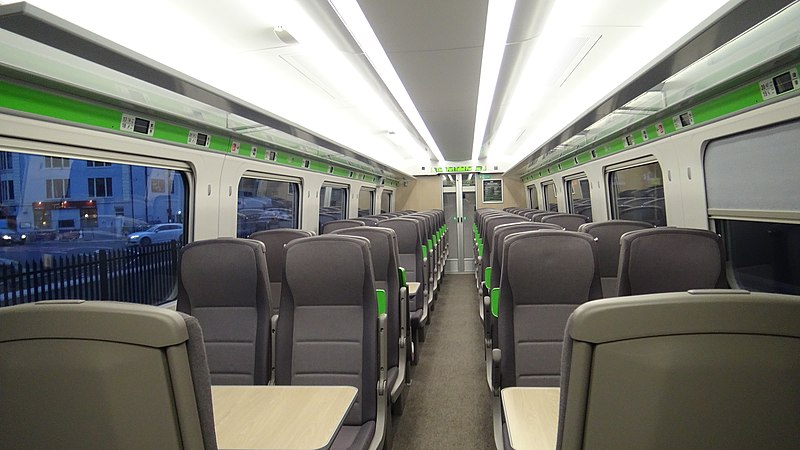
The seats are numbered based on which way they face—forward or back. So, there are two seats with the same number. This does not mean that two people have the same seat, rather it means you must look again to see if you’re in Seat 5 Forward or 5 Back. I don’t know how I manage it, but I invariably chose a seat that is facing backwards, which sometimes makes me a little motion sick.

British Rail, Standard Class train seats
Photo: Wikimedia Commons

As always, Bill Bryson puts it best

The platform televisions weren’t working and I couldn’t understand the announcements―it took me ages to work out that “Eczema” was actually “Exmouth―so, every time a train came in, I had to get up and make inquiries. For reasons that elude rational explanation, British Rail always puts the destinations on the front of the train, which would be awfully handy if passengers were waiting on the tracks, but not perhaps ideal for those boarding it from the side. Most of the other passengers evidently couldn’t hear the announcements either because when the Barnstable train eventually comes in, half a dozen of us formed a patient queue beside a BR employee and asked him if this was the Barnstable train…there is a certain ritual involved in all of this. Even though you have heard the conductor tell the person ahead of you that this is the Barnstable train, you still say, “Excuse me, is this the Barnstable train?” When he acknowledges that it is, you have to point and say, “This one?” Then when you board the train you must additionally ask the carriage generally, “Excuse me, is this the Barnstable train?” To which most people will say that they think it is, except for one man with a lot of parcels who will get a panicked look and hurriedly gather up his things and get off.  

Bill Bryson, Notes from a Small Island

Tonight, on the train from London to Birmingham, I read my Brother Cadfael mystery. Just as I am reading about the good brother setting out for his three-day journey from Shrewsbury to Coventry on horseback, my train whizzes through Coventry. I love this little coincidence!

On Tuesday, I attend a lecture by Dr. Henry Tam; deputy chief executive for the Town of St. Edmundsbury. Well-spoken and incredibly intelligent, he advocates for a system of policy reform that he calls “Communitarianism.” He criticizes the Blair government saying that it isn’t a “third way” at all. I don’t think he made a great hit with the public policy staff, but I enjoy his talk.

I go to lunch with a group of the staff (Helen, Philip, and Mike). We eat at a café on Bristol Road, not far from my B&B. It serves Persian food, similar to, but not quite the same as, Lebanese. I have potato burgers, which are like potato pancakes, fried and crispy, but served with a tomato coulis. They are yummy.

I was right. My colleagues were not impressed with Dr. Tam’s views. They ask me what I thought of the lecture and I tell them he was interesting, but that he didn’t tell us what communitarianism was. He only told us what it was not. “Exactly,” they say excitedly. But, I suggest, “British local government could be run in a nonpartisan way, like in the U.S.” This is something that Dr. Tam advocated, but they can’t get their heads around it. They base a lot of their argument on the tradition of council members representing a party. “How will citizens know what (council) members stand for? How will members know how to vote if they don’t have a party platform?” I understand that local governments in the UK manage and fund social services, which towns in the U.S. do not, and choices on funding these types of services vary based on political party values. But they have no answer to my question, “What is the party platform on picking up trash?”

My friend Lisa is visiting in December and we are planning a weekend trip to Paris. I start working on arrangements—Chunnel tickets and hotel reservations. I am nervous about calling the Paris hotel with my limited French vocabulary. After some trouble getting through, a woman finally answers in French. I say, “Bonjour. Parlez-vous anglais?” And thank goodness she says, “Yes.” Her English is heavily accented, and I am sure she doesn’t understand me any better than I understand her. But now, at least, the telephone barrier is broken. Tomorrow the fax. I have to fax her my credit card information to confirm the room.

  • In today’s news: Buckingham Palace has rejected suggestions that the Queen may abdicate rather than rule throughout her old age. Their statement comes as a result of comments from Prince Phillip, who was recently quoted as saying, “It’s much better to go while you’re still capable, than to wait for people to say you’re doddery.”
  • In an interview with Saga magazine, which was reprinted in The Daily Telegraph, Prince Phillip, speaking about worker retirement, is purposefully obtuse. When Mr. Keay, the interviewer, suggested the Prince might be in a different position to others considering retirement, Prince Phillip responded, “Why?” Mr. Keay said it was a fact that the Queen was not going to abdicate, and Phillip replied, “Who said that?” The interviewer said it had always been understood that the Queen would not abdicate, Phillip said, “Well, you’ve said it.”

Thus, the Palace’s retraction.

Design a site like this with WordPress.com
Get started