It seems strange to think that today is Thanksgiving. In the UK, they don’t celebrate Thanksgiving. In fact, most people here don’t know what Thanksgiving is. My first day in Birmingham, Chris, my fellowship coordinator, asked me, “What is that holiday in November that Americans celebrate by eating turkey? And just what does it commemorate?”
Mom emails me and describes the holiday menu she is cooking at home. I am missing all that lovely turkey and gravy and mashed potato.
But, it’s just another workday for me. I spend a couple of days writing my paper. Peter Watt, my fellowship mentor, when I ask him, willingly agrees to review it for me.
I love the old Victorian brick buildings on Birmingham’s campus. I take a few minutes on my way to lunch to admire the central Aston Webb building; the science building. The huge five-domed building, named after its architect, forms a semicircle around the clock tower. Constructed in fashionable red brick, it looks like several buildings linked together by galleries with tiers of arched windows two stories high.
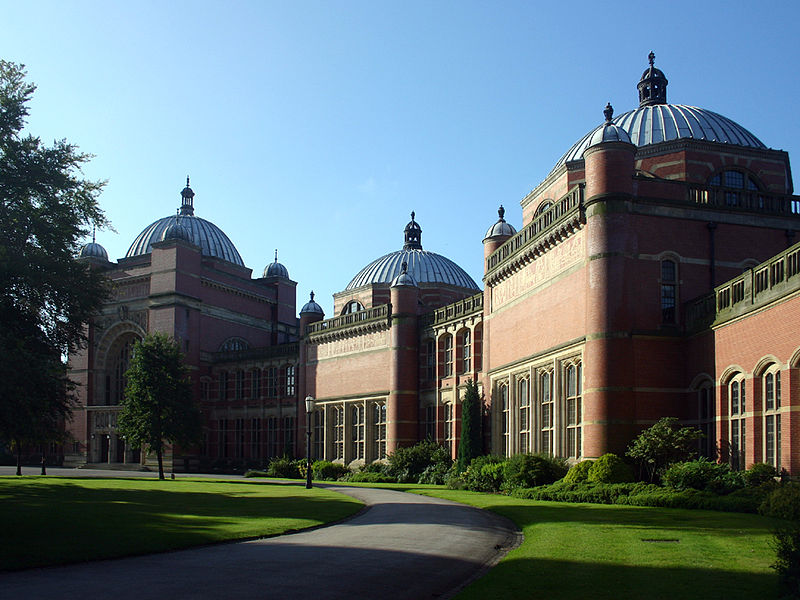
Its Byzantine style reminds me of the Kora Shrine Temple in Lewiston. The main hall’s entrance has a neat row of three doorways, above which are life-sized, cream-colored, stone statues of the world’s greatest minds: Plato, Michelangelo, Shakespeare, Newton, Darwin….and above these is a large round stone arch also carved from the light beige stone enclosing rows of small windows.
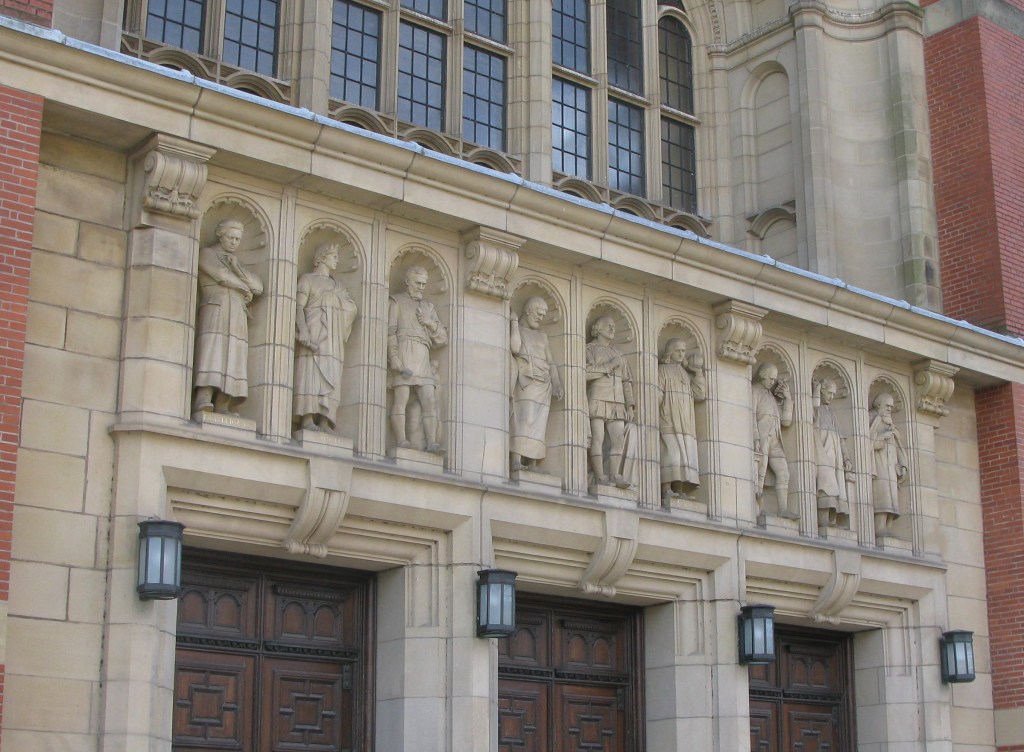
Photo: Wikimedia Commons
Mr. Webb’s interior is equally impressive. Greeting visitors is an ornate, circular, oak reception desk punctuated by four tall Victorian-style lamps. The checkered, marbled-floor lobby looks up into the huge, round, butter-colored dome decorated with plaster embellishments that resemble icing on a cake. Like Kensington Palace’s Cupola Room, the dome’s inside diamond pattern is smooth, only painted to look three dimensional. Second- and third-floor railed balconies encircle the room.
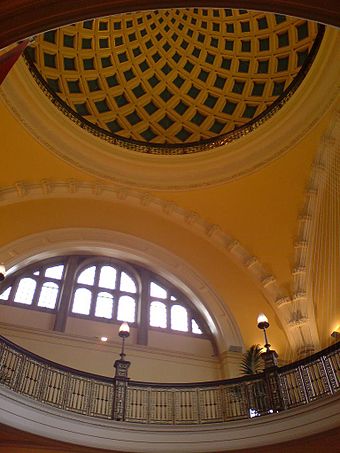
Photo: University of Birmingham Wikiwand
The building contains the university’s Great Hall where they hold graduation ceremonies. With its lofty ceiling and stained-glass windows, one particularly florid Victorian writer says of the ceremonial hall, “The Great Hall…marks the university out as a cathedral of learning.” (Source)
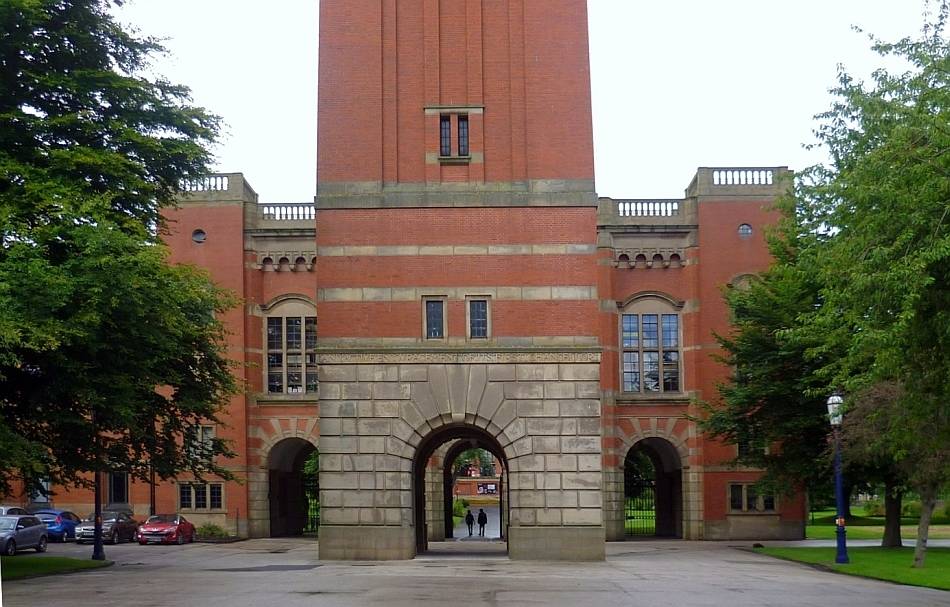
Photo: The Victorian Web
Very different than the Victorian science building, the Barber arts building is in the 1930s Art Deco style. Opened in 1939 by Queen Mary, it was “The first building to be purpose-built for the study of art history in the United Kingdom.” (source)
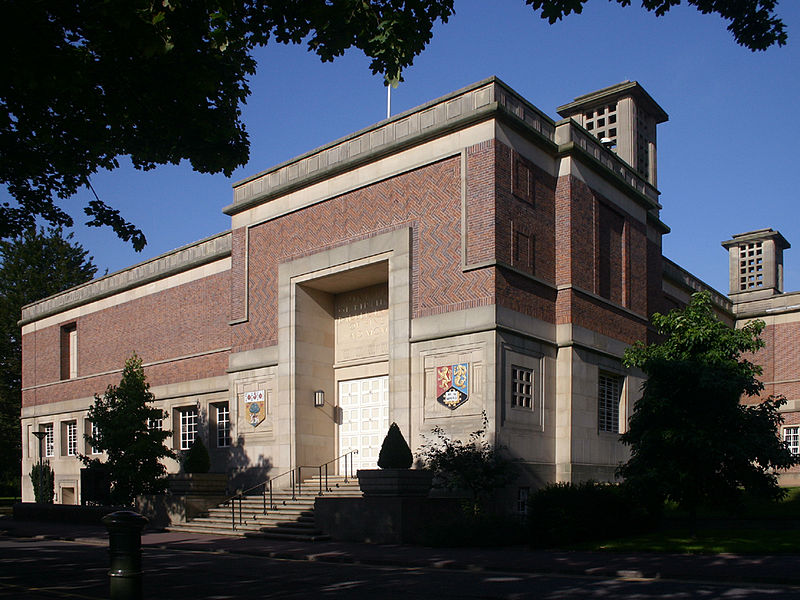
On Friday, after work, I attend a reception at the Barber Institute, which hosts a lecture by Michael Lyons, chief executive of the city of Birmingham. I talk with two city councilors from Birmingham. They tell me there are 110 councilors for Birmingham. I can’t believe the system actually works. Apparently, they manage based on a committee system, much as the U.S. Congress does.
They have a huge buffet for us. I suppose each country has its own typical buffet. In the U.S., it is potato salad, lasagna, and finger rolls. In England, or in Birmingham at least, it’s cold pizza, a spicy potato-filled Indian pastry, and egg mayonnaise sandwiches. I love the little potato pastries and eat enough to make up my dinner for tonight.
They tell me that the fine arts building has a Van Gogh, Picasso, and Monet. Sadly, I don’t get to see them and never make it back here.
Someone actually says, “Cheerio” to me tonight. It sounds strange. I wonder if he thinks the same when I reply, “Good night.”
- A word about a word: “Cheers” seems to be Britain’s all-purpose word. It is used in the traditional way that we know, as a toast. It is also used for “thanks,” “good-bye,” and “hello.” I have even heard it used as sort of an acknowledgement, like “OK.”
- In today’s news: The Birmingham Post reports that archaeologists have found new remains at a Roman site near University station, which prove that Birmingham has been around a lot longer than anyone imagined. This site, archaeologists speculate, may have had ties to the ancient Celtic Warrior Queen, Boudicea, and witness to her efforts to drive the Romans out of Britain in 60-61 AD.
 Jody’s UK Memories
