I leave for York before breakfast, but Tony kindly makes me some toast anyway. I meet their new Swedish guest as I am going out the door. He is an officer in the Royal Swedish Army here for a war studies course, which he says is very interesting.
The trip to York is about 2-1/2 hours north of Birmingham and as the train pulls into the Victorian train station, I am surprised how big it is…and beautiful. An on-line description says of the York station
Designed by William Peachey and Thos. Prosser, the station opened in 1877. It became the largest railway station in the world with thirteen platforms all excepting three being under a wondrous glass roof. A further innovation was the construction of an hotel within the station to become known as the Royal Station Hotel in honour of Queen Victoria who is known to have frequented the establishment whilst en route to Balmoral. (source)
I climb aboard the Guide Friday hop-on-hop-off bus and it takes me inside the city walls.
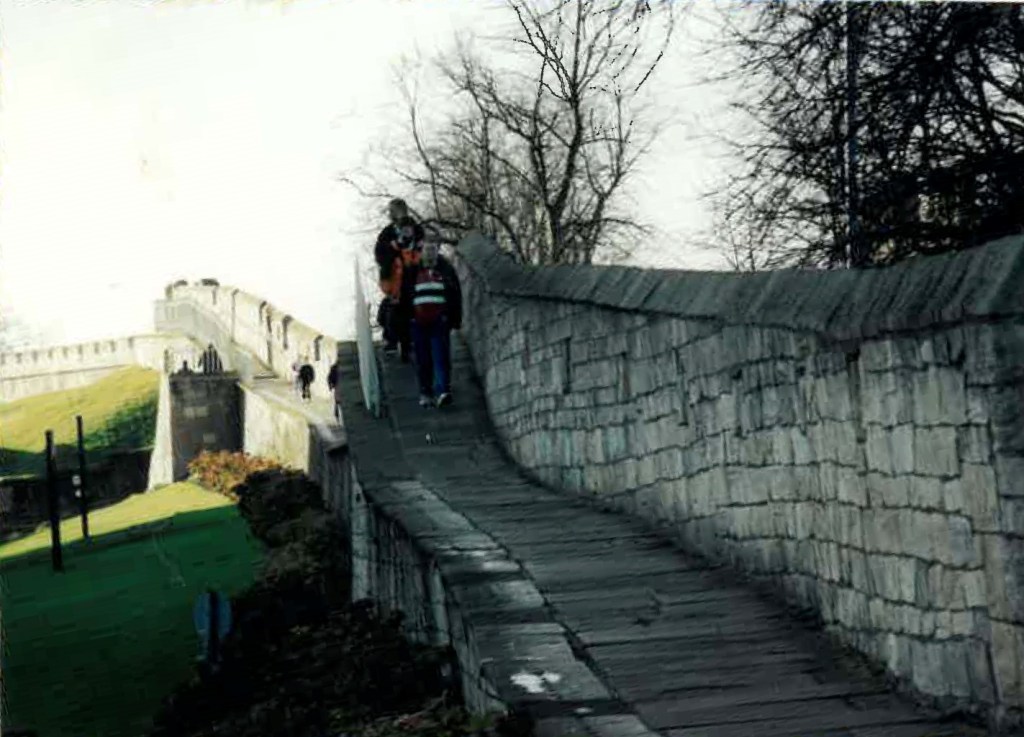
I am immediately charmed by the walled city. The old section of York is surrounded by a massive, 13-foot-high, six-foot-wide, stone wall. While the wall was constructed mostly in the 14th century, there still remain some sections built by the Norman invaders in the 11th century, and the whole thing is aligned along the original Roman ramparts. You can walk along the top of the wall for miles.
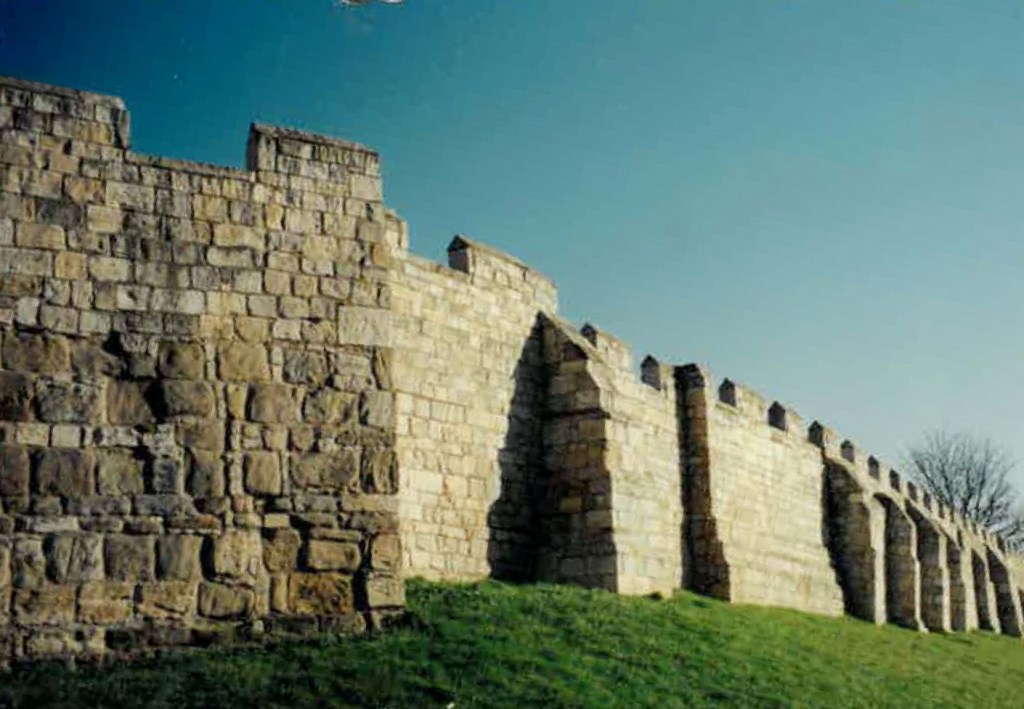
Towering gatehouses punctuate the wall at four locations with huge round-arched passageways providing entry into the old city. We enter through the four-story Micklegate Bar where the head of Richard Plantagenet (father of King Richard III) was displayed after his defeat in a battle of the War of the Roses in 1460.
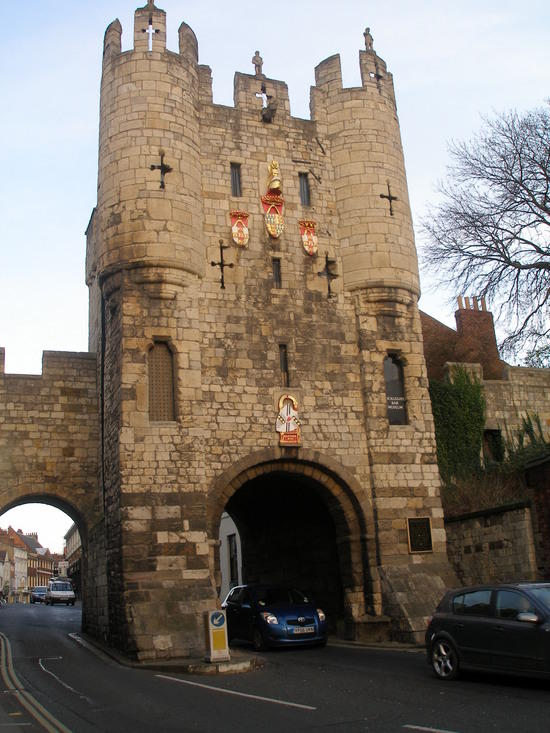
Photo: Friends of York Walls
Many of York’s street names are Danish in origin reflecting the city’s Viking heritage—Coppergate, Petergate, Monkgate—“gate” or “gata” being the Danish word for “street.”
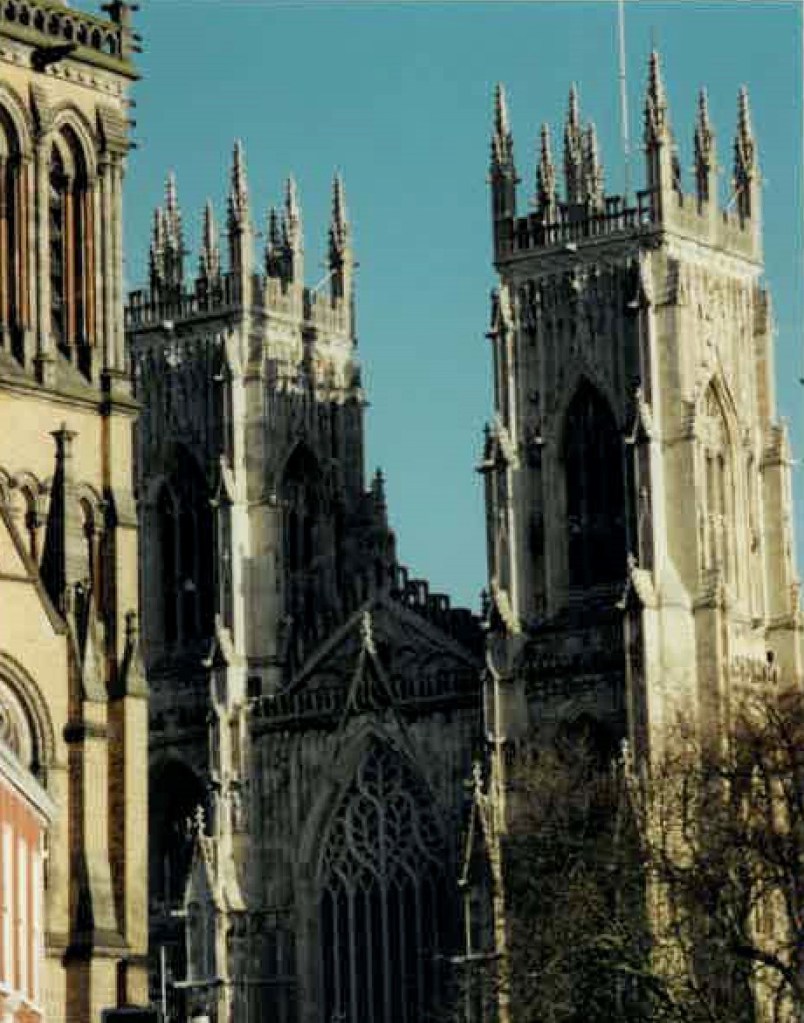
York’s colossal Gothic church, the York Minster, is the seat of the Archbishop of York. The Archbishop of York is second only to the Archbishop of Canterbury in the church hierarchy, who himself is just below Her Majesty, the Supreme Governor of the English Church.
Although resting on a foundation centuries older, the Minster with its amazing stained-glass windows dates from the 13th and 14th centuries. My guidebook says the Minster has, “The largest expanse of medieval stained glass in the world.” A magnificent rose window commemorates the 1486 marriage of Henry VII and Elizabeth of York that ended the War of the Roses.
The Minster also contains the celebrated Five Sisters Window. Each of the five narrow stained-glass windows is over 50 feet high. They are made from “a distinctive frosted, silvery-gray glass.” I find it hard to see the illustrations in the grey, dark glass.
York Minster’s Five Sisters Window is the only memorial in the country dedicated to all women of the British Empire who lost their lives during the First World War. The window, which dates from the mid-1200s, was restored and rededicated between 1923 and 1925 after it was removed during the First World War to protect it during Zeppelin raids.
yorkminster.org

Photo: © John Scurr (WMR-30648)
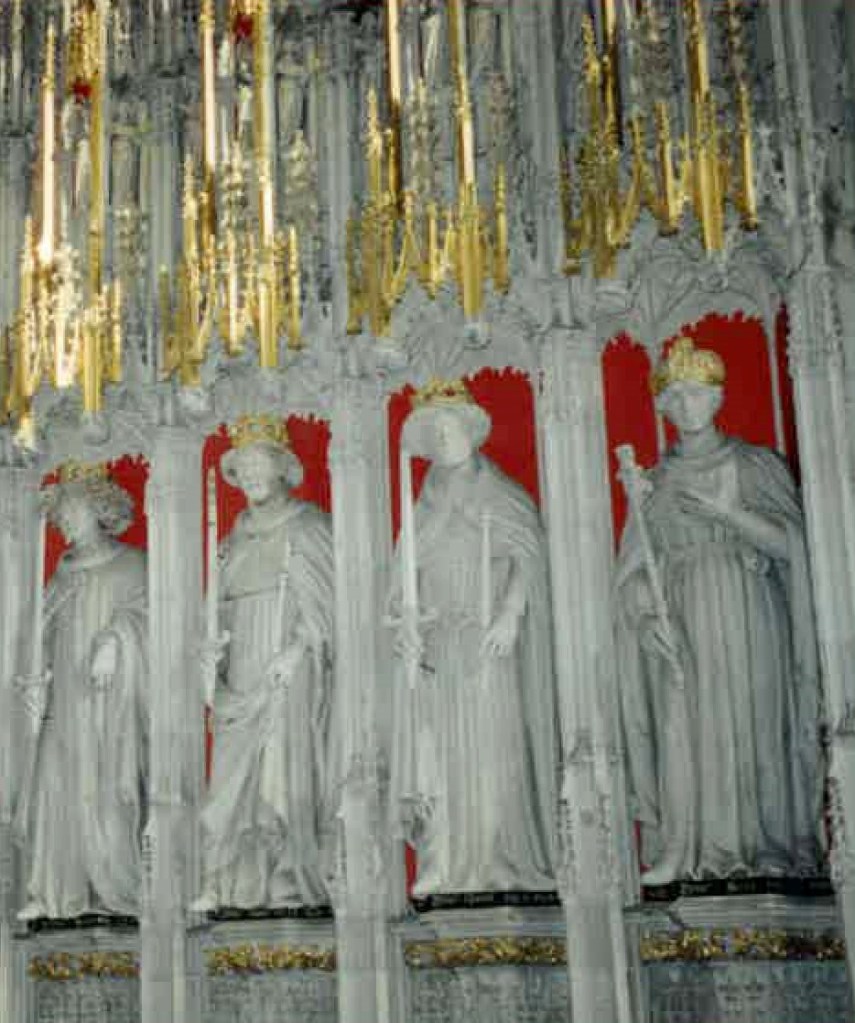
The Minster’s most arresting feature to me is the ornate 15th century Kings Screen; a stone half-wall that separates the choir from the nave. It has 15 intricately carved stone statues of English kings, from William the Conqueror to Henry VI on pedestals each wearing a golden crown.
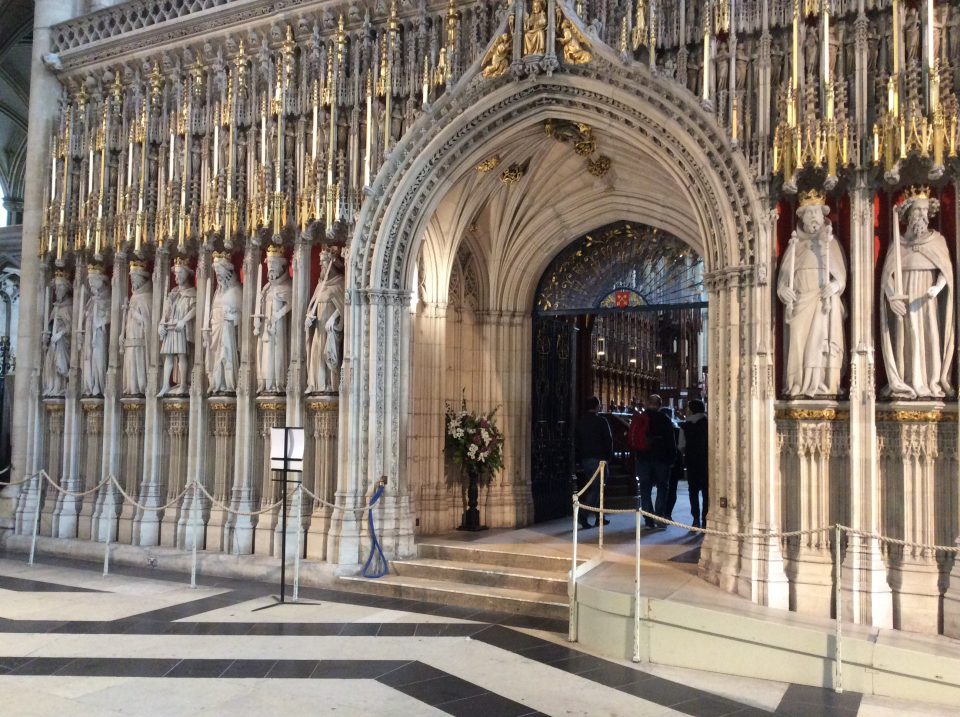
Photo: henrysixth.com
I also take delight in Gog and Magog, the two 400-year-old oak figures who use their iron pikes to strike the bell to sound the “Striking Clock’s” chime. Indeed, the little wooden men go into action at 12:45 PM while I am looking at it.
I exit the church in the rear and find the Roman Emperor Constantine, his statue marking a solitary stone pillar put there two thousand years ago by his Legions as part of his efforts to fortify this northernmost outpost of the empire.
I leave the emperor to history and walk through the heart of the city known as the Shambles where the upper stories of old timber-framed buildings lean precariously over the narrow, cobble-lined, medieval street. It feels like I am stepping back in time or perhaps into Diagon Alley in the wizarding world of Harry Potter. I look to see if I can buy a wand or invisible cloak in some dark, misshapen little shop.
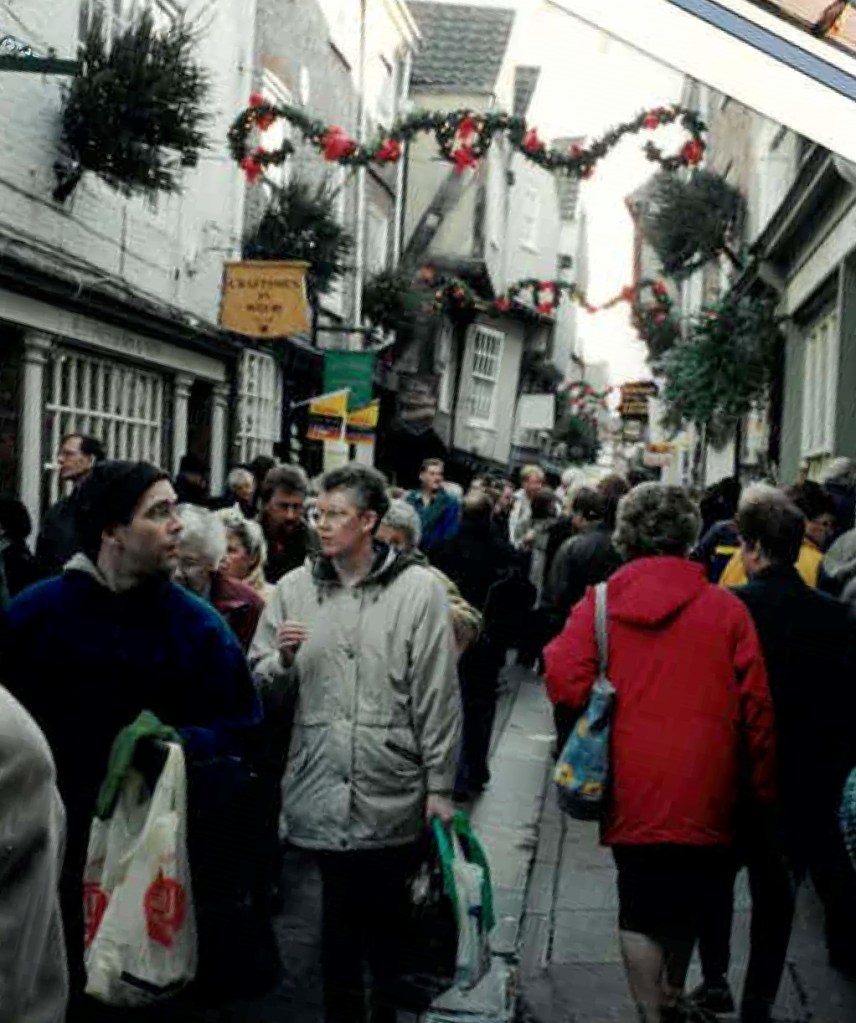
In medieval times, the street was home to the city’s butchers and bakers. Shambles is taken from the Anglo-Saxon word for “shelves” on which the butchers displayed their mutton chops and bacon. The butchers are gone, but there are several bakeries along with boutiques, souvenir shops, and fast food restaurants.
People mob the street so that I can hardly pass through, let alone look in the shop windows. I find out later that the city is celebrating St. Nicholas’ Day with a festival today.
I am looking forward to the Jorvik Viking Center with its “back-through-history” ride from present day to a Viking-age York. I wait 25 minutes in line for tickets which is nearly three times as long as the ride itself.
In 866 AD, the Vikings sailed their longships up the River Ouse and named their conquered city Jorvik or York, where they ruled for 200 years, even fairly peaceably for a few decades. A “time car” facing backwards takes us back through the decades and centuries for a show of life-sized dioramas of previous historical eras.
We time travelers ride past a group of 1960 swingers and then a man in a bowler hat from the 1940s, past a young woman in a turn-of-the-century, mutton-sleeved dress, and on past Cavaliers, Elizabethans, and medieval English villagers. We come to 1066 and can smell the burning buildings of the conquering Normans as they finally expel the Vikings.
Then the time car turns and faces forward and we proceed through the peaceful settled Viking village of 948 AD with its squawking chickens, roaring hearths, and busy market stalls. The life-like plaster figures are reconstructed from actual skulls unearthed in York’s archaeological excavations. The end of the ride gives us an overview of the earthworks and archaeological digs of the Viking village beneath the streets of modern York.
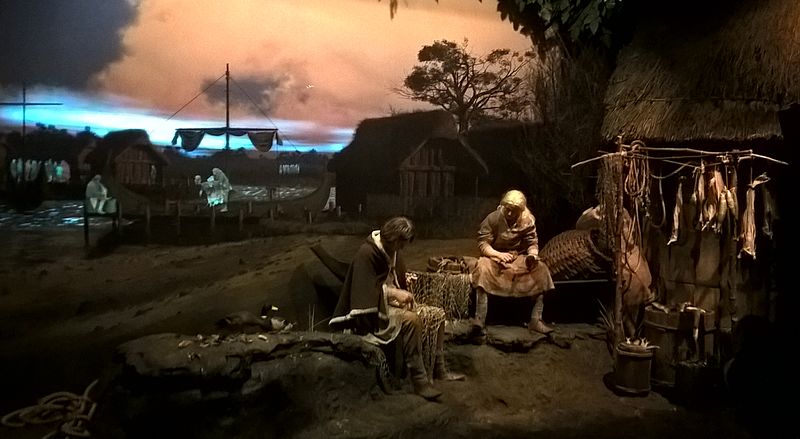
Photo: Wikimedia Commons
After having my fill of the marauding Vikings, I make my way back to the Minster and to another of the city gates—Monkgate—and walk a bit on top of the wall and take in the view. I rejoin the tour bus, which circles the rest of the city, past York Castle, and returns us to the train station.
I leave the tour and walk to the National Rail Museum. I make my way past the big steam locomotives and miniature model trains, to the Royal carriages. There, amidst flagpoles of fluttering Union Jacks and speakers ringing out “God Save the Queen,” are the Royal trains of Victoria, Edward VII, George V and Mary, and George VI and Elizabeth (the Queen Mother). The Victorian and Edwardian trains are resplendent with polished oak and brocade fabrics. In contrast, the Queen Mother’s recently retired train, much like Britannia, is plain and seemingly passé. The current Royal train is still in use. Tony Blair hasn’t gotten wind of it yet, I suppose.
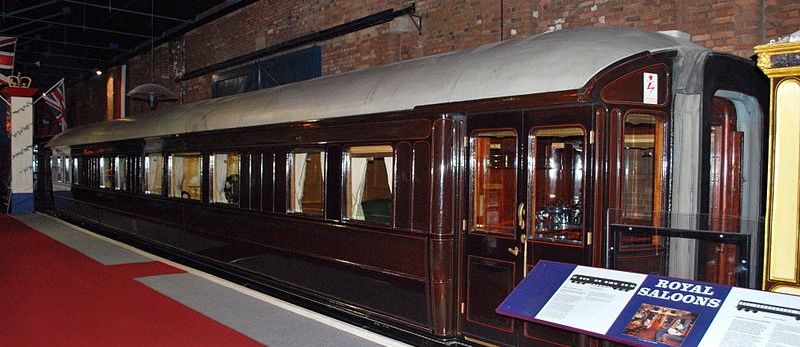
Photo: Wikimedia Commons
Back in Birmingham city center, I have dinner and walk through the squares admiring the Christmas lights. There are so many lights—much more than typical American cities. They are lovely.
 Jody’s UK Memories

.jpg)