London is a wonderful city to move around in if you are a tourist with a relatively flexible schedule, but if you need to be in a specific place by a set time, forget it. This morning on the tube, it takes me 1-1/2 hours to travel from Bayswater to Euston to drop off my luggage and then ride to Bond Street arriving at our Best Value conference in posh Grovesnor Square 15 minutes late.
The conference is quite good. We hear from the central government’s minister for local government and I pick up a lot of material that I can use for my paper. Now, I have to get busy and write the darn thing.
I get to Euston and run to catch the 17:50 PM train, making it with one minute to spare. I drop into my seat, sit back, and relax.
For as much as navigating the tube system is a hassle and time-consuming, I find train travel to be a luxury. With more than 2,500 rail stations across the length and breadth of the UK, it is easy, convenient, and reliable. There are 158 trains daily from Birmingham to London alone. The regular run from London Euston to Birmingham takes under two hours and I have made the trip so many times now, I feel like a regular.

Photo: Wikimedia Commons
Traveling by train did not become fashionable until Queen Victoria took a fancy to that mode of travel—at Albert’s instigation. She seemed to set the style for everything, didn’t she?
Generally, Euston station to the north is the terminal for trains going to Birmingham and north-northwest. Victoria is for southbound trains including routes to Gatwick and Dover while trains departing to Heathrow and points west—Bath, Cornwall, and Wales—leave from Paddington. And Kings Cross trains go north-northeast to Yorkshire and Scotland and, of course, to Hogwarts.
There are a few little quirks in UK train travel. First, train schedules run on military time. It has taken me time to learn it without counting on my fingers every time. But now, three months into my fellowship, I have mastered the 24-hour clock―and it may be a better system for telling time.
The seats are numbered based on which way they face—forward or back. So, there are two seats with the same number. This does not mean that two people have the same seat, rather it means you must look again to see if you’re in Seat 5 Forward or 5 Back. I don’t know how I manage it, but I invariably chose a seat that is facing backwards, which sometimes makes me a little motion sick.
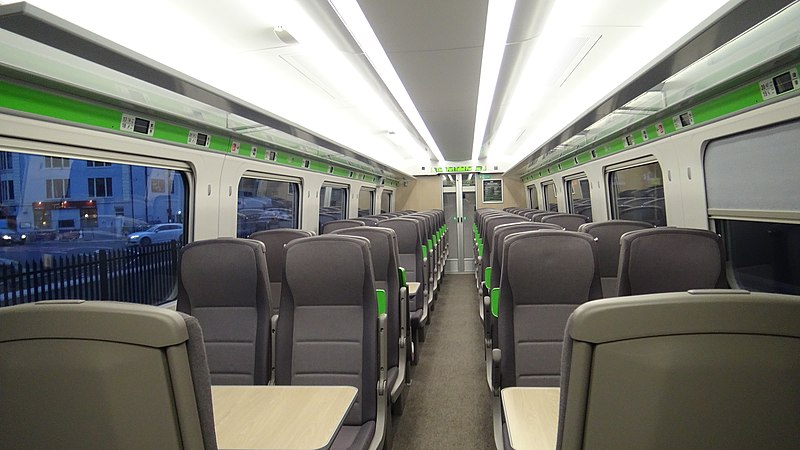
Photo: Wikimedia Commons
As always, Bill Bryson puts it best
The platform televisions weren’t working and I couldn’t understand the announcements―it took me ages to work out that “Eczema” was actually “Exmouth―so, every time a train came in, I had to get up and make inquiries. For reasons that elude rational explanation, British Rail always puts the destinations on the front of the train, which would be awfully handy if passengers were waiting on the tracks, but not perhaps ideal for those boarding it from the side. Most of the other passengers evidently couldn’t hear the announcements either because when the Barnstable train eventually comes in, half a dozen of us formed a patient queue beside a BR employee and asked him if this was the Barnstable train…there is a certain ritual involved in all of this. Even though you have heard the conductor tell the person ahead of you that this is the Barnstable train, you still say, “Excuse me, is this the Barnstable train?” When he acknowledges that it is, you have to point and say, “This one?” Then when you board the train you must additionally ask the carriage generally, “Excuse me, is this the Barnstable train?” To which most people will say that they think it is, except for one man with a lot of parcels who will get a panicked look and hurriedly gather up his things and get off.
Bill Bryson, Notes from a Small Island
Tonight, on the train from London to Birmingham, I read my Brother Cadfael mystery. Just as I am reading about the good brother setting out for his three-day journey from Shrewsbury to Coventry on horseback, my train whizzes through Coventry. I love this little coincidence!
On Tuesday, I attend a lecture by Dr. Henry Tam; deputy chief executive for the Town of St. Edmundsbury. Well-spoken and incredibly intelligent, he advocates for a system of policy reform that he calls “Communitarianism.” He criticizes the Blair government saying that it isn’t a “third way” at all. I don’t think he made a great hit with the public policy staff, but I enjoy his talk.
I go to lunch with a group of the staff (Helen, Philip, and Mike). We eat at a café on Bristol Road, not far from my B&B. It serves Persian food, similar to, but not quite the same as, Lebanese. I have potato burgers, which are like potato pancakes, fried and crispy, but served with a tomato coulis. They are yummy.
I was right. My colleagues were not impressed with Dr. Tam’s views. They ask me what I thought of the lecture and I tell them he was interesting, but that he didn’t tell us what communitarianism was. He only told us what it was not. “Exactly,” they say excitedly. But, I suggest, “British local government could be run in a nonpartisan way, like in the U.S.” This is something that Dr. Tam advocated, but they can’t get their heads around it. They base a lot of their argument on the tradition of council members representing a party. “How will citizens know what (council) members stand for? How will members know how to vote if they don’t have a party platform?” I understand that local governments in the UK manage and fund social services, which towns in the U.S. do not, and choices on funding these types of services vary based on political party values. But they have no answer to my question, “What is the party platform on picking up trash?”
My friend Lisa is visiting in December and we are planning a weekend trip to Paris. I start working on arrangements—Chunnel tickets and hotel reservations. I am nervous about calling the Paris hotel with my limited French vocabulary. After some trouble getting through, a woman finally answers in French. I say, “Bonjour. Parlez-vous anglais?” And thank goodness she says, “Yes.” Her English is heavily accented, and I am sure she doesn’t understand me any better than I understand her. But now, at least, the telephone barrier is broken. Tomorrow the fax. I have to fax her my credit card information to confirm the room.
- In today’s news: Buckingham Palace has rejected suggestions that the Queen may abdicate rather than rule throughout her old age. Their statement comes as a result of comments from Prince Phillip, who was recently quoted as saying, “It’s much better to go while you’re still capable, than to wait for people to say you’re doddery.”
- In an interview with Saga magazine, which was reprinted in The Daily Telegraph, Prince Phillip, speaking about worker retirement, is purposefully obtuse. When Mr. Keay, the interviewer, suggested the Prince might be in a different position to others considering retirement, Prince Phillip responded, “Why?” Mr. Keay said it was a fact that the Queen was not going to abdicate, and Phillip replied, “Who said that?” The interviewer said it had always been understood that the Queen would not abdicate, Phillip said, “Well, you’ve said it.”
Thus, the Palace’s retraction.
 Jody’s UK Memories

