Off to London today. Stacy has arranged for the fellows to tour the Houses of Parliament and, afterwards, the Plowdens have invited us to a cocktail party at their home.
My train pulls into London Euston at 14:20. The hotel that the BC arranged for me, instead of being 10 minutes by cab on Oxford Street, is 35 minutes away in Bayswater. It has a big, bright lobby, but my room (a single with one twin bed) is smaller than you can imagine. The bed is barely big enough for one person and I cannot turn around in the shower.
Being further afield than I planned, I am late meeting everyone at the scheduled time of 3:20 PM at Westminster Palace. I run down Parliament Street, past the statue of Churchill on the corner of Parliament Square Park, arriving breathless about 3:35 PM. I am relieved to see my group is still there. We gather at St. Stephen’s Gate, go through security, and enter one of the most famous buildings in the world.
Parliament is located in Westminster Palace, which most people don’t realize is owned by the Crown, although Parliament has met here since the 13th century. An older building sat on the same site but was mostly destroyed by fire in 1834. It is an enchanting neo-gothic building of honey-colored stone that runs nearly a quarter of a mile along the bank of the Thames. With its fairy-tale spires and towers, Tsar Nicholas I of Russia called the building, “a dream in stone.” (source)
We enter the building and walk along St. Stephen’s Hall towards the Central Lobby. The hall is lined with historical paintings and statues. Our guide tells us these were Prince Albert’s idea to draw attention to Britain’s heritage. Spaced along the hall on both sides are marble statues of the prime ministers.
We have hired a private guide for the evening, Mary, a Blue Badge tourist guide, who is extremely knowledgeable as she explains the significance and symbolism of the State Opening of Parliament that we have all just seen on TV.
In the massive octagonal Central Lobby, soaring Gothic arches are interspersed with stained-glass windows so that I feel like I am in a church rather than a government building. I crane my neck upwards to take in the high, arched windows surrounded by stone statues of all the British monarchs stacked three high. This is the central crossroad between the House of Commons and the House of Lords.
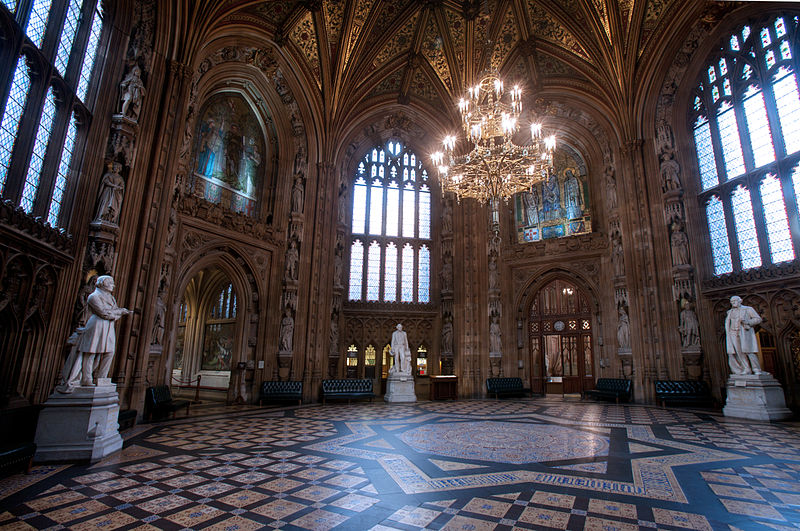
Photo: Wikimedia Commons
Two long corridors (the Commons Corridor and the Peers Corridor) lead off from the Central Lobby to each of the parliamentary chambers. The House of Commons with green benches is to the north and the House of Lords with regal red seats to the south. Along the Commons Corridor are paintings of scenes from the Civil War “specifically chosen to depict the struggles through which national liberties were won.” I can’t quite reconcile the idea of greater freedoms with the fanatical Puritan Oliver Cromwell but I suppose they are talking about the greater parliamentary powers that evolved from this conflict.
On the door to the House of Commons, we can see a huge dent from the whacking by the Gentleman Usher’s black ebony stick. Just outside the door is a large bronze statue of Winston Churchill. Like bronze statues do, it has turned black over the years. Except Churchill’s bronze left foot, which is as bright and shiny as a new penny. Mary tells us this is because everyone who passes through the door touches Winston Churchill’s foot. So, of course, we all do too.
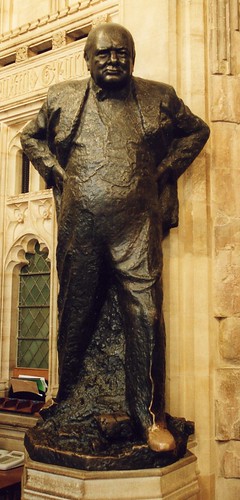
Photo: Pinterest
Westminster Palace’s clock tower—Big Ben—is Great Britain’s iconic symbol. Big Ben is not the name of the tower or the clock, but of the 14-ton bell, named after Sir Benjamin Hall, a Welsh politician and engineer who oversaw the bell’s installation. Mary tells us a red light on the top of the clock alerts people to when Parliament is in session. I did not know that!
We exit through the 900-year-old Westminster Hall, yet another huge cavernous hall and the only original part of Westminster Palace not destroyed by fire. England’s second King, William Rufus, built Westminster Hall in 1097. Rufus, only one generation out from the Norman invasion and still trying to cement the dynasty, intentionally built the large hall—the largest in Europe at the time—to impress his new subjects. Charles II and Guy Fawkes were tried and convicted here 44 years apart.
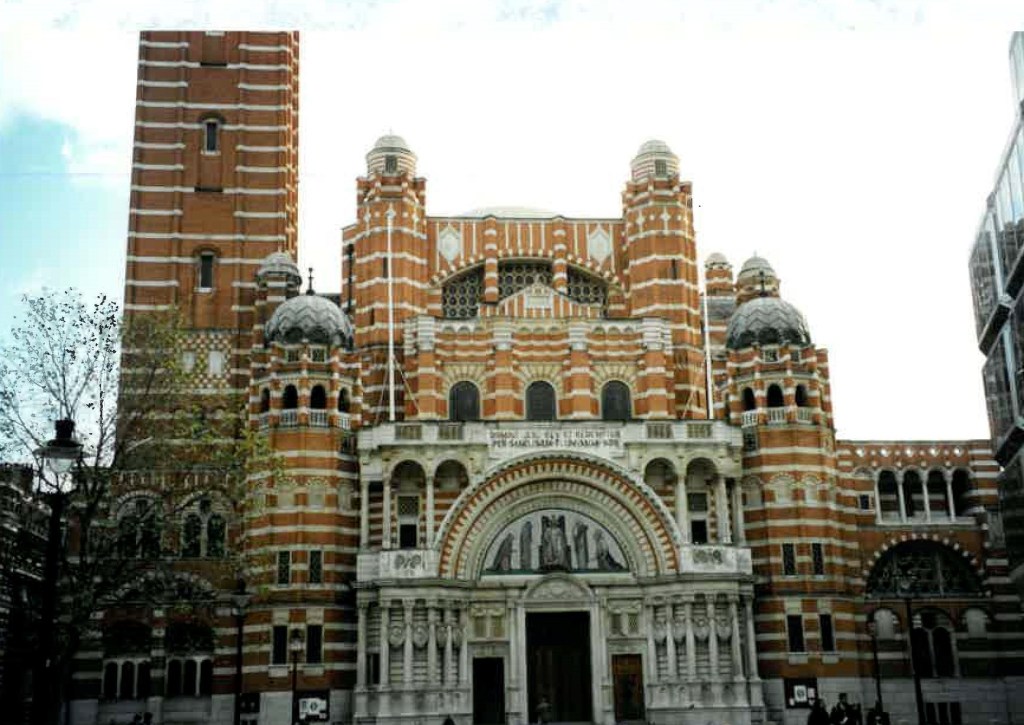
After leaving the Houses of Parliament, we walk to Westminster Cathedral, not to be confused with Westminster Abbey. The abbey, by the way, looks very clean and bright as we walk past it. I remember how black with grime it was when Mom, Brian, and I visited a number of years ago. Our guide said it took 25 years to clean; slow work because of the soft stone which had to be treated carefully.
Westminster Cathedral, near Victoria station, is a Catholic church. Its mosque-like architecture is beautiful and unique and a contrast to the Gothic abbey. Constructed in 1903, when Catholics were not allowed to buy land, the church hierarchy had to get a middleman to purchase the site for them. Just shy of 100 years later, but in time to celebrate the Millennium, church officials have planned a march from Westminster Abbey, the Anglican church, to Westminster Cathedral, the Roman Catholic one. We go in, but there is a mass going on, so we don’t stay long.
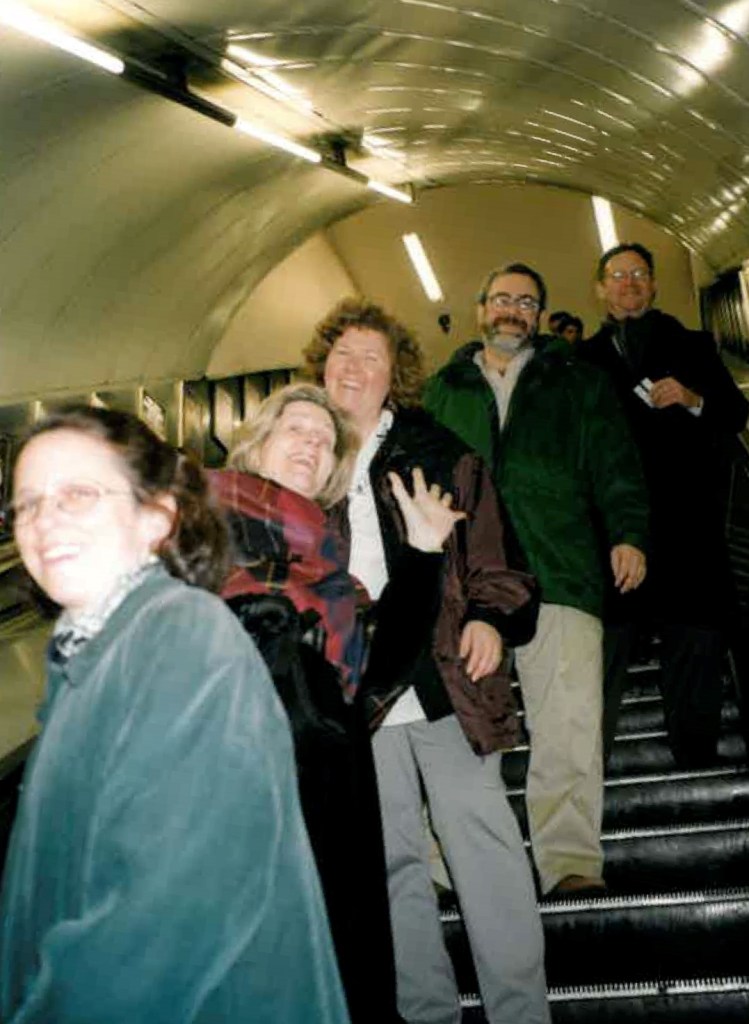
We are a smaller group now as those with children go back to their hotels to take care of meals and sitters. The rest of us head to a pub. After two pints in the smoky pub, we walk to Victoria station. Tube travel always takes longer than you expect, and we arrive about 45 minutes late for the Plowden’s party, which is already in full swing.
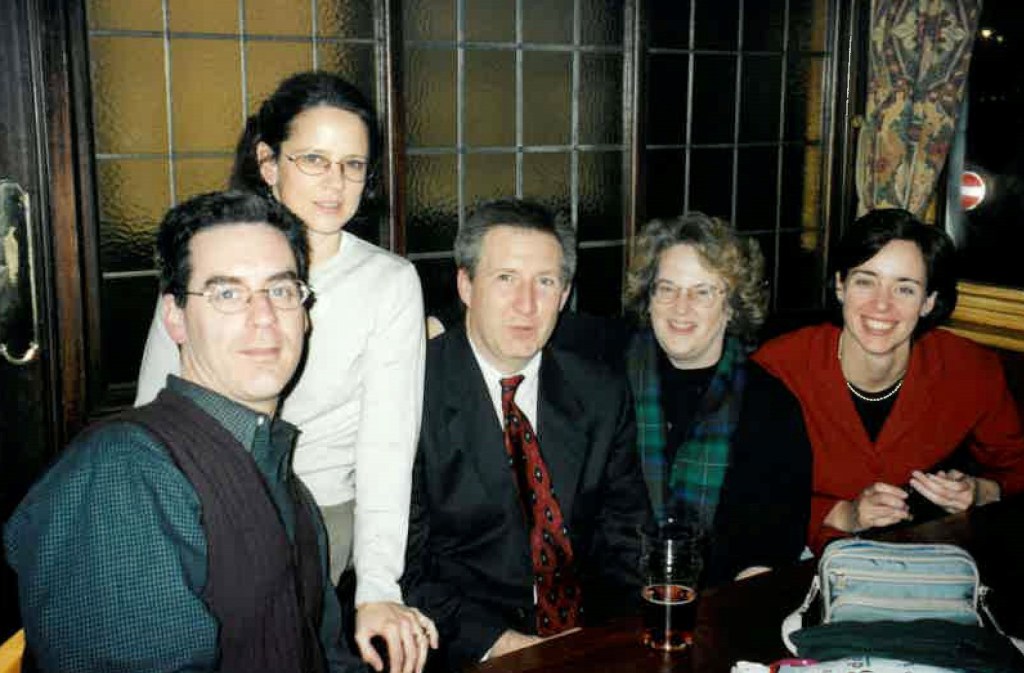
William and his wife, Veronica, live in south London off the Stockwell tube stop. It is a narrow townhouse with 3-1/2 levels filled with books. I ask Veronica where the bathroom is and she says there are two, one at the top of the stairs and one off the room where we stashed our coats. I chose the latter but, unless I am losing my mind, there is only a bathtub and linen closet in there, no toilet. Why she told me to use it, I have no idea. Sometimes I don’t understand the Brits.
William offers us drinks and I am soon talking with Elizabeth Mitchell again, who is there with her husband this time. I also meet the Atlantic Policy Program’s other Maine fellow—Tom Judge from Port Clyde—a 1996 fellow. So, the three of us from Maine stand in a circle and speculate about the Maine connection to the fellowship program. I mention George Mitchell, but Tom is convinced that is not it.
I meet lots of interesting people. One, a news reporter, has a Scottish accent that makes him sound like Sean Connery. Stacy questions him about the lack of coverage of the Scottish Parliament in the English papers to which he has no good answer.
I leave around 10:30 PM taking the tube at the Stockwell station, changing at Victoria, and back to Bayswater. I fall asleep almost immediately.
- In today’s news: Blairs expecting a baby. Tony Blair and his wife Cherie are expecting a new baby—the first for a serving prime minister in more than 150 years. Mrs. Blair, 45, and her husband are said to be delighted at the news though it came as a “total shock.” The couple already has two sons, Euan, 15, and Nicky, 14, and a daughter, Kathryn, 11. The baby is due in May.
 Jody’s UK Memories
