The sun is shining in Paris this morning and I have a totally different outlook. I feel I can hold my own with any rude French proprietor or civil servant.
We find a patisserie and order croissants and café. If you order café in Paris, you get espresso, as I discover to my chagrin. I am handed a tiny cup of very strong black coffee that I drink in three gulps and hope there is enough caffeine to avoid any headaches. Next time I will know to order café au lait.

Photo: Wikimedia Commons
We adore the Musee d’Orsay—an amazing museum of French artists—located in a vast, former railway station, Gare d’Orsay. There are more famous paintings here under one roof than anywhere in the world. A huge charcoal canvas of the risqué Moulin Rouge dancers by Toulouse-Lautrec is the first thing to greet us. From there, we go into a room full of Degas’ ballerinas. After that I lose track—Monets, Manets, Van Goghs, Renoirs. We turn a corner and there is Whistler’s Mother. Then there are the Gaugins, Cezannes, and Sisleys. We see Van Gogh’s famous self-portrait; Monet’s water lilies, and Renoir’s City Dance and Country Dance. In addition to the paintings, there are Rodin sculptures, Tiffany glass, and antique furniture.
There is a special exhibit called, Aux Colours de la Mer (The Colors of the Sea), which contains an assembly of all the museum’s French seascapes. Manet painted his On the Beach in the open air and we can see tiny specks of sand in the paint blown by the wind and embedded there before it was dry. I think this is very cool—a palpable link to the very moment that Manet painted it that instantly transports you 125 years back in time.
I see a painting by an artist whose work I recognize but did not know his name. James Tissot and his painting The Ball is very like a print hanging in my bedroom at home. My Tissot—A Woman of Ambition―features a pretty young woman from the 19th century―a Gibson-girl-type―her brown hair piled high upon her head. She is on the arm of a much older, white-haired man. We see them back-to as they enter a crowded salon party, but her head is turned toward the viewer so we can see her full in the face. She is fashionably dressed in a high-neck, tight-corseted gown of layered pink flounces and carries a large fan of pink feathers. Behind their backs, two men have their heads together, their gloved white hands covering their mouths as they gossip to each other about the pair. I love everything about this painting―the colors, the clothing, the period it represents, and the hint that something slightly improper is going on. The d’Orsay’s painting is so similar to mine but, in this one, the woman is blond, wears a yellow dress, and the scene is cropped tighter with no gossiping old men on the sidelines. I am glad to learn the artist of my print.
The last room we explore contains more Renoirs, Monets, and Bazilles. There is an evocative painting by Monet called La Pie (the Magpie) that captures my imagination. It is a snowy scene of a tiny black bird sitting on an old wooden gate; the gate creates an opening in a stout fence that runs the length of the picture. The snow-covered ground at the base of the fence is shaded, but I can feel the warmth of the sun spilling out beyond its shadows. I buy a huge, five-foot-long print of this painting. The d’Orsay’s website gives me some history of the painting:
In the late 1860s, Monet tackled the great challenge of a snow-covered landscape; a frail magpie perched on a gate, like a note on a staff of music… Sun and shade construct the painting and translate the impalpable part-solid part-liquid matter [and] the Impressionist landscape was born. This painting of a place in the countryside near Etretat [in Normandy] uses very unusual pale, luminous colours, a fact…[that flabbergasted the public who were used to bold colors]. The novelty and daring of Monet’s approach, which was more about perception than description, explain the painting’s rejection by the jury of the 1869 salon. (Source)
I am happy with my purchase, but I may not have thought it all the way through. I now have to hand-carry the long, rolled-up poster tube with me on planes, trains, and automobiles from Paris to London to Birmingham, back to London and through the Heathrow and Boston airports.
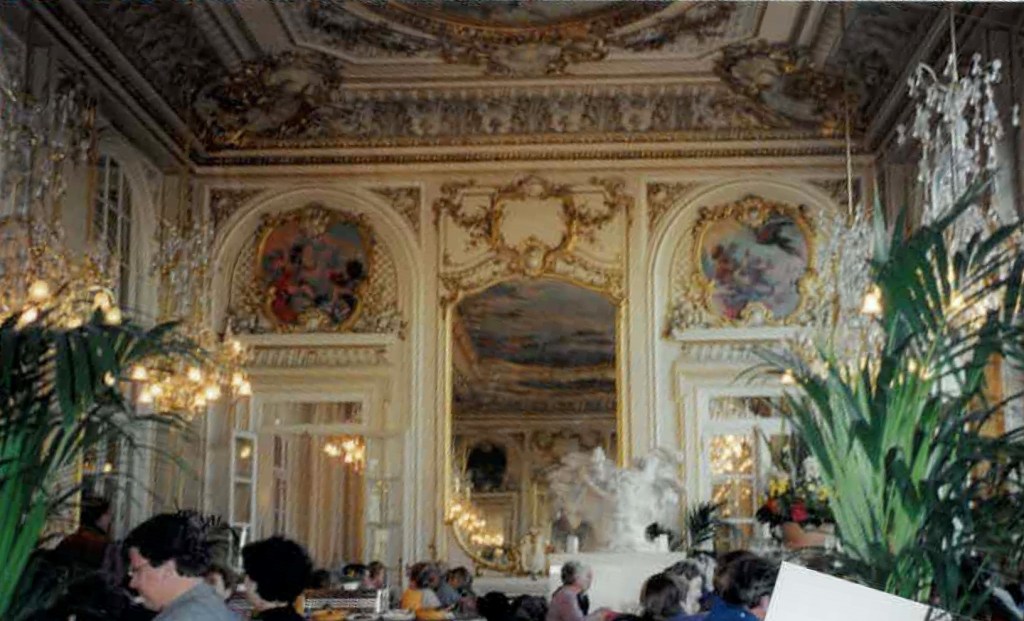
We eat lunch in the museum’s elegant sit-down restaurant—a huge, mirrored, chandeliered room with elaborate ceiling frescoes. It feels good to sit down. I order the special, a mild white fish and an ice cream for dessert that is creamier than any ice cream I have ever had.
The d’Orsay’s impressionist paintings stay with me for years. My leisurely stroll through the museum is an intense course in art history. For a long time, I can tell the difference between Cezanne and Sisley and recognize a Gaugin from 100 paces. I come away with a deep appreciation for Renoir to whom I had barely given a thought before. I fall in love with Monet’s misty, dream-like scenes. The d’Orsay has enriched my life.
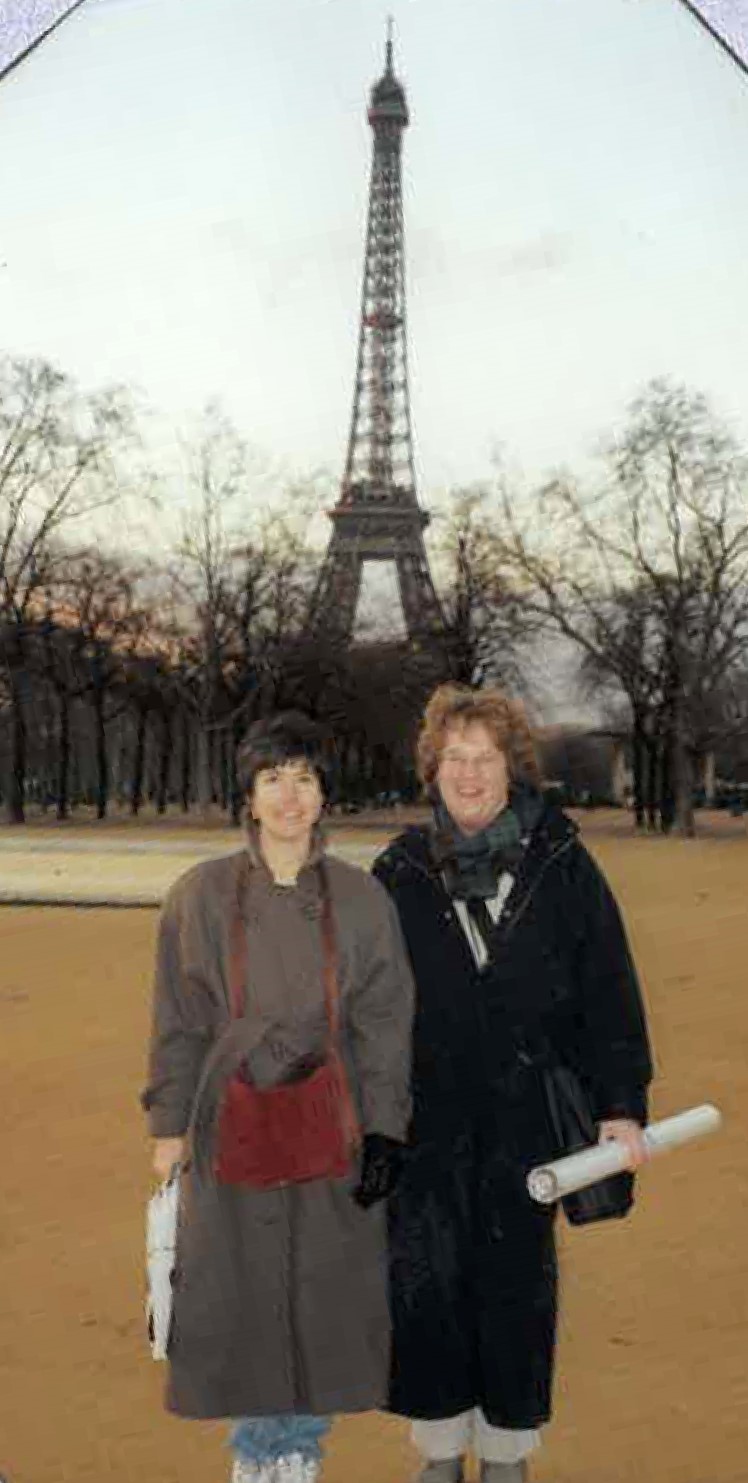
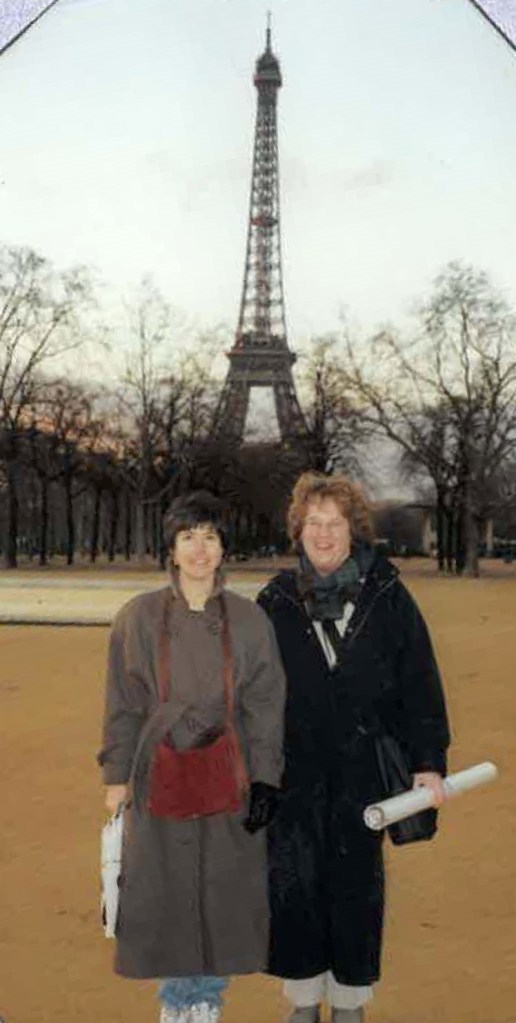
We stay almost the entire day; it is after 4:00 PM when we leave. We take the tube to the Metro stop at Ecole Militaire and walk towards the Eiffel Tower. We had expected to be able to see the Eiffel Tower from everywhere in the city, but so far, we have not even had a glimpse of it and even now this close to it, there is a tall building blocking our view as we walk east. Then suddenly, it comes into view towering over the large grassy plaza that fronts it. We are thrilled.
It is daylight (barely) but, by the time we get through the line to go up the Eiffel Tower, it is dark. We stand in line for the elevator for an hour, which, in 30 seconds, takes us up what would have been a 300-step climb. We are too cold to go further than the first level. Still, we have an amazing view of the sparkling city of lights. We can see the Seine River snaking through the city, and the brightly lit gold dome of Les Invalides, which holds Napoleon’s tomb. It is very windy and soon, defeated by the cold, we descend.
Gustave Eiffel designed the 1,063-foot-tall Eiffel Tower to serve as the gateway to the 1889 World’s Fair. It was meant as a temporary addition to the Paris skyline but has been there ever since. For 40 years, it stood as the tallest man-made structure in the world until New York’s Chrysler Building topped it in 1930.
Turning around to look back at the monument as we walk to the Metro, I think it is prettier lit up at night than during the day and it is prettier than pictures or postcards portray it.
From Ecole Militaire, we change at Sevres Babylone and get off at our home stop, Odeon. We rest in our room for a bit before going out to dinner. It is nearly 8:00 PM by the time we find a creperie (crepes being highly recommended by Barbara and Dean). The art-themed restaurant is located on the Rue des Arts. My crepe is the Picasso of crepes with sausage, cheese, mushrooms, and a mustard sauce. I order what I thought was a glass (verre) of Gamay wine, but end up with a half-bottle instead. It is good and I drink the whole thing as Lisa has only a sip. We sit and talk for an hour before walking home, browsing the shops along the way.
By the end of our first full day in Paris, I have figured out the currency. It is a 10:1 ratio of francs to pounds. By simply dividing by 10, you can easily convert it: 200 francs equals £20; 100 francs equals £10; 5 francs equals 50p; 1 franc equals 10p. Lisa tries converting pounds to dollars, but I gave up doing that months ago.
It seems so strange that it is less than a week until Christmas and even stranger still to think that I am in Paris a week before Christmas.
 Jody’s UK Memories

