It snowed in Birmingham today. While waiting for my bus to London, I see it start to gently fall in soft, wet flakes. Later, on the bus traveling south, the wet snow sticks to everything. It looks like the snow in my Christmas postcard.
The taxi dispatcher isn’t quite sure what I am talking about when I call for a ride to Birmingham’s Digby bus station. “Do you mean the “coach” station?” she asks.
The bus station is not really a station. It looks like a big garage; open to the air on both ends where the buses enter and exit. The buses unload passengers at bays lettered A-M. It is cold and damp and the snow delays the London bus. Visibility looks bad as we get on the highway; the speed limit signs blink 30 kph. I sleep and doze most of the way. After one stop at Golding Green station, we arrive at Victoria station a little before 4:00 PM. A porter helps me with my luggage and I get a taxi to the BC offices. The taxi waits while I take two bags in. The BC staff assures me they will be open on January 4 so I can pick them up again before heading to the airport.
When we drive by Buckingham Palace, the taxi driver tells me that because it is the Union Jack flying over the palace, not the Queen’s standard, the Queen is not in residence. I know that traditionally no flag flies when the Queen is away. But he says all that changed after Princess Diana’s death and the furor over the flag.
At the Winchester Hotel on Belgrave Road near Victoria Station, I am not sure what to expect because when I called to reserve a room last week, the proprietor was quite rude. But a friendly Irishman checks me in. But then a scruffy, curmudgeonly man comes to get luggage my and I know he is the grumpy fellow who took my reservation. He grabs my bag and tells the Irish receptionist to carry my box. I say, “No, it’s not that heavy, I can get it.” He says, “You’re right, I wouldn’t trust the looks of him either.” To which I reply honestly, “Actually, he looks more trustworthy than you!” I think I get a grudging smirk.
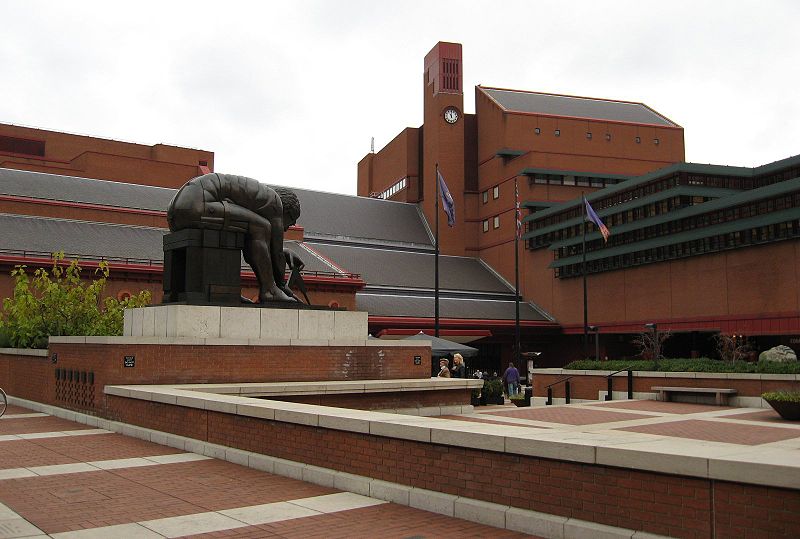
After a rest and change of clothing, I make my way to the British Library where the Harkness Fellows, a health care policy fellowship program, have graciously invited the Atlantic Fellows to their Christmas party.
The British Library’s massive building is located on Euston Street. The party is in the Pearson Gallery where there is currently an exhibit on British postage stamps. The library’s philatelic collection comprises eighty million stamps.
I run into Andy and Rebecca and Dean as I walk in. We make our way to the Pearson Gallery where William Plowden greets us and gets us some wine. A very attentive waiter never lets my wineglass get more than half empty. Only white wine is being served because, William tells us, red wine, if spilled, would stain the costly marble floor. There are 50-60 people there. Frank and Carolyn are there. Stacy and Matthew arrive a few minutes later with Stacy’s mom. Stacy is planning a going-away dinner for me on December 29 when I am in London. That is so nice of her.
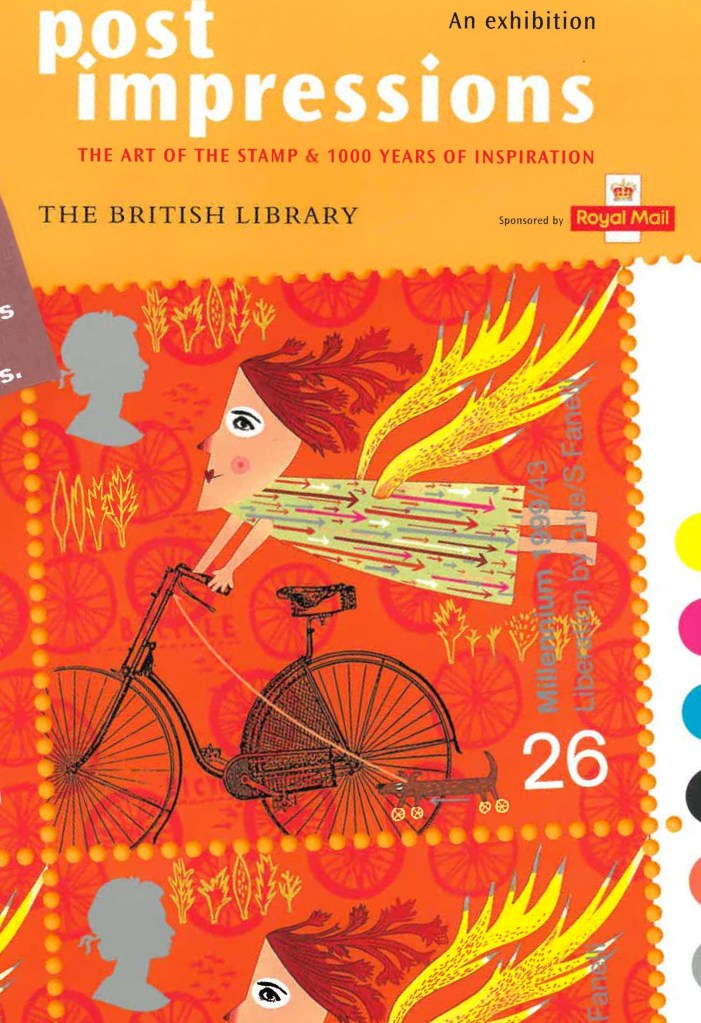
The British Library is the depository for all of Britain’s recorded history. Among its countless treasures are: The first Gutenberg bible, Chaucer’s Canterbury Tales, Magna Carta (two copies), Leonardo da Vinci’s notebook, Shakespeare’s First Folio, explorers’ original map of New Amsterdam in the New World, Captain Cook’s journal, Charles Darwin’s natural selection letter, Jane Austen’s Jane Eyre manuscript, Handel’s musical score for the Messiah, oral histories of Jewish survivors of the Holocaust, a recording of Gandhi’s Spiritual Message to the World, and sheet music from the Beatles. I know the Library of Congress has a similar astounding collection and it boggles the mind to think of all these important works assembled in one place. I am happy they are preserved. At the party, of course, we don’t get to see any of these things, except the stamps. I must come back here if only to see the Magna Carta.
When I traveled to London for my senior class trip, I desperately wanted to see the Magna Carta. I dragged my travel companion, a high school friend, Donna Bennett, to the British Museum. We moved quickly past the Rosetta Stone, the Elgin Marbles, the Egyptian mummies, directly to the case that contained the Magna Carta. Only when we got there, there was a little sign in the place where the transformational historical document should have been saying the Magna Carta was on loan to the U.S. as part of a traveling exhibit celebrating our nation’s bicentennial.
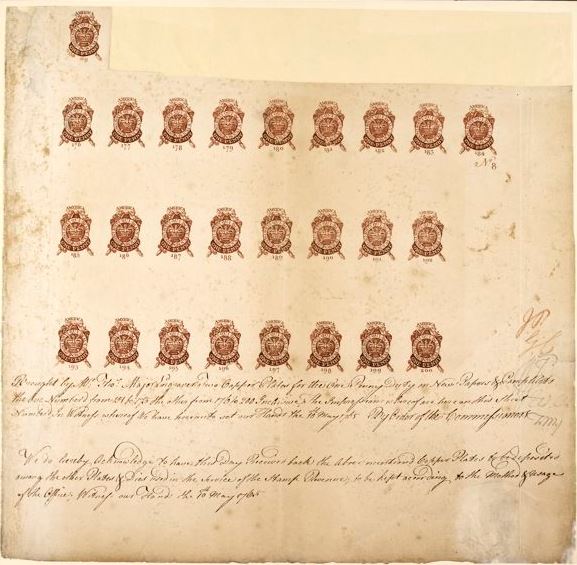
Photo: The British Library
There are a few speeches and toasts and enough canapés that I don’t need dinner.
I take a taxi back to my hotel. The city is brilliant—all lit up with twinkling Christmas lights. I am mesmerized as my taxi hurdles down Piccadilly and rounds Wellington Arch in front of Buckingham Palace and onto Grovesnor Place. It is magical.
The Christmas lights in London are elaborate with over-sized decorations—angels, stars, snowflakes, even peacock feathers—looping across the streets overhead and millions of lights draping trees, buildings, and lamp posts. The best-known lights are on Oxford and Regent streets, chic shopping areas, where there are splashy events with celebrities turning on the lights in mid-November.
 Jody’s UK Memories