People either love performance measurement or they hate it and my research topic generates a lot of discussion among the fellows. Fellow Kathy Taylor, who clearly is in the skeptical camp, says performance measurement is probably good in my hands, but not everyone is as reasonable an administrator as I am.
A law and public administration professor, Peter Falconer, is here from Glasgow Calendonian University to comment on my presentation, He is great! He volunteers to write up his comments and send them to me. I think that will be a tremendous help in framing my paper.
Dean and I meet with the strategic planning person for Edinburgh County Council and then I am free for one last afternoon in Edinburgh. I move out of my chic, BC-funded hotel, to the Travel Inn in a much less grand part of the city; located behind Edinburgh Castle. I dump my stuff and head to the Writers’ Museum, which closes at 5 PM, so I only have about an hour.
The Writers’ Museum celebrates the lives of three giants of Scottish Literature―Robert Burns, Sir Walter Scott and Robert Louis Stevenson. Although their lives stretched over a century and a half, there is much more that connects these three outstanding writers. Their sense of being Scottish is fundamental to their work and each, in turn, created a lasting awareness of Scotland, inspiring writers and lovers of literature the world over.
Edinburgh Writers’ Museum website
The museum is located just off the Royal Mile through a short passageway, called the Lady Stair’s Close, which brings me to an open courtyard in front of the museum. The courtyard’s flagstones are engraved with quotes from famous Scottish authors. This one catches my eye:
Sing it aince for pleisure / Sing it twice for joy
J.K.Annand
Despite the Robert Burns-sounding dialect, I look up the author to learn he is a modern children’s poet.
The three-story museum, a graystone manor house―brandishing lots of turrets, chimneys, and dormers―has one prominent round turret with a sweet little Romeo and Juliet balcony.
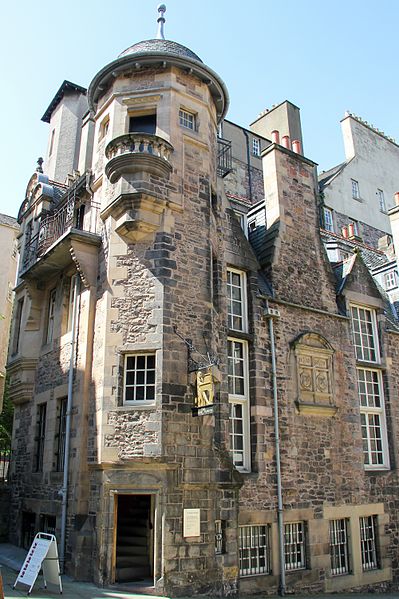
Photo: Wikimedia Commons
The museum is split into three floors―one for each author―reached by a narrow, stone spiral staircase. It contains manuscripts and personal items. There is a mini scale replica of the Scott Monument, Burns’ writing desk, and Sir Walter Scott’s slippers.
I bump into Deacon Brodie again, in the form of a cabinet that belonged to Robert Louis Stevenson, which William Brodie, a joiner, church deacon, and respected member of the town council, built. His secret cadaver-thief-turned-murderer persona is said to have inspired Jekyll and Hyde’s double life.
I leave the museum and walk along the Royal Mile. It is after 5:00 PM and while most of the shops are closed, many of the upscale restaurants are not yet open. I find a casual Tex-Mex place off Princes Street from where I can hear my favorite bagpiper playing under the floodlit monuments.
As I spend my last hours in the lovely city of Edinburgh, another quote from the Writers’ Museum’s flagstones seems appropriate.
There are no stars so lovely as Edinburgh street lamps.
Robert Louis Stevenson
 Jody’s UK Memories
