The Inverness sky this morning is pink with light-gray mackerel clouds unlike anything I have seen before. It is pink, not just where the sun peaks through the clouds, but all over. As the sky lightens, the pink fades into daylight yellow and I realize it hadn’t been quite daylight; the pink sky part of the brimming dawn.
I arrive early at the train station and settle in for my 3½-hour ride to Edinburgh. The ride passes uneventfully until, just outside of Edinburgh when there is an announcement, which of course I can’t understand, followed by the train coming to a complete stop. Suddenly we are going backwards at a fairly high rate of speed. I don’t know why we are going backwards away from Edinburgh rather than toward it. However the British Rail employee assures us that we will be at Waverley Station within 15 minutes, and, indeed, just as he says this with a glance at his watch, we pull into Haymarket and then, shortly thereafter, into Waverley. I have no idea what just happened.
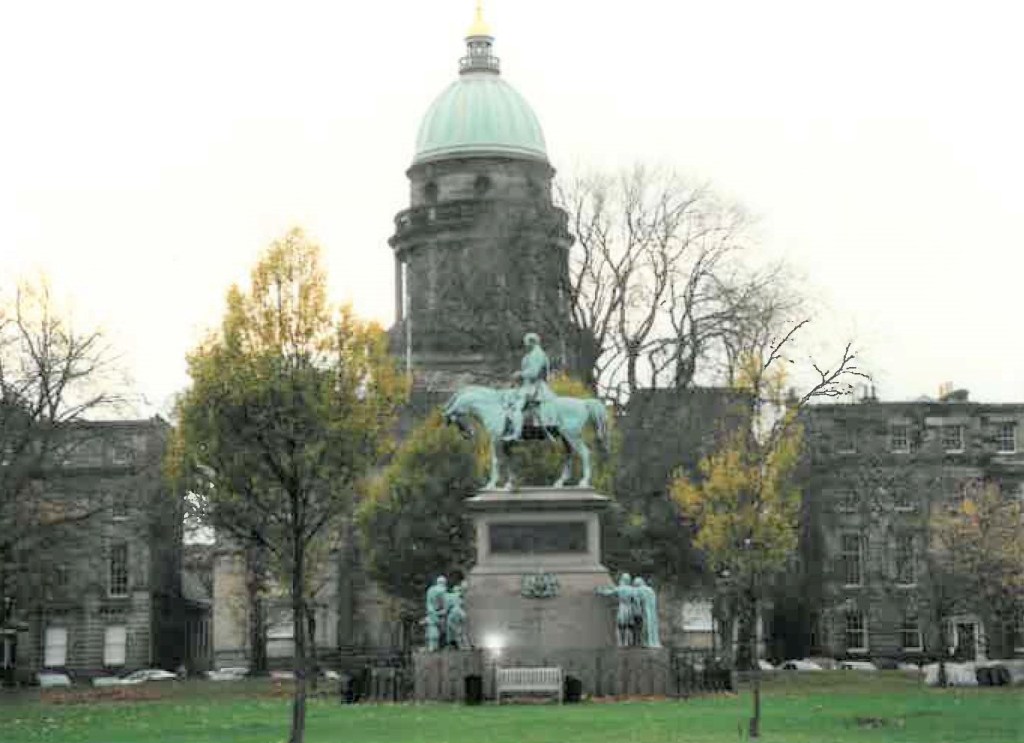
I take a taxi to the Roxburghe Hotel where the BC has arranged for the fellows to stay. It is in lovely leafy Charlotte Square in Edinburgh’s New Town. Despite its name, New Town isn’t really all that new; designed and built in the early 1800s with lots of lovely Georgian architecture.
The square’s center is marked by an equestrian statue of Prince Albert. The former St. George’s Church―now the National Records Office―dominates the west side of the square. No. 6 Charlotte Square is the official residence of the secretary of state for Scotland. The “Georgian House”―a period-furnished historic house owned by the National Trust for Scotland―is at No. 7. Our hotel is opposite at No. 38.
I walk through the tranquil Princes Park; a respite from the bustle of the busy Princes Street above. There is a huge cast-iron fountain in the center of the park—Ross Fountain—brought back from France’s Great Exhibition of 1862. I climb the long paved path up the steep slope to the Royal Mile.
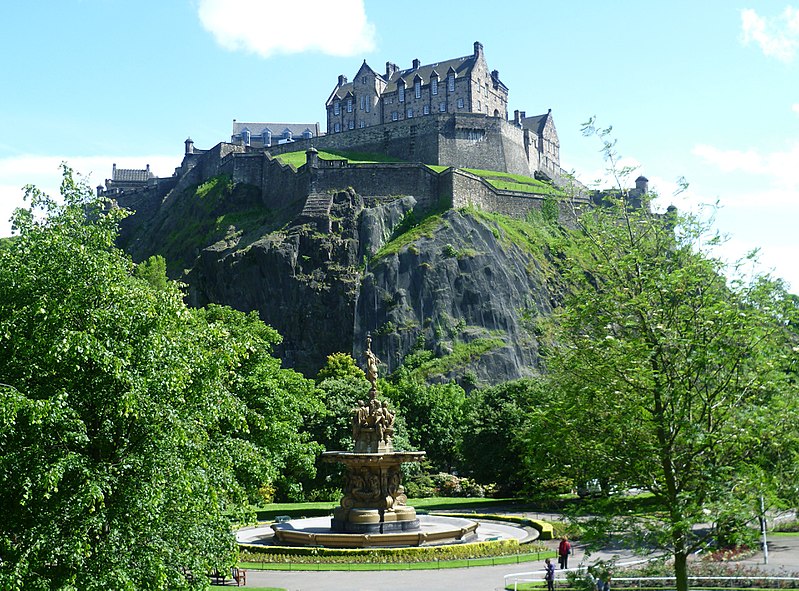
Photo: Wikimedia Commons
The Camera Obscura and Outlook Tower is at the top of Royal Mile. Victorian town planners installed the “camera” in 1853. Using technology with mirrors similar to a periscope, moving images of streets outside are reflected onto a white table. These original Victorian moving pictures caused a sensation at the time. Although dull compared to today’s videos and camcorders, back then it was the closest thing the Victorians had ever seen to live moving images.
On the round white table, the attendant points out the Royal Academy of Art building on the Edinburgh skyline. He says that Sean Connery, in his youthful days as a milkman in Edinburgh, used to pose as a nude model for the artists at the art academy to earn extra money. It is amusing to think of a load of nude Sean Connery portraits stashed in a basement somewhere in the art building waiting to be discovered.
From the balcony of the viewing tower, I have tremendous views of Edinburgh.
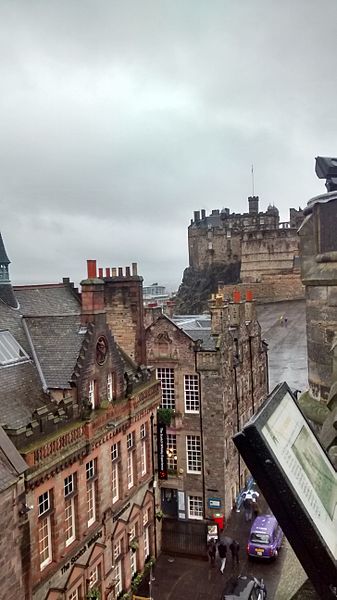
Photo: Wikimedia Commons
I shop for wool tartan scarfs. I buy one for myself in a lovely Isle of Skye pattern. It’s a new tartan—instigated and registered by Mrs. Rosemary Nicolson in 1992, an Australian of Skye descent. The tartan’s colors—green, black, and purple—depict those of the watery island. I also purchase a scarf for my boss at home—a red, black, yellow, and green weave newly commissioned to mark the millennium—called the Millennium Tartan.

I admire the monuments on Princes Street—the massive Scott Memorial, commemorating Sir Walter Scott, and the David Livingstone statue.
The 200-foot-tall Scott monument looms large over the city skyline. By comparison, the Paul Bunyan statue in Bangor ME stands just 31 feet high. It is blackish in color and ornately decorated with 64 smaller statues sculpted by different Scottish sculptors of Scott’s literary characters including Rob Roy, Rebecca from Ivanhoe, and Bonnie Prince Charlie from Waverley, the novel for which Waverley train station is named. In the center of the monument under the dark Gothic spires is a white marble statue of Scott himself.
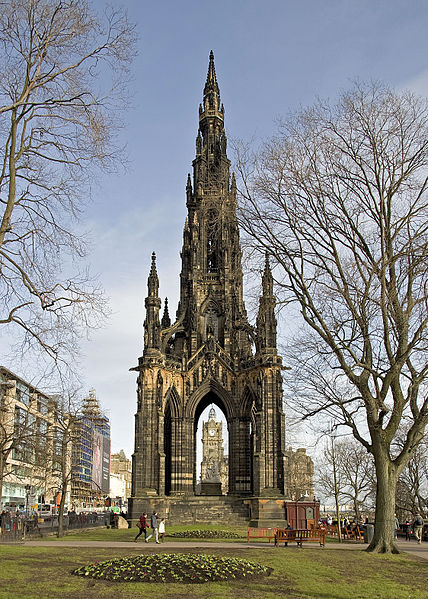
Photo: Wikimedia Commons
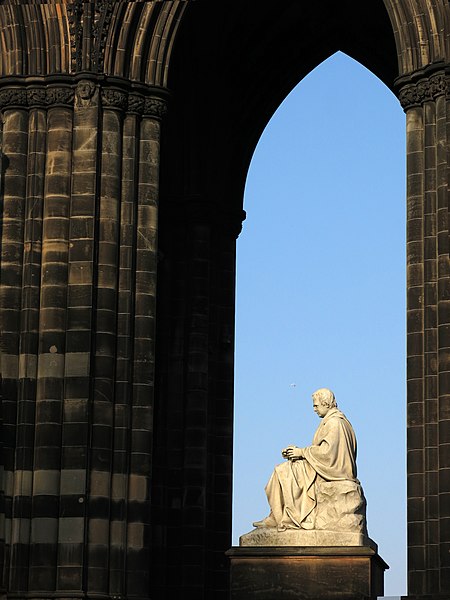
Photo: Wikimedia Commons
A few yards from Scott is that of David Livingstone, the Scottish doctor/missionary/explorer who worked tirelessly in Africa and who was located there by Henry Stanley in a famous encounter (Dr. Livingstone, I presume?).
I bump into Carolyn and Frank in the hotel and join them for a drink. Later all the fellows meet in the lobby and we head out together to dinner.
The BC treats us to dinner at the Tower Restaurant on the rooftop of the Museum of Scotland where there are marvelous night views of the floodlit castle on the hill. If you visit Edinburgh, I recommend this restaurant for the views alone. But the food is excellent too. I have the Aberdeen Beef and probably a bit too much red wine.
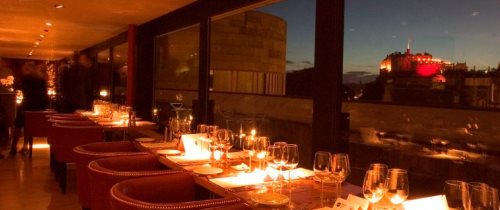
Photo: This is Edinburgh
 Jody’s UK Memories


