The BC has arranged a tour of the British Foreign and Commonwealth Office (BFCO) for us in London and a chance to listen to some parliamentary debate in the House of Lords. We are also invited to a reception at the BFCO sponsored by the Baroness Scotland.
I board the 10:15 train to Euston and am seated next to two lovely white-haired ladies, dressed in blue uniforms sporting WAAF badges (Women’s Auxiliary Air Force). Outgoing and cheery, they tell me they are on their way to London for a RAF band concert in honor of the WAAF’s 60th anniversary. Next week, for Remembrance Day, they will march in the parade when the Queen lays a wreath on the Cenotaph. One of them says to me, “Look for me on the telly because I am tall, and I will stand out. You can tell everyone that you met that lady on the train!”
It seems that the ladies have a reunion every few months. This summer they all dressed up in 1920s garb, even wearing garters to hold up their stockings. My new tall friend laughed and said the cameraman wanted proof that they were wearing garters. She shows me a picture of a group of elderly ladies with their dresses pulled up to their thighs showing off their garters. She said she wouldn’t have done it except for the challenge—that, and the three glasses of wine she had drank. As the noble motto goes, Honi soit qui mal y pense.
I am delighted at having met these ladies and disembark with a smile.
I take the tube to Charing Cross and walk through Trafalgar Square to the BC offices. We have a “fork buffet lunch” of salmon, rice, and plum pie with custard.
After lunch we walk over to the BFCO to hear about British foreign policy. One speaker tells us the Blair government has two objectives related to the EU: 1) to win a place at the high table of EU’s decision-making body; and 2) to win the war in the UK about Britain’s participation in the EU. He said, however, the more they talk about the EU, the more the British people retrench.
There is more discussion about the differences between UK and US politics, like the story of a visiting U.S. senator who could not understand why a major private business could not call up their MP and get legislation introduced into Parliament. At the reception later that evening, a British civil servant is appalled when we describe the Electoral College. “It makes no sense,” he says. I reply, “No one in the U.S. understands it either.” He is so worried that U.S. citizens don’t get to vote for who they want. But then, a few days later, The Times reports on how the Labor Party is deciding who they will put up for candidates for a particular district. There are no primary elections in England; the party decides who will run. So, in England, voters don’t get to elect who they want either; they can only vote for a contender the Party puts forward.
Following the program, a very proper and precise guide gives us a tour of the stunning BFCO offices. Just two years ago, the government restored of a number of the public rooms to their magnificent 19th century grandeur.
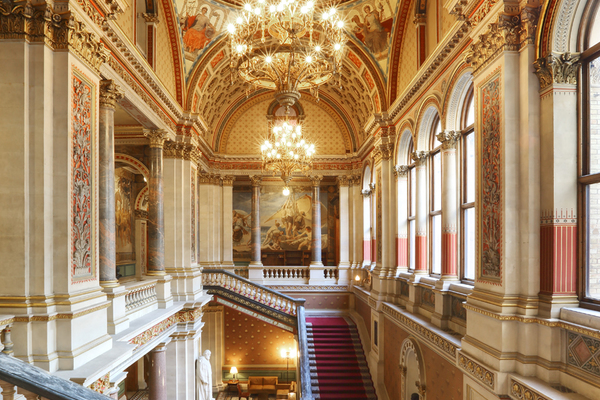
Photo: Open House London website
One of these—the 1867 Dunbar Court in the former India Office—is striking. It has a sunken floor of swirling Greek marble and a glass ceiling. All four sides of the massive hall are lined with three-story-high, colonnaded, arched glass windows trimmed with ornate, molded, plaster friezes. The 19th century architect, who earlier in his career had made an acclaimed book of illustrations of London’s glorious Crystal Palace, was clearly influenced by those drawings in designing Dunbar Court. I think that this is what the Crystal Palace must have looked like.
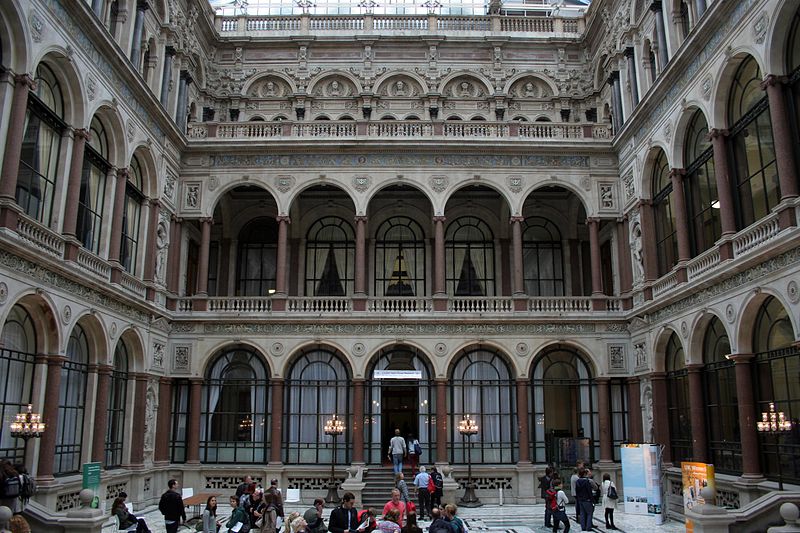
Photo: Wikimedia Commons
Our meeting earlier was in the Map Room complete with a large wooden map case that once held maps of Britain’s colonies. Each map slot is marked in gold leaf lettering: Canada, Jamaica, Guyana, Central Africa, etc. The Map Room is supposedly the scene of the only meeting between Britain’s two greatest military heroes: the Duke of Wellington and Lord Horatio Nelson.
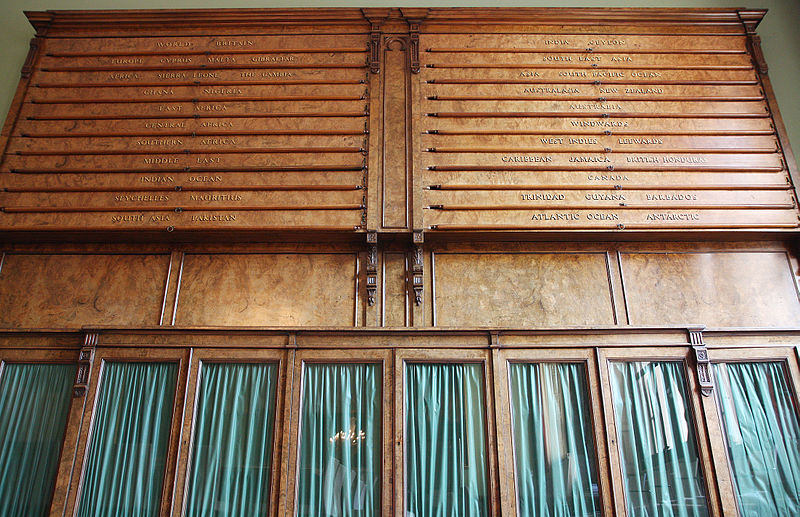
Photo: Wikimedia Commons
After the tour, we head over to the House of Lords where a debate is in progress.
It is dark and Big Ben is lit up. I’d forgotten how splendid it is, even more so at night and up close like we are.
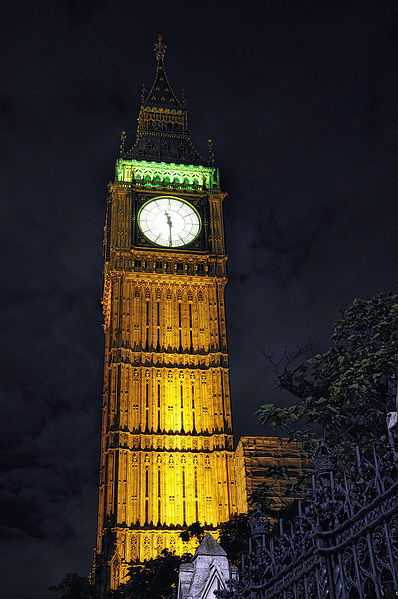
Photo: Wikimedia Commons
Inside the Palace of Westminster, we are led through several ante-chambers, down a wide hallway, and finally up some stairs into the visitor’s gallery. The huge debate hall below us is richly decorated in reds and golds. The peers sit on red leather benches. A massive, ornate, golden dais at one end of the hall holds the Sovereign’s gilded wood and red-velvet throne. I see the red woolsack in the middle of the hall. The debate is very civilized; everyone addressing each other as “My Lord.” It is less raucous than in the House of Commons—no jeering or harrumphing, although there are a few, “Here, here’s.”
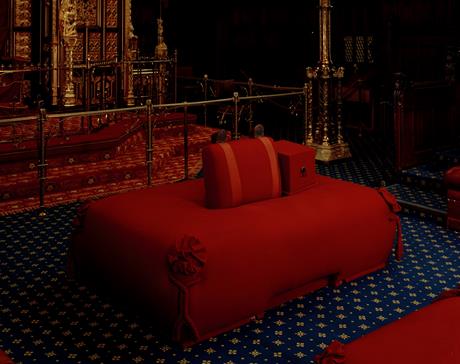
Photo: UK Parliament Website
The bewigged Lord Chancellor sits on the woolsack and a few old peers are asleep (I counted three sleeping peers; Stacy saw five). They are debating Tony Blair’s welfare reform bill that controversially seeks to cut benefits for people with disabilities who have pensions. Referencing a work requirement, one peer argues for part-time work, although I cannot tell if he favors the bill in question or not. Apparently, it is this peer’s maiden speech and the next speaker congratulates him on his eloquence.
- Note: The House of Lords exercised their muscle voting down the Welfare Reform and Pensions Bill just days before most of the peers themselves are cut from the upper chamber and its hereditary membership abolished.
At the BCFO reception, I meet the Baroness Scotland, our hostess, who is not a hereditary peer, but received her honor from the Queen for her good works. A tall, striking, Black women, she is dressed very formally in a long black dress and wears a diamond and black pearl necklace. A lawyer by trade, she says she likes the Atlantic Fellows program because it gives high-level, policy people, who are busy fighting day-day fires, an opportunity to step back from the fray and think long-term.
I leave early to catch my 19:45 PM train. Of course, I cannot find a taxi on Whitehall and I end up walking to Westminster station. I remember vividly being angry with Brian for not getting a taxi after attending the theater and having to walk back to our hotel in high heels. My feet hurt today just as much as they did back then and I can’t even blame Brian.
It slips past 7:30 PM and I am still on the tube. I start to worry that I won’t get to Euston in time. I run to the train with only a minute or two to spare and sink into my seat; my feet swollen, and my head aching from too much red wine.
I take a taxi home from New Street station and gratefully slip off my shoes.
 Jody’s UK Memories

.jpg)
