The early morning sky is still dark as I walk up the hill to the train station to begin my four-and-a-half hour journey to Tintagel.
It is not easy getting to Tintagel via public transportation. I must take the train from Bristol as far as Bodmin Parkway. From Bodmin, I catch a bus to Tintagel. There are only two buses from Bodmin to Tintagel; one at 11:30 and one at 17:00. So, to get to Bodmin in time for the morning bus, I have to take the 7:40 train out of Bristol rather than the more leisurely 10:00 one I had anticipated. From Bodmin, it is an hour-long bus ride to Tintagel. There is no bus service tomorrow, on Sunday, so I have to come back tonight, when I had originally planned to stay overnight in Tintagel. The bus leaves Tintagel at 16:35, but only goes to Bodmin Town, not the train station, so I have to make a city bus connection at 17:28 (the Tintagel bus gets in at 17:18 PM) to catch the 18:40 PM train back to Bristol. Phew.
The train winds down the south coast through Exeter, Torquay, and Plymouth, running along the edge of the gray and choppy water of the Cornwall coast, before turning north and skirting Bodmin Moor. From the train window, Dawlish catches my eye—a cozy seaside town with large resort hotels hovering on the water’s edge. Dawlish, along with Torquay, is part of what is known as the English Riviera on the southern English Channel. I didn’t realize when I made my travel plans that I would pass through Agatha Christie territory; Torquay being the setting for several of her books and where she lived for much of her life. I must come back.
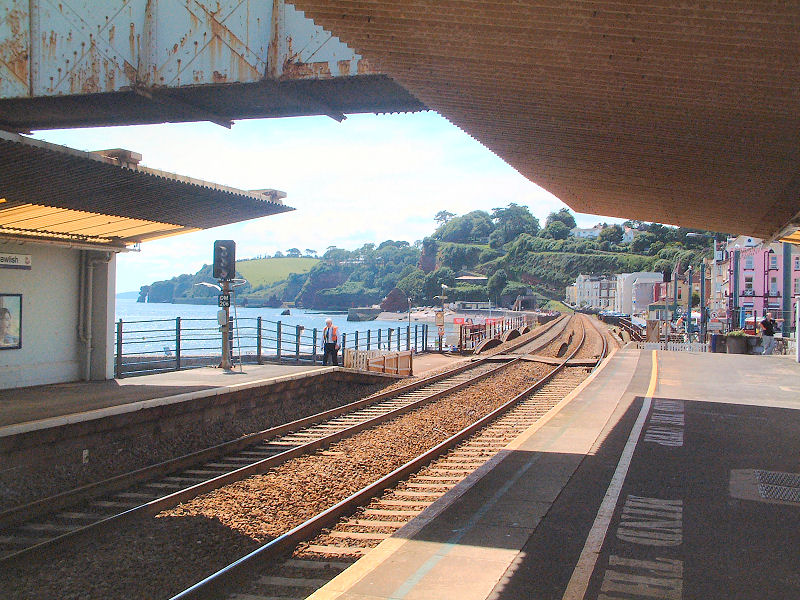
Photo: Wikimedia Commons
I am no longer surprised when I see two women who share my carriage eating crisps with their morning coffee. It is just after 8:00 AM. At Frances’s house the other night, I commented on how eating crisps seemed to be a British national pastime. Frances said, “You mean people in America don’t eat a lot of crisps?” I responded, “Yes, but not for breakfast.” They asked about the flavors in the U.S. and I named them: barbeque, sour cream and onion, salt and vinegar. At this point, Frances’s daughter, Kate, brings out some for us to have as a pre-dinner snack. I asked which is her favorite flavor? She said, “Oh, I’m disgusting actually, I like prawn cocktail. I confessed that it is my favorite too.
The train takes forever with about 15 stops along the way. I am anxious about making the bus connection. But, shortly after I disembark, the #125 bus to Tintagel pulls up. The driver tells me I can’t board yet, it’s about a 10-minute wait. A sweet little lady in the train’s buffet area makes me a cheese and tomato sandwich. She cuts mild white cheddar off a big block, sprinkles it lightly with salt, and puts it between two slices of soft white bread along with sweet, juicy tomato slices. It is delicious.
I am the only one on the bus, although others get on and off during the 1-1/2 hour trip. It begins to rain hard. Near the end of the journey, I see two large windmills whirling madly in the wind and rain. They are massive and stand out dramatically on the stark moor. As we move to higher ground I can see there are a dozen or more of them lined up. They are white and utilitarian and look like they are marching along the hill’s ridge like the walking war machines in the War of the Worlds.
- Editor’s note: I learn later, when checking my facts on the Internet, that the live Halloween broadcast of War of the Worlds that sent the American nation into full-scale panic was aired on Sunday, October 30, 1938―this very day, 61 years ago. I am astonished at the coincidence.
By the time the bus pulls into Tintagel, I am once again alone on the bus. I am not confident of the connection back and ask the driver. He doesn’t know either because it is a different bus line going back. But, he says the bus will pick me up around the corner at the Methodist Church.
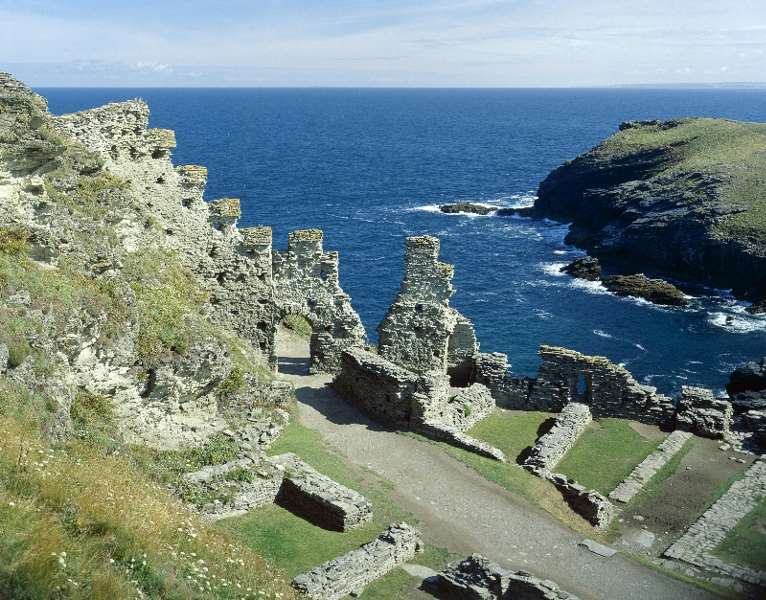
It is pouring and, as I walk towards the castle, I pull my hood tightly around my head. My upper body clad in Gortex is dry, but my jeans and sneakers quickly become sodden. I begin to wonder why I made this crazy trip out in the middle of nowhere. Then, I get my first glimpse of the castle ruins, the 12th century stronghold belonging to the Duke of Cornwall that legend attributes as the birthplace of the mythological King Arthur. It takes my breath away.
The eerie ruins of Tintagel Castle stand high up on a cliff, stark against the stormy sky amidst the whipping wind; angry ocean waves ebb and flow from Merlin’s cave hundreds of feet below. It is easy to understand how so many legends became associated with this place.
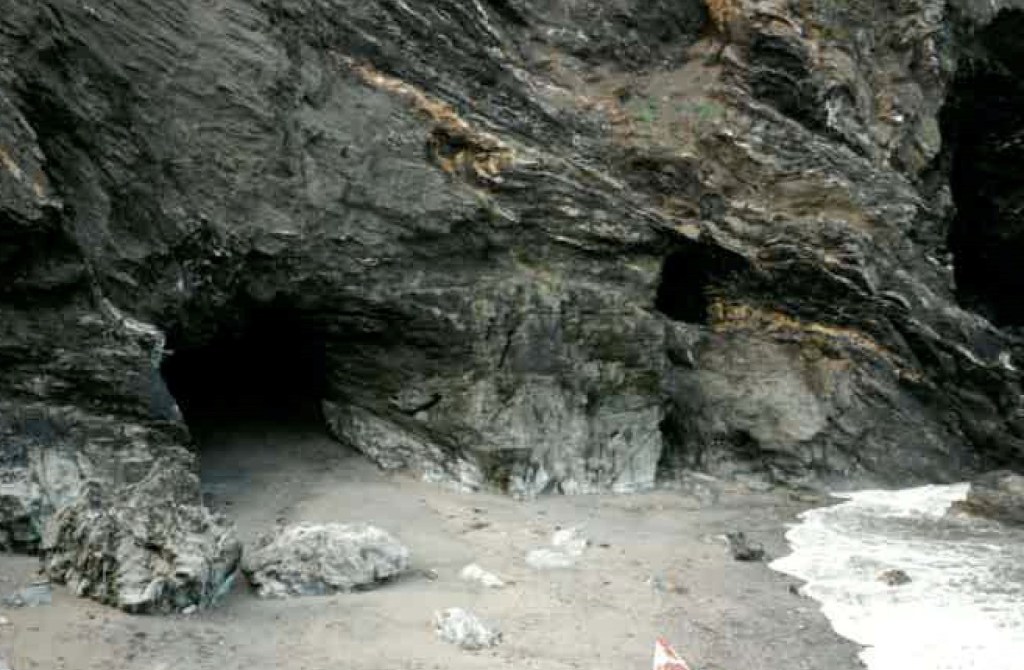
The cliffside climb to the ruins is steep and the stone steps are slippery and uneven. It is not for the faint of heart and my legs are little wobbly by the time I reach the top. But the rain is beginning to slow.
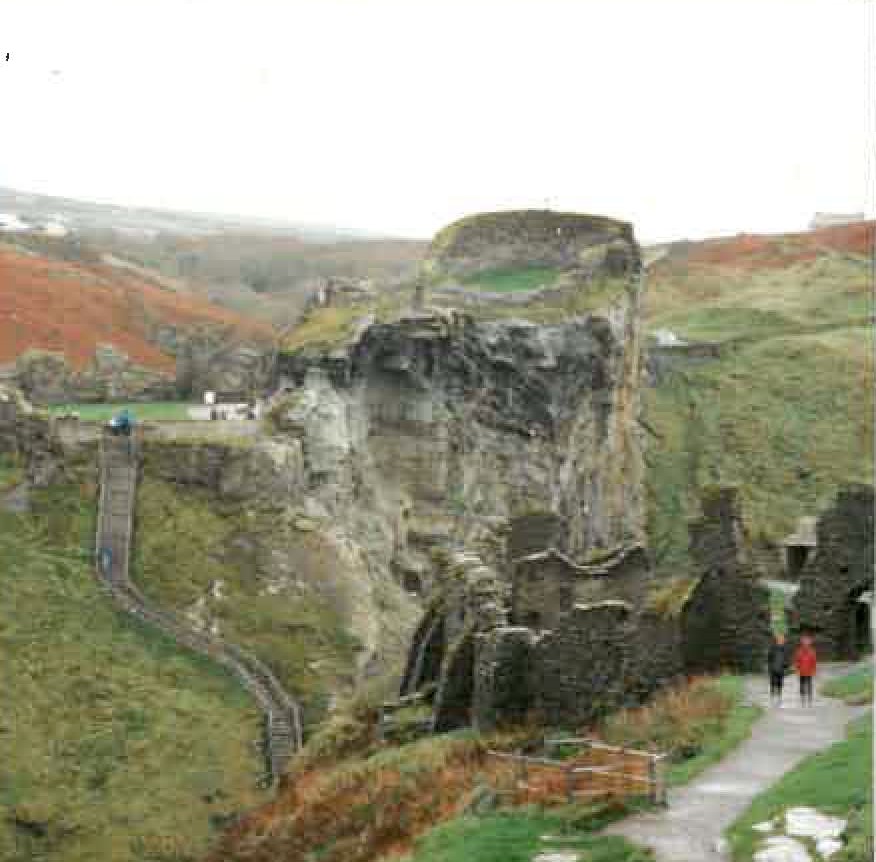
An English Heritage guide, a local historian, is giving a free tour to a small, umbrella-ed group and I join them. The bearded, burly guide is excellent, giving an overview of the castle’s Roman origins and its intimate connection with the Arthurian legend.
He tells us about the 400-year Roman rule of Britain. England, at the time of Arthur, was thoroughly Roman. By 400 AD, Celtic rule would have been as far back in the memory of those Roman Britons as our association today is with the Spanish Armada. However, Britain’s pleas for help from Mother Rome against the invading Saxons went unheeded as she battled her own invaders, the Huns. The Arthurian legend stems from a powerful Roman Briton king who beat back the Saxon invaders. History tells us however that the Saxon’s relentless onslaught was, in the end, invincible.
By the time our guide finishes his tale, the sun is out; the water sparkles below us.
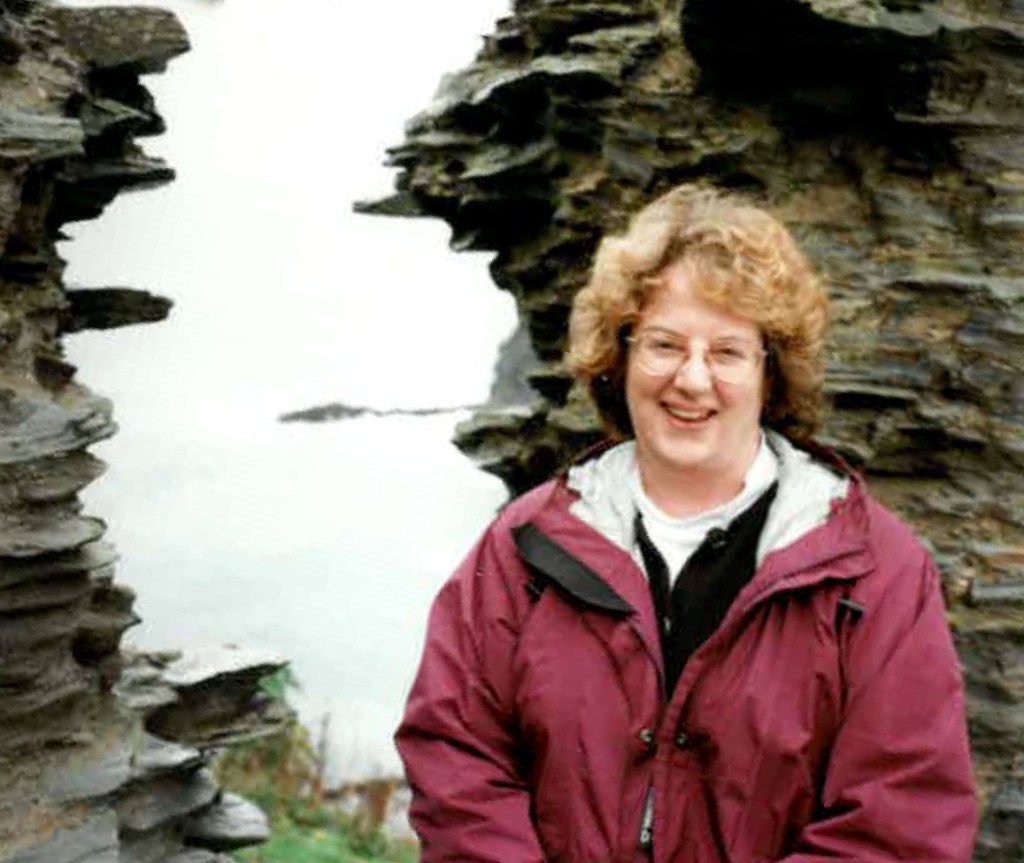
When asked if Arthur was a real man, our guide says that much of history is steeped in myth and legend. But legends have their origins somewhere; told and retold over centuries so that you no longer recognize the truth. He tells us about an ancient oak door covered with supple leather that hangs on one of the gates in the walled city of Exeter. Local lore, long dismissed, had it that the leather was the human skin of a captured Viking invader put there as a warning to other raiders. In the 1980s, when repairmen were re-hanging the door, someone thought to test the leather. It turned out not to be animal skin as people supposed, but human, and carbon-dated to within 30 years (+/-) of the height of the Viking invasions of England. So, while our guide does not subscribe that King Arthur is a real man, neither does he dismiss the Arthurian legend as totally fiction.
I love history. To study it teaches you how to think, how to ask questions, how to interpret facts. It is much more a discipline than a bunch of dates and facts.
- Arthurian inscription found at Tintagel: On 6 August 1998, English Heritage revealed that while digging on the Eastern terraces of Tintagel Island, a broken piece of Cornish slate was discovered bearing the name “Artognov.” The 6th century “Arthur Stone” as it has already been christened, clearly reads “Pater Coliavificit Artognov,” which Professor Charles Thomas of Exeter University has carefully translated as “Artognou, father of a descendant of Coll, has had this built. Dr Geoffrey Wainwright, chief archaeologist at the, normally cautious, English Heritage declared, “Tintagel has presented us with evidence of a Prince of Cornwall, in the Dark Ages, living in a high-status domestic settlement at the time Arthur lived. It has given us the name of a person, Arthnou. Arthnou was here, that is his name on a piece of stone. It is a massive coincidence at the very least. This is where myth meets history. It’s the find of a lifetime.” Source
I walk back to town and poke in the shops along the way, all wonderfully tackily named commemorating the Arthurian legend: King Arthur’s bookshop, Camelot Collectibles, Merlin’s Gifts and Confectionery, etc. I stop at King Arthur’s café and eat a Cornish pasty; a meat pie in pastry folded like a calzone and eaten hot or cold. At this café, they proudly claim to have the true thing—“Cornish pasty made by the Cornish.”
King Arthur’s Great Hall is not old but founded in the 1920s as a fraternal order to celebrate fellowship and chivalry. The grand hall holds a regal granite throne, a massive oak roundtable, and some of the most beautiful stained-glass windows I have ever seen. There is a laser light show that describes the King Arthur legend. Afterwards I walk quickly through the hall and exhibit area. I only have a few minutes before my bus is due to arrive.
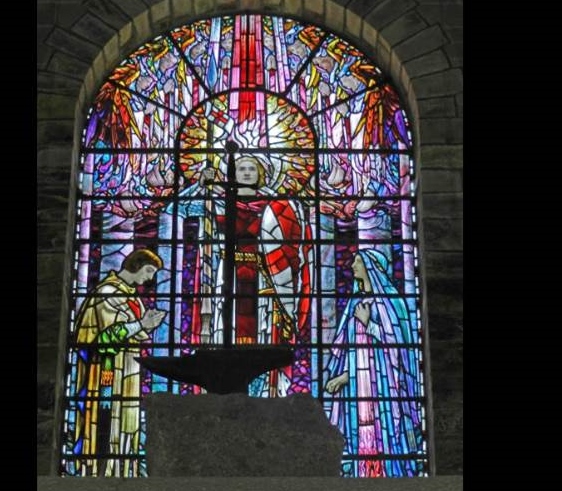

Photo: Wikimedia Commons

Photo: Wikimedia Commons
At the Methodist Church, I see no sign of a bus or a bus stop. I go into a pet food shop next door and ask the proprietor. She says, “Oh, just stand in the church yard, they will pick you up there.” I ask if she knows the bus number. “No,” she says, “but it will be the only one.” After much anxiety that I will be marooned on the Cornish coast, the bus pulls up.
Once again, I am the only person on the bus and, as it winds through the back roads, it reminds me of Ireland with the lush, green countryside, off-and-on rain, and narrow roads. Only this time, I am in the bus and it’s the oncoming cars that must pull over. One lady backs up her car, smiles, and waves to the driver as we pass.
Bodmin Parkway station is very small and empty. I feel like I am in Fiddler on the Roof, when Tevye takes his middle daughter to catch the train to Siberia, where it is nothing but a bench and a flag on a pole. Bodmin is not that bad, but it is definitely not full service. There is one rail worker, but the buffet is closed. I’ll have to get something on the train.
There are no sandwiches on the train’s trolley cart; I get a flapjack and bottle of water. As we speed through the dark, along the edge of the rough ocean, I have a fleeting thought wondering how the train driver sees at night, but then decide I am better off not thinking about it. I lean my head back and close my eyes. We pull into Bristol around 10:30 PM. Back at my Holiday Inn Express, I set the clock back one hour before turning off the light.
 Jody’s UK Memories

.jpg)
.jpg)