I am going back to Oxford today to see the town. Oddly, I have been to Oxford twice in the last week, but haven’t seen any of it!
Looking at the train’s departure board, I notice that two stops beyond Oxford is Basingstoke. One of Brian’s favorite Gilbert and Sullivan scenes features the Baronet of Ruddigore who uses the word Basingstoke as a code word to calm Mad Margaret when she gets overly excited.
Ruddigore. Margaret―pray recollect yourself. Basingstoke, Basingstoke, I beg!
Margaret. (recovering herself) Basingstoke it is!
Ruddigore. Then make it so.
I arrive in Oxford just after 11:00 AM. In the parking lot of the train station, there is a sea of bicycles. It is the preferred mode of transportation in Oxford and, as I make my way through the busy, narrow streets, I can see their advantage.
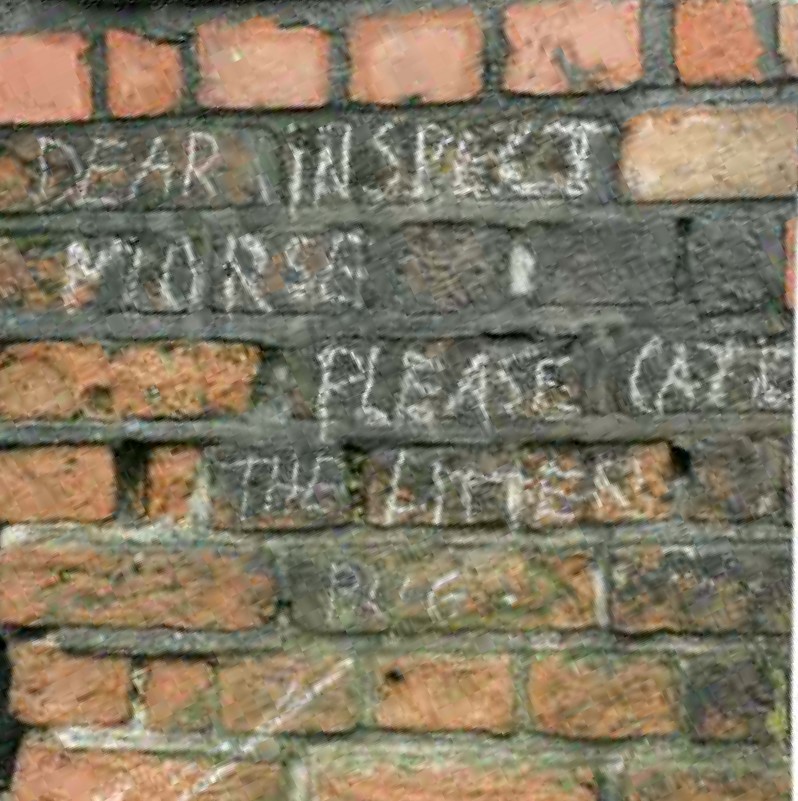
Heading towards the tourist information office, I cross one of Oxford’s many canals. On the brickstone bridge spanning the canal, there is a hand-scratched note in chalk that says, “Dear Inspector Morse, please catch the litter bug.” Someone has drawn an arrow pointing to some insolently discarded McDonald’s wrappers. I love this and immediately snap a picture. Oxford is the setting for Colin Dexter’s mystery series about an opera-loving, police detective, named Morse.
The first stop on the hop on/hop off bus tour is “The Oxford Story,” a museum ride through Oxford’s tumultuous history. Burned by Vikings―twice—the city has withstood fires, plagues, and riots. The most notorious deed was by Queen Mary who burned two of Oxford’s bishops and an archbishop at the stake for their Protestant teachings.
There are 39 colleges in Oxford, all independent. One guy asks our tour guide, “Can you explain the college system, I can’t figure it out.” The tour guide shakes his head sadly and replies, “Nobody can.”
Oxford’s colleges are intertwined among the shops, pubs, and churches. Each college looks rather nondescript from the outside; plain, multi-story, stone buildings. Some have cupolas or are decorated with gargoyles. However, enter the massive wooden doors and each one opens up into beautiful grassy quadrangles surrounded by lovely cloisters, ancient academic buildings, and student housing. There is a whole college behind each door.
Each college has its own history and its own personality. I explore Magdalen College (pronounced “Maudlin”) that dominates the east end of the High Street. The medieval tower, chapel, cloisters, and grounds are magnificent. Deer graze on the grassy river bank. While the college dons once ate the venison, they found they could make more money by selling it, and you can now purchase Magdalen College Oxford venison as a delicacy at Harrods Food Hall.
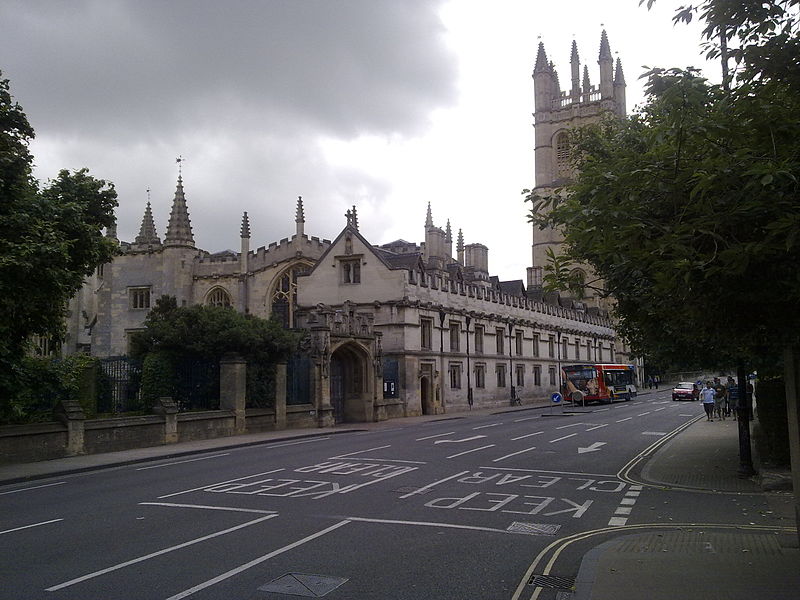
Photo: Wikimedia Commons
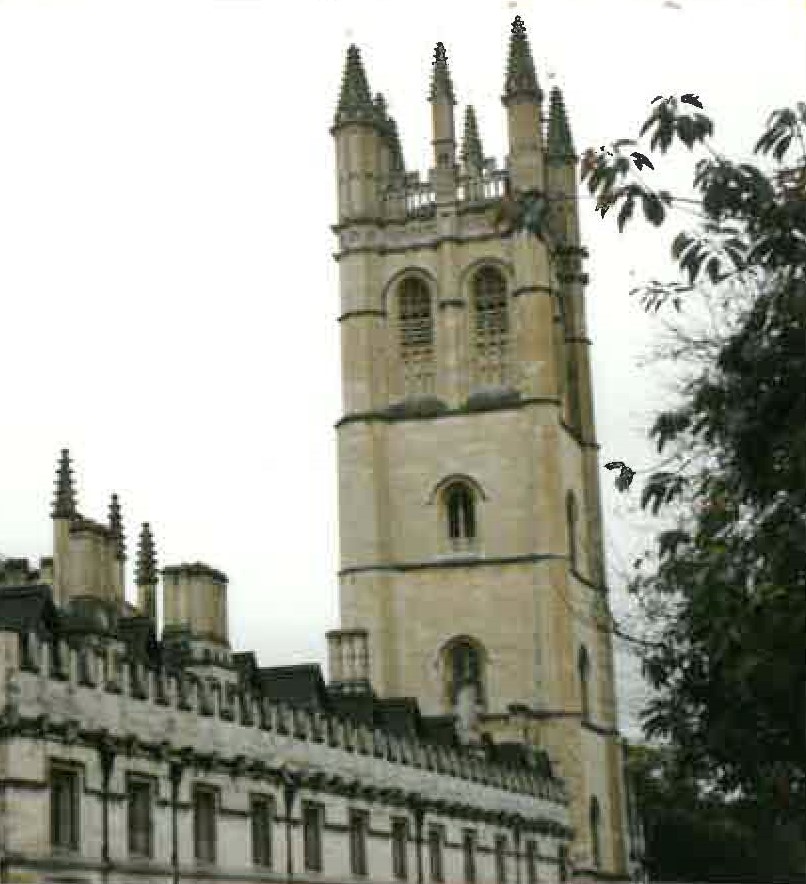
Apparently Magdalen’ soaring 1505 bell tower, 144 feet high, is one of the most celebrated views of Oxford. Writing to amuse wounded soldiers recovering in the local hospital, an Oxford professor described Magdalen:
Cross the street from the Hospital door and go a few yards eastward and you will see the grand curve of the High Street, from Magdalen on the east to All Souls on the west. Lord Macaulay, in his History of England, picked out the High Street of Oxford and the Close at Salisbury as the two places in Britain through which no Briton would like to see foreign soldiers marching; which was, I suppose, another way of saying that they were the two most beautiful things in Britain. It is all historic ground. That tall tower to the east, with its graceful pinnacles, was called by King James I (no bad judge of buildings) the ‘most absolute building in Oxford’: the wall below it was the wall against which his foolish grandson, James II, ran his head, when in 1687 he tried to turn out the Magdalen Dons because they wouldn’t elect a royal favourite to be President of the College; he ended by turning himself out of his kingdom.
C.R.L. Fletcher, A Handy Guide to Oxford, 1915
Many famous people studied at Oxford. Bill Clinton went to University College and Tony Blair studied law at St. John’s College. When Margaret Thatcher studied chemistry at Somerville College, her tutor told her she was talented enough to be a good, assistant chemist. Rowan Atkinson went to Queen’s College; C.S. Lewis, Oscar Wilde, and the Prince of Wales, later King Edward VIII, Magdalen. Oh, yes, and P. G. Wodehouse gives his fictional character, Bertie Wooster, a degree from Magdalen.
A brilliant mathematician, C.S. Lewis spent most of his professional life at Oxford. It was here that he met 9-year-old, Alice Liddell, the daughter of the school’s president, who was his inspiration for Alice in Wonderland. Queen Victoria is said to have enjoyed reading Alice in Wonderland so much, she asked Lewis to send her a copy of his very next book. He was happy to oblige sending her a copy of a theoretical tome on mathematics. I think she was probably not amused.
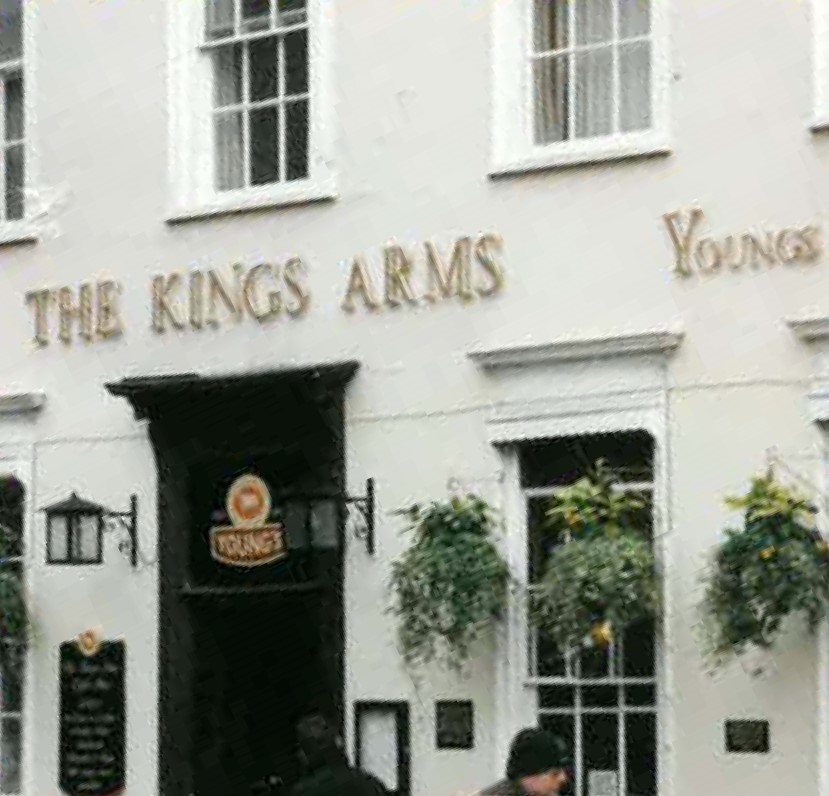
I have the Sunday Roast at the Kings Arms, a favorite pub with the students where I meet a traveling Canadian couple who are on a 4-week tour. They suggest a number of Cotswold villages that I should visit: Bourton-on-Water, Broadway, Castle Combe, Pianswick, Banbury, and the Slaughters.
The Bodleian Library, the oldest library in Europe, is beautiful; the circular, domed science library building next to it, known as the Radcliff Camera, is one of the most recognized buildings at the college.

Photo: Wikimedia Commons
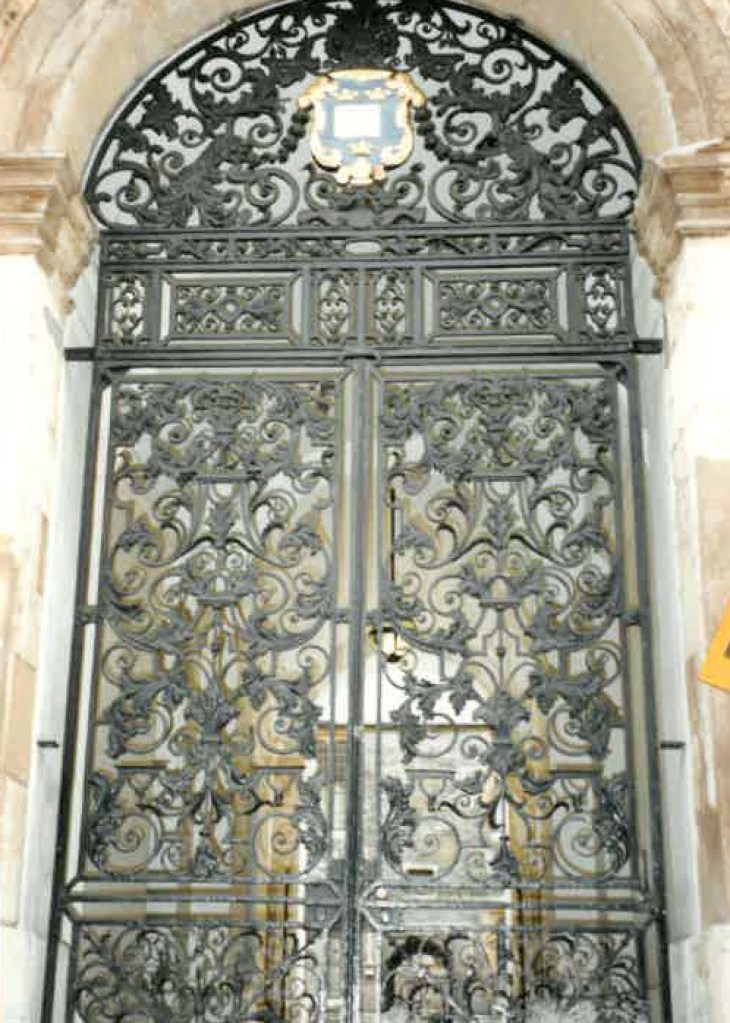
Oxford’s Sheldonian Theater, designed by Christopher Wren, is where Oxford graduates receive their degrees. It is best known for the 13 carved stone Emperor Heads that surround it. According to one article: “Wren’s original heads famously had wide-eyed and shocked expressions. This was to portray his disgust at the limited and insufficient budget he was given to design the theatre.”

Photo: Wikimedia Commons
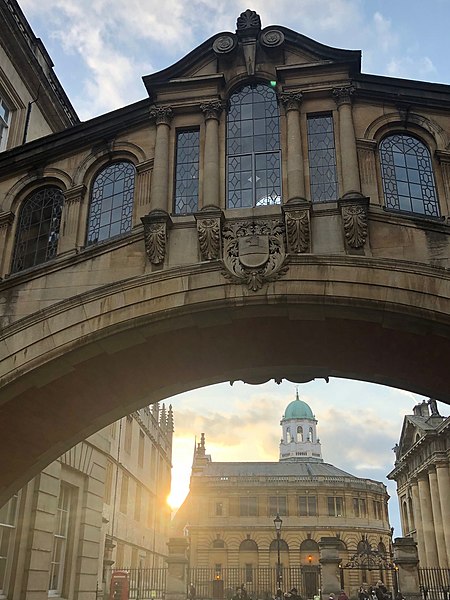
Photo: Wikimedia Commons
A lovely little skywalk is another Oxford landmark. Some call it the Bridge of Sighs after a similar bridge in Venice.
It begins to rain so I stay on the bus tour for while just listening to the guide who tells us the story of Queen Victoria’s son, Prince Leopold, who went to Oxford. While he was there, he fell in love with a commoner. The Queen was definitely not amused and put a stop to the romance. It turns out that the woman he fell in love with was Alice Liddell. Our tour guide says, “Alice inspired C.S. Lewis at 9 years old and she inspired Prince Leopold at 19.” But it seems theirs was a genuine love story; the Prince named his first child Alice, and Alice named hers, Leopold.
I am charmed by Oxford and would love to spend more time here.
The train home is unbelievably crowded. There are no seats and I stand all the way to Birmingham New Street (over an hour). At least it was the fast train with no stops.
At Tesco’s, I find something even more decadent than shortbread—shortbread layered with caramel and chocolate. It just melts in your mouth.
 Jody’s UK Memories


