Mary Metcalfe is coming today. I am meeting her at New Street station. Mary lives in Sheffield, about 100 miles north of Birmingham. A friend of my aunt, I met her two years ago when she was visiting in Pemaquid. She is retired; the former head of a London girl’s school and was once invited to one of the Queen’s garden parties at Buckingham Palace in recognition of her distinction in the field of education.
Mary is already there by the time I arrive and gives me a warm welcome. She says she’s never spent any time in Birmingham and would like to walk around and see the city. It is very sweet of her to come down.
She is so interesting to talk to and has some thoroughly modern views.
Mary loved Princess Diana and will never forgive the Royal Family for how they treated her. She says everyone was furious with the Queen for staying in Balmoral after Diana was killed. “Tony Blair finally had to say something to the Queen” she says, even writing the Queen’s remarks for her televised broadcast. In Mary’s opinion, the Royal Family did three unforgivable things: 1) not mentioning Diana’s name at Balmoral Sunday church services following her death; 2) not leaving Balmoral to come to London to be visible to those in mourning; and 3) not flying the flag at Buckingham Palace at half-staff.
I am surprised by her view on the flag. I thought she would appreciate the 100-year-old tradition that no flag is hoisted unless the Queen is in residence. But I agree; the Palace got it horribly wrong sticking to tradition in this case. People were grieving and the Queen was hidden away. The Mirror headline at the time cried out, “Your People Are Suffering. Speak to Us Ma’am.” She badly misjudged people’s moods and their need for her reassurance; just as she would do for victims of a train crash or a bombing.
After a café latte in the Palisades Mall above the train station, we head out walking towards Victoria Square. Mary wants to take some pictures only her camera isn’t working. So, what does she do? She marches right into Boots and asks them to look at it. They sell her a new battery and it seems to work fine after that.
Mary takes pictures of me in front of the fountains in Victoria and Chamberlain squares. There is a captivating bronze statue of the 19th century reformist MP, Thomas Atwood, reclining on the steps leading up to the Chamberlain monument. He appears to have just stepped down from his soapbox surrounded by pages of the bill he is reading—also bronze—that have been blown and scattered by the wind.
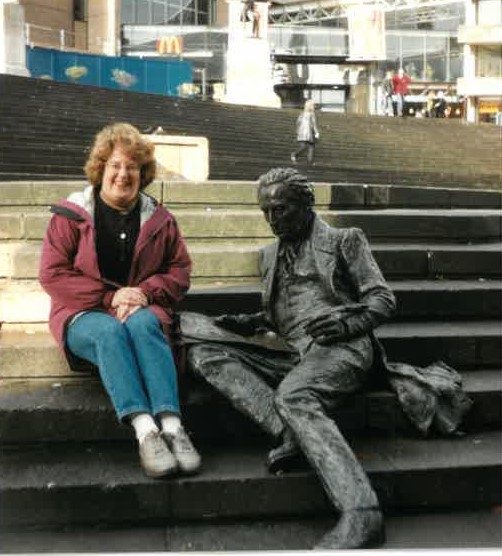
I want to see the Pre-Raphaelite paintings in the Birmingham art museum and Mary is game. I am immediately entranced by their intense colors and captivating scenes. They mostly portray famous literary characters or legends; nearly all of them of striking women. The sorrowful drowning death of Shakespeare’s Ophelia is the most famous, but there are portraits too of the mad Lady of Shallot, the bewitching Helen of Troy, and even a nude Lady Godiva riding her horse through the village of Coventry (which appropriately hangs in a museum there). There are hundreds of Pre-Raphaelite paintings scattered all over the world, many at the Tate in London, but also one at the Isabella Stewart Gardner museum in Boston; Lord Andrew Lloyd Webber owns three. But Birmingham has an amazing collection.
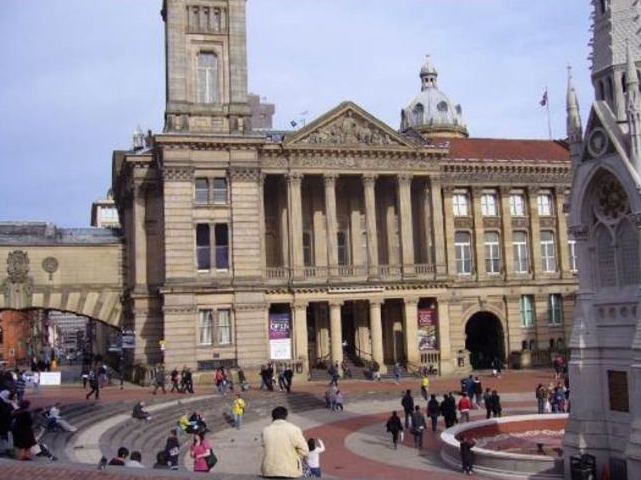
Daniel Gabriel Rossetti, John Everett Millais, and William Holman Hunt founded the Pre-Raphaelite movement in 1848 with what they called a “brotherhood” of new-age painters. Disenchanted with artists’ perspectives at that time, they wanted to go back to nature; to a time when paintings were more realistic than idealistic―a time before the Renaissance, or before the artist Raphael.
Realistic they are too—Millais’s model for Ophelia almost died of pneumonia from spending hours in cold bath water in the dead of winter modeling for the painting. Rossetti painted dozens of portraits using his muse, Jane Morris, wife of fellow artist, William Morris, as his model. They were lovers as well.
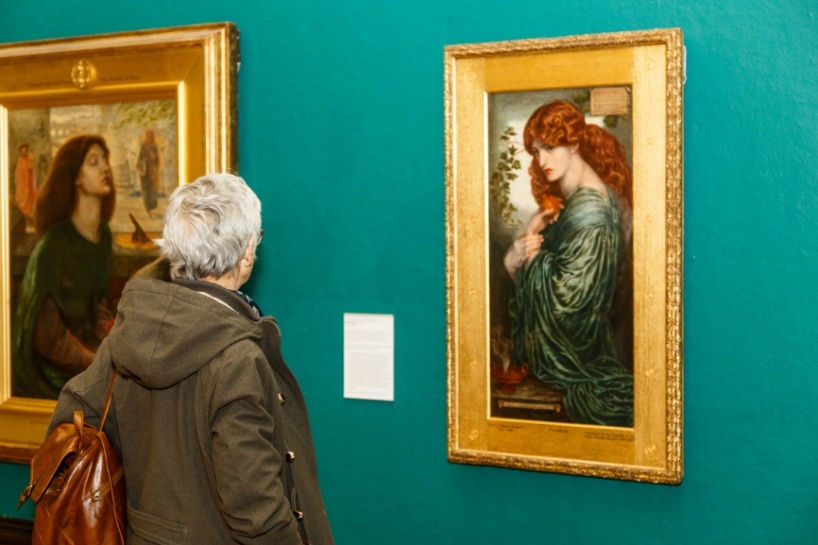
In his beguiling painting, Proserpine, Rossetti portrays Jane as the goddess of the underworld who Pluto imprisoned in Hades for tasting the forbidden pomegranate. In legend, Pluto allowed Proserpine to return to earth each summer. The sub-text to Rossetti’s painting alludes to their own lives; just as Jane lived with her husband in winter, she returned to Rossetti in the summer months each year.
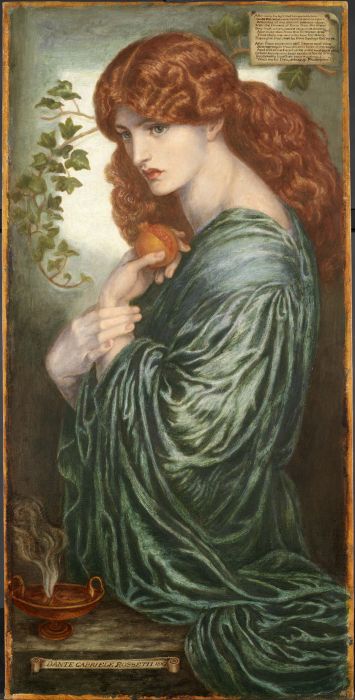
Photo: Birmingham Museum and Art Gallery Pre-Raphaelite Online Resource
In addition to Proserpine, Birmingham’s Pre-Raphaelite paintings include Arthurian legends, Shakespearean scenes, and biblical compositions.
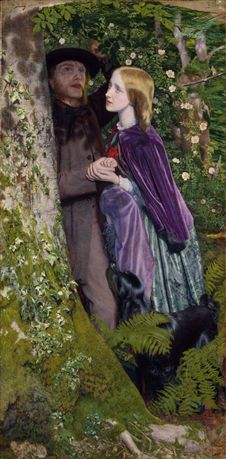
Photo: Birmingham Museum and Art Gallery Pre-Raphaelite On-line Resource
A scene from Chaucer of a lowly cleric, too poor to marry. The length of their courtship is shown by the ivy having grown over her name, Amy, carved into the tree.
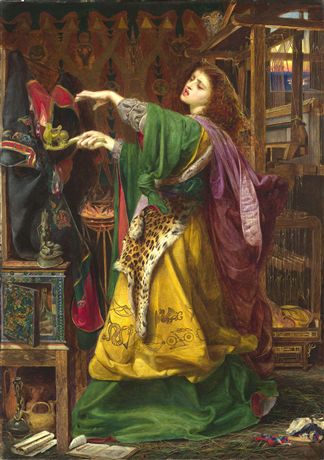
Photo: Birmingham Museum and Art Gallery Pre-Raphaelite On-line Resource
At the museum’s Edwardian tearoom where we eat lunch, I order shepherd’s pie and Mary has the chicken hot pot. The waitress brings out our lunch and says, “We were out of shepherd’s pie, so I brought two chicken hot pots. I hope that is OK.” This is fairly typical of the service in England and by now I am getting used to it. I smile and nod and the hot pot is very tasty.
After lunch, we walk to Brindley Place and take a canal boat ride. Mary is full of information about the history of the canals and the people who lived here. Then we make our way back stopping for tea at Rackhams; a huge, Porteous-type department store. I say a fond farewell to Mary and leave her at the train station.
When I get home, Tony and Caroline greet me at the door. Tony shows me their wedding picture. They look so young. Caroline looks like Marlo Thomas in the 1960s sitcom, That Girl, with straight shoulder-length hair that flips up at the ends. Tony tells me how Caroline, as a young woman, sang in musicals and cabaret shows and was lead lad in the Jack and Beanstalk pantomime. He says cheekily, “She still has her black fishnet tights.” Caroline responds even more cheekily, “Tony makes me wear them sometimes.” They are like a comedy duo these two.
- In today’s news: The Times reports that two RAF pilots were killed on a training mission when their plane went down on the outskirts of a village in the Lake District. Debris blocked the West Coast railway line.
 Jody’s UK Memories