I’m off early this morning to Oxford to see Blenheim Palace (pronounced Blen-im, with clipped syllables). From the train station in Oxford, I take a bus that puts me down at the top of the entrance road to the stately house. It is about three-quarters of a mile walk in and sheep peacefully munch grass in the fields along the way.
There is no good view of the house from the drive. My first glimpse of grandeur is the palace clock tower, which looms in front of me as I peer through the large stone archway with black iron gates that provide access to the palace.
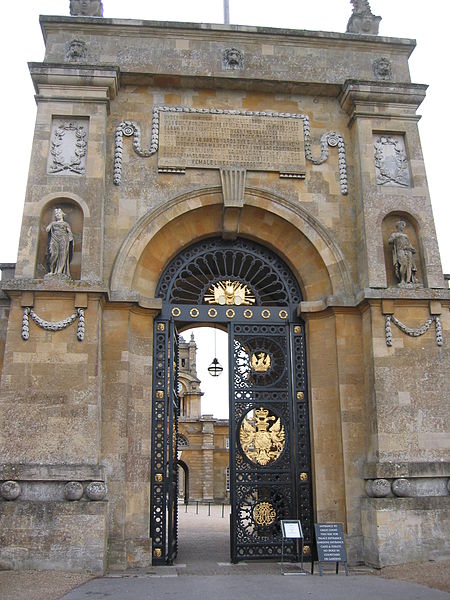
Photo: Wikimedia Commons
Queen Anne paid to build the house for John, 1st Duke of Marlborough, to honor him for his 1704 victory over France’s Louis XIV at the Battle of Blenheim―the thanks of a grateful nation. But after Sarah, the Duchess, clashed with her, the Queen withdrew her support. Following Queen Anne’s death, the Duke and Duchess made it both their lives’ ambitions to complete the palace albeit at their own expense.
Under the auspices of a munificent sovereign this house was built for John Duke of Marlborough, and his Duchess Sarah, by Sir J Vanbrugh between the years 1705 and 1722, and the Royal Manor of Woodstock, together with a grant of £240,000 towards the building of Blenheim, was given by Her Majesty Queen Anne and confirmed by act of Parliament…to the said John Duke of Marlborough and to all his issue male and female lineally descending.
Plaque above the East gate of Blenheim Palace
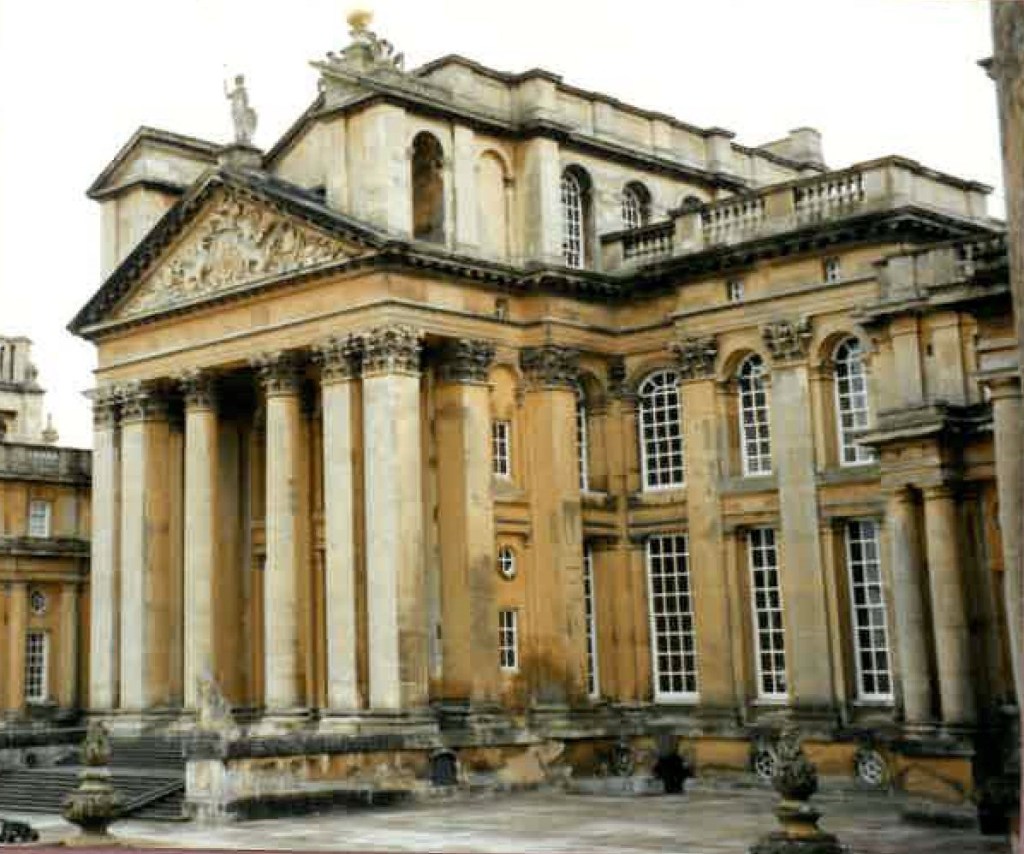
The palace has a bewildering array of 187 rooms that covers an astonishing seven-acre footprint. Its great hall, at 67-feet, is as high as the Great Sphinx of Egypt is tall, with an opulent domed ceiling and two stories of marble pillars that is said to have made even King George III gasp, saying to Queen Charlotte, “We have nothing to equal this.”
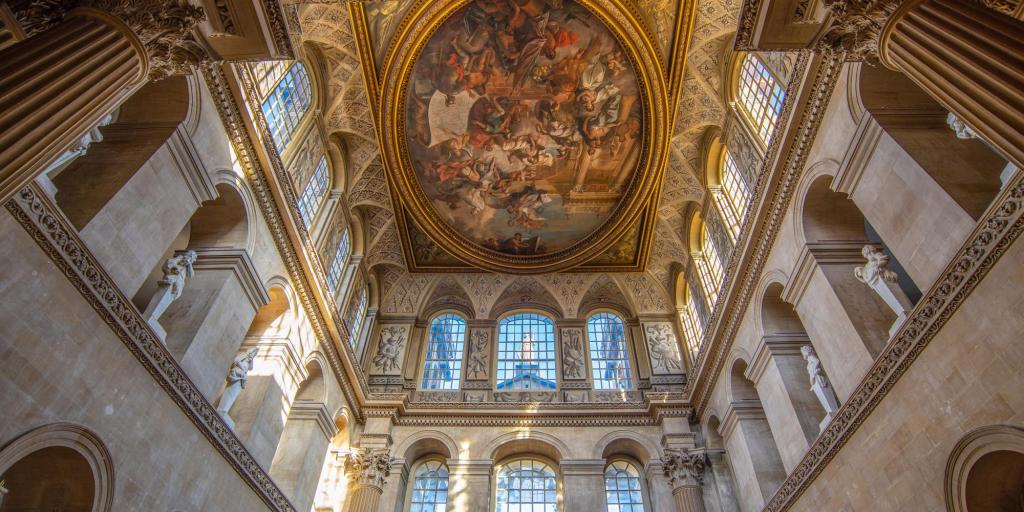
Photo: Blenheim Palace Website
According to my guidebook, “Blenheim is the only non-royal, non-ecclesiastic dwelling in England to be called a ‘palace.’”
The whole house is an extravagant monument to the 1st Duke’s triumphant battle. Paintings and tapestries depict the war hero on the battlefields, consulting his engineers, or charging on his horse. Our guide goes on at length about the 10 Blenheim tapestries, which at 15 feet tall, chronicle the Duke’s sweeping victory at Blenheim in Austria. On the ceiling of the grand entrance hall is a mural depicting Marlborough kneeling to Britannia offering her a map of the Battle of Blenheim. It takes someone with a big ego to approve designs such as these; representing the Duke as savior of Britain and arbiter of world peace. (I learn later reading its history that it was Sarah who, after the Duke’s death, commissioned many of the egocentric portraits and murals.)
It is over the top.
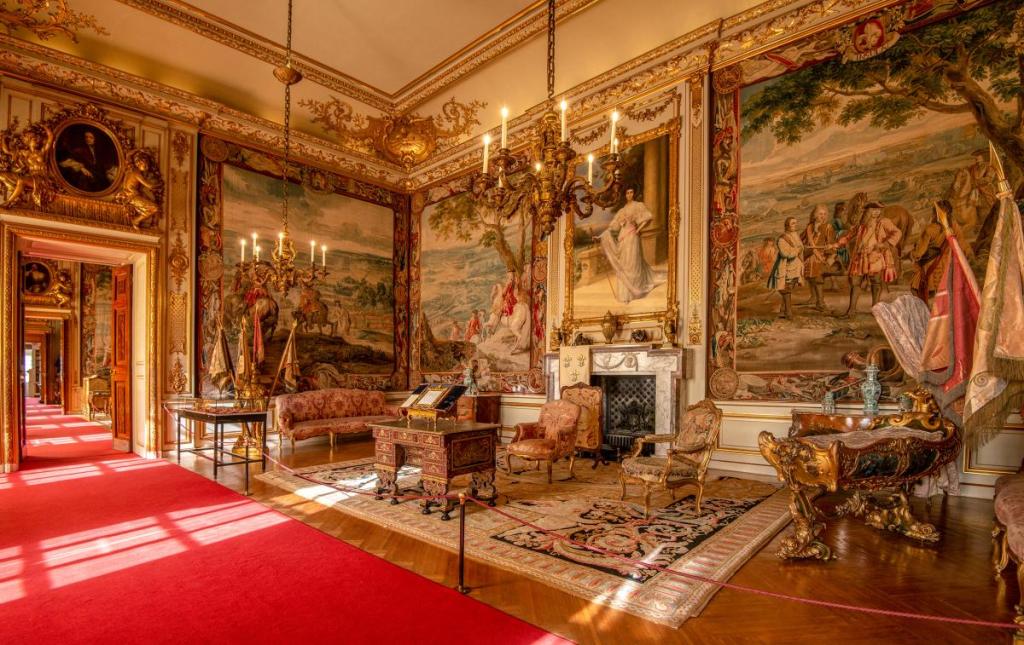
Photo: Blenheim Palace Website
Our tour guide—spinsterish in a wool skirt and sensible shoes and brown, mousy hair tied up in a bun—leads us through the palace. She speaks reverentially several times about “His Grace,” referring to the current Duke of Marlborough.
Over its 300-year history, Blenheim had its fill of colorful personalities including:
- Sarah Churchill (1660-1774) who was an intimate companion to Queen Anne, but who overstepped her bounds and was ultimately dismissed from Court.
- Jenny Churchill (1854-1921), Winston Churchill’s mother, who had many lovers and three husbands; her last husband was three years younger than Winston.
- The wealthy American, Consuelo Vanderbilt (1877–1964), who was coerced into marriage, stood six feet tall and dwarfed her aristocratic husband, the 9th Duke.
In the red drawing room, there is a charming family painting by John Singer Sargent with Consuelo, the 9th Duke, their two young, curly-topped sons, and their pet King Charles spaniels. Sargent painted Consuelo in a black dress with wide sleeves lined with rose satin. Our guide points to another portrait, a Van Dyke painting of Lady Anna Kirk that is hanging in the same room on the north wall, painted in the 16th century. Lady Anna is wearing an identical dress to Consuelo Vanderbilt; Sargent copied it nearly 200 years later.
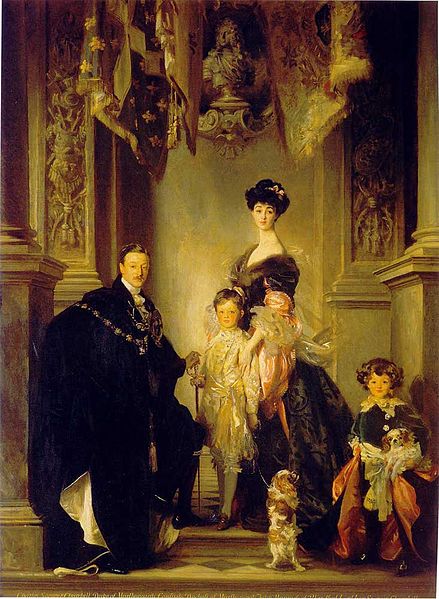
Photo: Wikimedia Commons
The tour concludes in the remarkably long library where at one end stands a large-as-life marble statue of Queen Anne. Sarah Churchill, re-writing history a bit, commissioned the statue to memorialize her everlasting friendship with the Queen.
At the other end of the room is a grand pipe organ; the largest pipe organ in private ownership in Europe. The room contains the coronation robes worn by the current Duke and Duchess at the Queen’s 1953 coronation. As peers of the realm, they would have had a role in the ceremony. There are several black and white framed photographs of the Duke with Princess Diana. Through a complicated genealogy and a special act of Parliament to allow the Marlborough title to pass through the female line, two of the earlier Marlborough duchesses were Spencers and forebears of Diana’s.
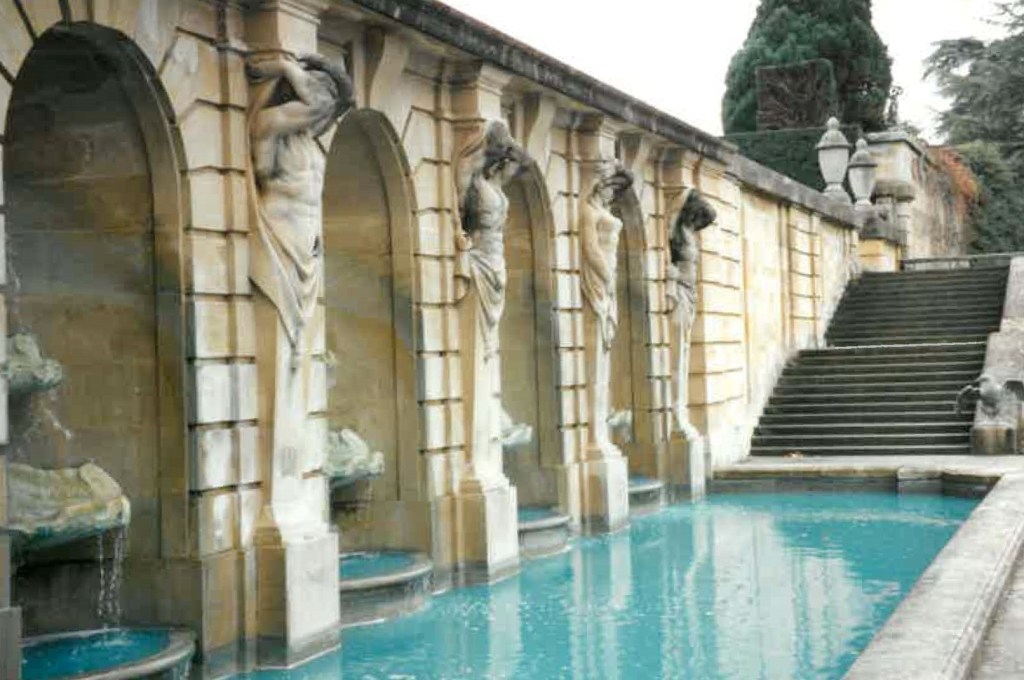
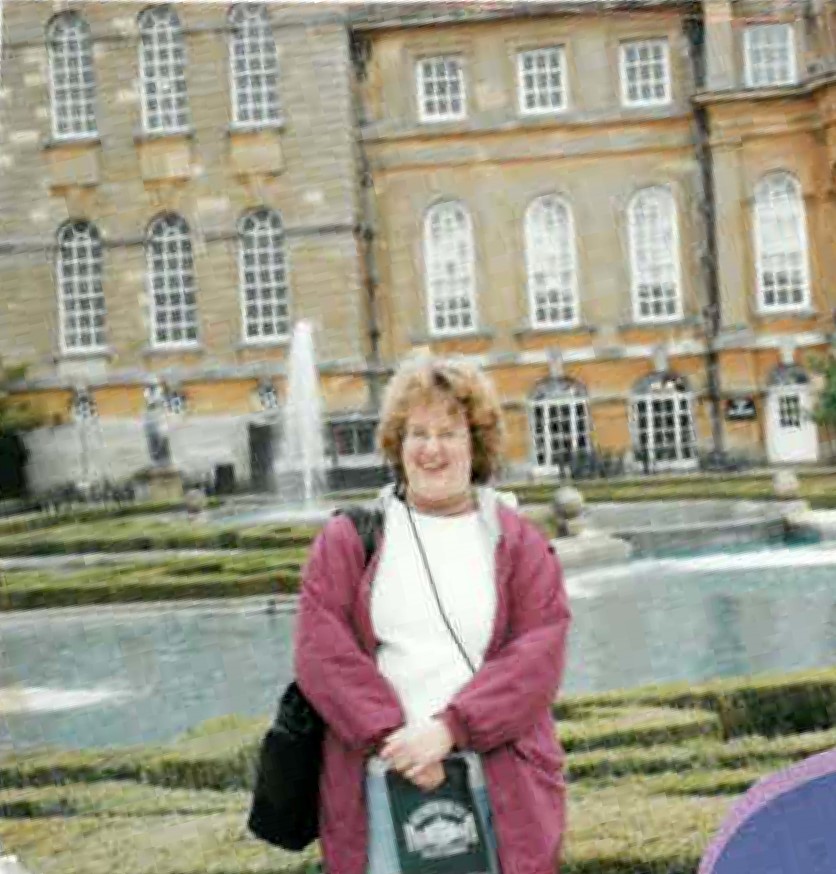
Then we are free to roam the park and gardens on our own. The vast Capability Brown-landscaped Italianate gardens are unbelievably ornate. There are many lovely spouting fountains surrounded by neat, low box hedges, all fringed with marble cupids, winged goddesses, and mythical creatures. I love the fountains and manicured hedges and can only speculate that they must rival the grandeur of the famous gardens of Versailles, which I have never seen.
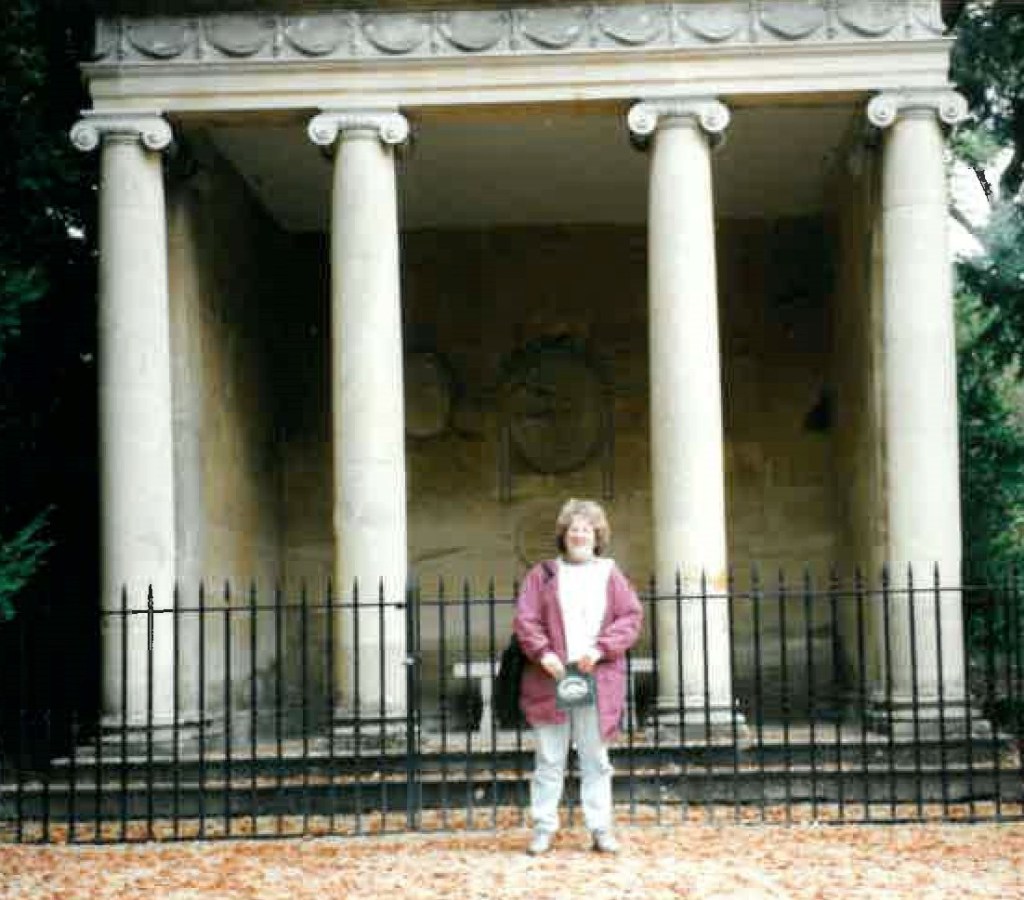
A short walk from the garden is a summerhouse, constructed in the style of a Greek temple; a small, stone, decorative building with Doric columns fittingly called the Temple of Diana. This is where Winston Churchill proposed to his wife, Clementine, in 1908. He is quoted as having said: “At Blenheim I took two very important decisions; to be born and to marry. I am content with the decision I took on both occasions.”
Winston Churchill was born at Blenheim. Churchill’s father, Lord Randolph, was the youngest son of the 9th Duke of Marlborough and not in line to inherit the princely estate. Although not titled, Churchill still spent a lot of time here as a boy and young man.
I take a small, “Fun-town” train to the Marlborough Maze, reputedly the second largest yew maze in the world. I get lost searching for the maze’s center. Disconcertedly, I eventually find my way in, where I climb an elevated platform and look down over the maze trying to memorize the path for the way out. I am thinking about the maze song in Andrew Lloyd Webber’s By Jeeves. I can’t remember the tune or the words. Brian would know them all.
In the distance of the 2,100-acre estate is the huge Column of Victory (looking a lot like Nelson’s column at Trafalgar Square) that Sarah erected to honor her husband.
I am happy to have seen Blenheim; it was on my list of “must-do’s.” But I can’t help thinking that the immense wealth concentrated into the hands of one family is senseless. Blenheim is so ostentatious; it is almost garish. It’s a display of conspicuous consumption in much the way that the 19th-century robber barons built Newport’s gilded mansions to legitimize their upper-class status to themselves and to other classes.
I don’t know why I don’t think this way about the Royal Family. Maybe because they give their lives in service to the country and the palaces don’t actually belong to them. It doesn’t seem like the other noble families, like the Marlboroughs, have a public role. At the same time, I love the historic and artistic significance of these houses and would hate to see them dismantled. Perhaps I have to think of the families that own them as caretakers of the nation’s cultural heritage…just really well-paid caretakers.
Back in Oxford, the station is crowded. A long series of announcements about delays and cancelled trains is confusing. I hear the conductor say that there has been a crash of a military airplane north of Lancaster, which is affecting routes north.
- A word about crisps: This morning on the train, a woman was eating potato chips (crisps) for breakfast. I am convinced that crisps are the new English national food, replacing scones, fish and chips, and roast beef and Yorkshire pudding. Everyone eats them at all hours of the day. And they come in the most tantalizing flavors: roast chicken, roast beef, Worcestershire sauce, and my absolute favorite, prawn cocktail.
 Jody’s UK Memories

