The Cotswolds are enchanting; a place that time passed by. Built on the wealth of the medieval wool trade, the villages look much the same as when they were built in the Middle Ages.
With their thatched-roof cottages, cobbled market squares, and Gothic “wool” churches—all made of the soft honey-colored Cotswold limestone—the villages are so quintessentially British. I can’t help but feel that Miss Marple is going to step out of the High Street tea shop at any moment.
A company called Good Friday sponsors my tour, which departs from Stratford-upon-Avon. There are 10 of us, plus Tony, the Good Friday guide and driver. Tony tells me, “I loved Margaret Thatcher.” He’s the first person I’ve talked to since I’ve been here who has said that. Two of my fellow tourists are from New Hampshire but, when they hear I am from Maine, they explain they are really from Maine too, just transplants to NH. He is from Berwick.
The term “Cotswolds” means rolling hills and, true to its name, the further away from Stratford we get, the greener and more bucolic the landscape becomes. We pass through Winton where, Tony tells us, the Telly Tubbies television show is filmed. He points to a green hill where the tubbies romp.
The Cotswolds were the heart of England’s profitable wool trade in the 14th and 15th centuries. The area’s rich, water-retaining limestone soil produced the lush grass that fed the “Cotswold Lion;” the local sheep whose prized wool is yellowish in color.
Our first stop is Chipping Camden; “chipping” meaning market, and likely the origin of the word “shopping.” Chipping Camden is the “flower of all villages of England,” to paraphrase the inscription in St James’s Church on the 1401 tombstone of William Grevel, a leading wool merchant.
I fall in love with the Cotswolds the moment I look down the Chipping Camden High Street and see all the lovely yellow stone buildings hugging the street enclosing the ancient stone, open-air market hall. I am charmed by the tea shops and want to spend the afternoon browsing the antique stores. Alas, following our tour, we only have 20 minutes allotted for Chipping Camden.

Photo: Richard Slessor, Wikimedia Commons
The soft golden stone, quarried locally, was the chief building material for houses and churches for over six centuries. Today, planning regulations require houses to be built from the local Cotswold stone to retain the area’s traditional character.
Chipping Camden has wonderful medieval buildings. William Grevel’s house on the High Street has impressive two-story bay windows. With wonder in his voice, Tony tells us this house is 700 years old.
Fittingly, PBS filmed a Miss Marple episode in Chipping Camden. In the show, Nemesis, Miss Marple takes an English villages house and garden tour, but Tony says, “We knew, the whole time, her bus was just riding up and down Chipping Camden High Street.”
In an ironic twist that history sometimes deals out, Tony tells us the story of Sir Baptist Hicks, the town’s main benefactor. One-time Lord Mayor of London, he built a fabulously ornate house in 1613, of which today there are only ruins. It seems that Sir Hicks was a Royalist and one day, at the height of the Civil War, he received news that Cromwell’s army was marching on Chipping Camden. Rather than let the traitors take over his manor and use it as their base, he burned it down, only to discover after the fact that the army had turned and marched in a different direction.
Tony calls St James’s Church, “ridiculously large for a town of 2,000 people.” Referred to as a “wool” church because it was built with the wealth of the wool trade, most Cotswold towns have these elaborate churches, almost like mini cathedrals.
St James’s soaring, boxy Gothic bell tower holds a carillon; a series of eight bells of different octaves, which we immediately deduce is the inspiration for the name of the nearby Eight Bells Inn. The bells play four different tunes, which we hear several times while we are there.

Photo: Stephen McKay, Wikmedia Commons
Laid into the church’s medieval floor is William Greville’s ledger stone, decorated with an engraved brass effigy of William and his wife, Marion, hands folded in prayer. The marker five-and-a-half-feet in length bears the inscription, ‘the flower of the wool merchants of all England’, acknowledging Greville’s prominence, not to mention his wealth that built the church.
Wool was big business in the Middle Ages and the Cotswolds had some of the best. In the 1300s, Edward III went to war with France over the wool trade. In the 15th century, the Lord Chancellor’s seat in the House of Lords was made of wool and he still sits on the ‘woolsack’ today; a nod to the importance of wool to England’s history. At that time 50% of England’s economy was based on wool.
My 20 minutes are up and I walk back down the High Street. Just as the bus comes into sight, I peer through a shop window and see half-dozen very old Royal commemoratives, including a Queen Victoria jug. I must come back to Chipping Camden.
The road out of Chipping Camden climbs higher and, turning around, we can see a wonderful view of the village and church nestled into the valley below.

Photo: Peter Barr, Wikimedia Commons
As we make our way to the next Cotswold town—Stanton—we see fields of cabbages growing on either side of the road. The Cotswolds grows the Brussels sprouts that feed the rest of England.
Stanton is called the most perfect village in the Cotswolds. The industrial revolution left Stanton to decay but, in 1906, a wealthy architect bought up much of the village and restored it to an ideal. Today, the village has no commercial enterprise—no school, post office, or shops.
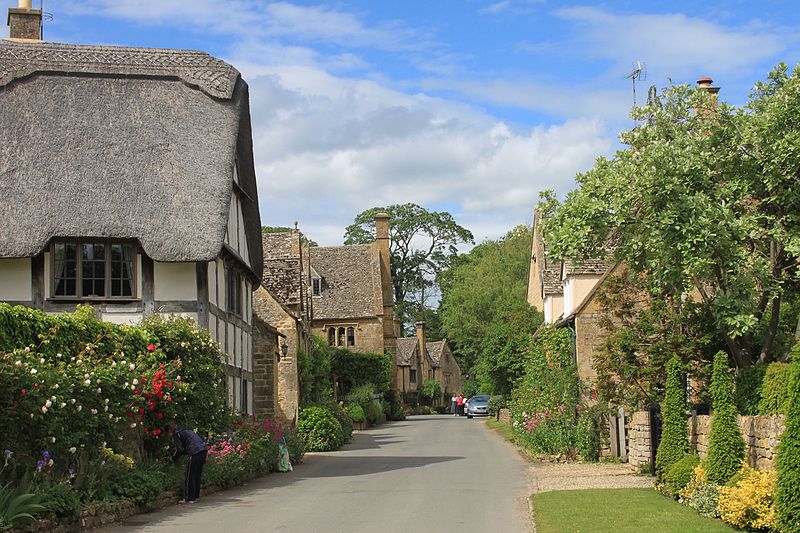
Photo: Roger Davies, Wikimedia Commons
Stanton’s St Michaels and All Angels is a wonderful little church complete with devilish-looking gargoyles. It houses the oldest pulpit in England dating back to the 1400s. Outside on the lawn is an old, stone market cross. In medieval villages, churches often ran the local markets; a cross designating the market site.
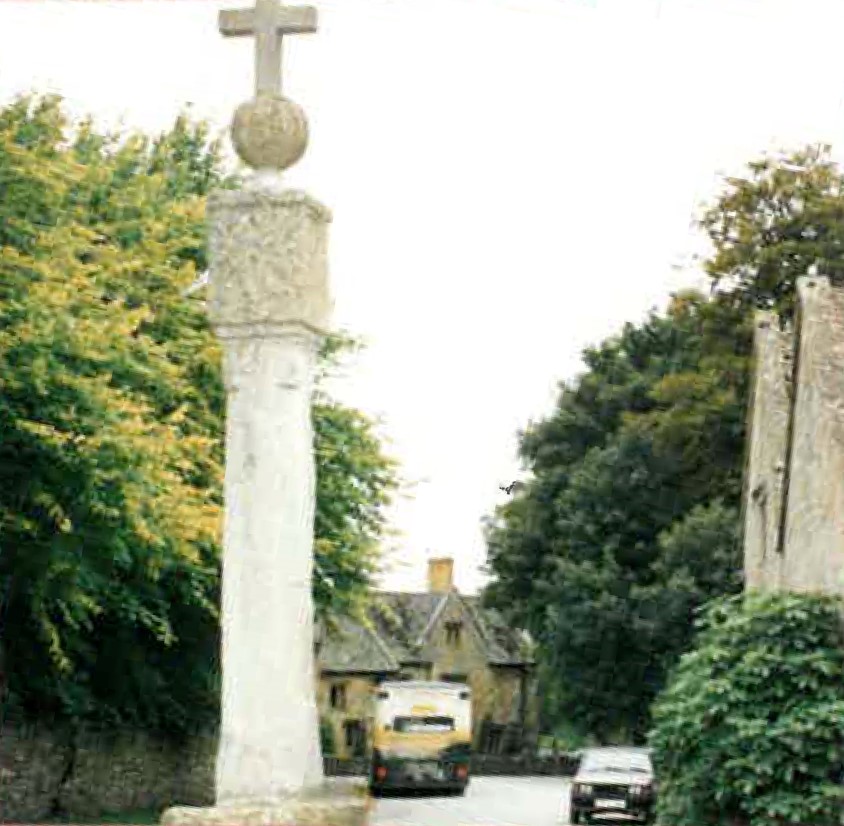
Just outside the village is Stanton Manor House, a Jane Austen-looking house where Tony tells us that Joan Collins and Nigel Hawthorne filmed a movie here this past summer; The Clandestine Marriage to be released later this year.
The manor has two literary references. One—J.M. Barrie was staying at the house in a room where his window looked out towards a nearby barn. A weathervane atop the barn turning rapidly in the blowing wind caused a light reflection to bounce around his room—and Tinkerbell was born. A Dr. Dover also stayed in the manor house. During his travels, Dr. Dover discovered a marooned castaway on a deserted island. Having rescued him, he subsequently introduced the shipwrecked survivor to Daniel Defoe and was the basis for Robinson Crusoe.
Henry VIII’s sixth and last wife, Catherine Parr, who outlived him, inherited Stanton and its environs. Historians do not know whether she ever lived in the manor house, which now sticks out into the road so that our tour bus barely has room to squeeze past.
Daniel Defoe penned a phrase about our next little village—“Stow-in-the-wold where the winds blows cold.” At the junction of three major roads, including the Fosse Way (A429), which is an old Roman road, Stow-in-the-wold is located on the top of Stow Hill, a windy 800-foot hill.
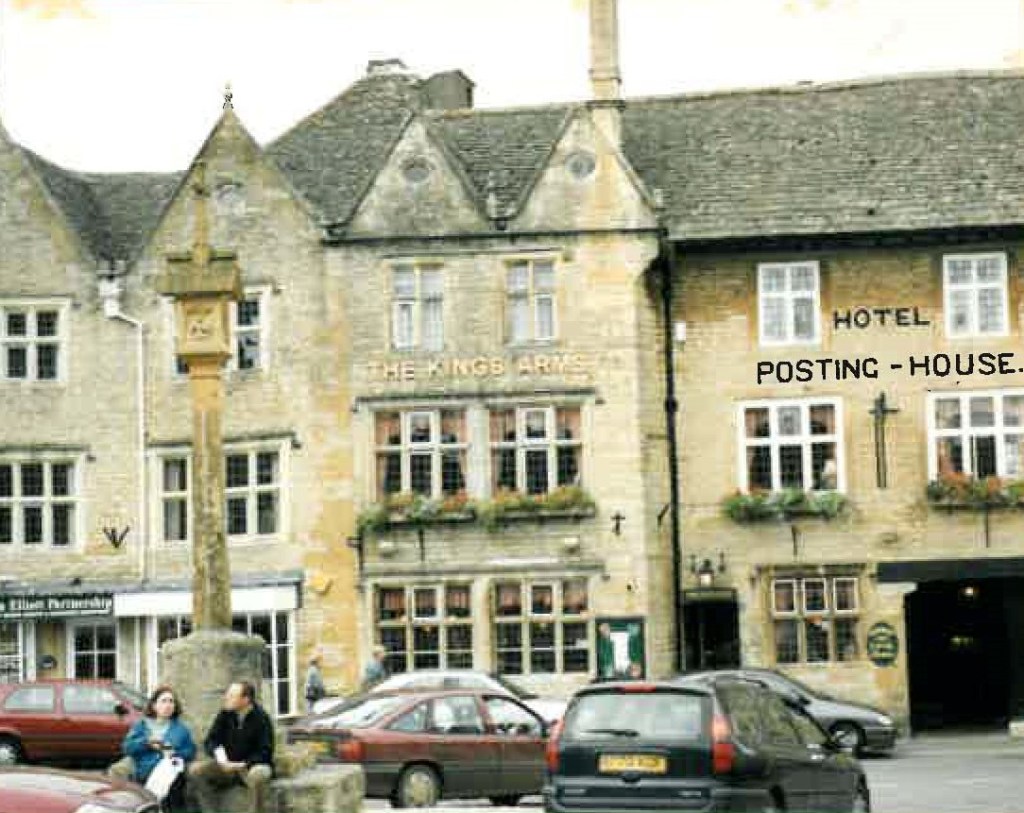
Tony heads for the tea shop. I head for the antique shops. Stow-on-the-wold’s marketplace is evident from an open, round, bricked area commemorated by its ancient market cross. The public space also retains the old stocks in which criminals were punished. The narrow alleyways or “tunes” running into the square were designed to funnel sheep to the market square. After a bit of shopping, I have tea and a scone at the Ann Willows tea shop before heading back to the tour bus for the ride back to Stratford.
The Cotswolds is a very special place; capturing both my heart and my imagination.
Back in Birmingham, it is nearly dark when I arrive home just after 7:30 PM. I walk through the door and Tony says to me in a Sherlock Holmes’ way, “So, you’ve been to the Cotswolds today, have you?” There is no way he could have known this since I did not see him before I left and they did not know where I was. Then he tells me, he read it on my shopping bag.
Caroline comes up to my room later and we sit on the floor looking at brochures for Hawaiian cruises. She and Tony are planning their next summer’s holiday.
Caroline tells me stories of some of the previous guests. One, a German lady, Tony walked in on while she was in the shower. She was in the wrong room and Tony did not know she was there. Apparently the shower mechanism in her room was broken so she went into another, empty room. Despite her current state of undress, she insisted on telling him about her broken shower right then and there and Tony says he really didn’t want to hear about it right then! Another time Caroline didn’t want a guest to see her in her dressing gown, so she ducked into the breakfast room, only the guest, unknowing, followed her in, so she hid behind the sofa. All was fine until Lutchford came in and started licking her face. Caroline says she should write a book—Tales from an English B&B.
 Jody’s UK Memories


