Since I am staying the weekend, I have a relaxed morning. While the others are packing, checking out, and storing luggage, I have a cup of coffee and pastry.
Our program today is packed with speakers from all arenas of government from civil servants to local authorities, and even a representative from the UK’s European Parliament Office. The head of the senior civil servants trade union is dynamic and energetic. Generally, he says, Britain’s civil servants support Tony Blair’s modernization efforts (it may have something to do with the fact that they know, if they don’t, the Blair government will not hesitate to privatize their jobs).
While not the private-sector crusader that Thatcher was, Tony Blair rode to victory on his “third way” platform. He is intent on bringing a “new” Labour government to Britain. The third way refers to Blair’s reform policies―not liberal-social ideas of the old Labour party, but not the free-market Conservative agenda either. We are left scratching our heads a little bit, but generally get it that he is trying to thread the needle between left and right.
The afternoon is devoted to Tony Blair’s Modernizing Government scheme. Our speaker is Jeremy Cowper, head of the Modernizing Government Secretariat in the Blair Cabinet. It sounds suspiciously like the Reinventing Government reform at home. One of its precepts is improving the quality of government-delivered services based on “Best Value” (UK’s term for measuring efficiency) and benchmarking performance, which is what I am here to study.
I note ironically that the Best Value program applies only to local governments, not the national government, which is imposing it. The Blair government has created a standardized set of measures for all towns (called local authorities here). One speaker we heard said emphatically that, yes, measurement has led directly to an improvement in the way services are delivered; a conclusion I am appraising in my research paper.
At the round-up at the end of the day, the BC staff asks for suggestions and criticisms. They say, “Please be blunt.” We remind them that we’re Americans. The group, of course, has a lot of ideas—they want more interaction with speakers; they want speakers who can address implementation, not just policy; they want additional social events among Fellows; they want spouses to participate; and more.
I think people are quibbling and wasting time. We are in London! I want to be out in it. Dean thinks that, being from Maine, I have a better perspective on life outside of work. Perhaps. I do see the fellowship as an opportunity to travel while doing just enough research and writing to get by. I don’t intend to neglect my studies, but still, no one is grading me.
I am disappointed as we continue talking until nearly 6:00 PM and, once again, I miss my chance to go to Harrods, which closes early on Fridays.
He Came Silently Out of the Shadows – Jack the Ripper’s London
I had picked up a brochure in the hotel lobby about a Jack the Ripper walking tour. It starts at 6:45 PM and I have just enough time to make it to Tower Hill tube station where it begins, if I leave right now. I grab a cucumber and cream cheese sandwich at Embankment station and go.
I’m afraid I’ll be the only one on the tour, but there’s a group of about 20 of us. Our guide Tony, a Beefeater by day who conducts tours at the Tower of London, says to me, “Have we met? Have I seen you today?” I assure him I was in meetings all day and that we have never met. He is lively, enthusiastic, and articulate—a consummate actor—and he offers an historically accurate, if a bit dramatic, overview of the Jack the Ripper story.
We walk from the Tower through grimy streets, crossing from the new part of the city to the old into an area known as Whitechapel, and follow the path of the Ripper’s gruesome rampage through London’s East End. From the Tower, to Petticoat Lane, to Spitals, to the Docks, Tony augments his story with reproductions of actual news articles, police documents, and photographs of the time. He even has four Victorian pennies, the cost of lodging for one night in a rented box (literally, a box) in a boarding house of the kind in which the Ripper’s prostitute victims would have slept.
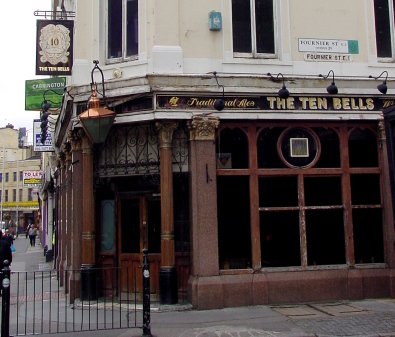
At the end of the tour, we stop for a drink at the Ten Bells Pub, which several of the murdered prostitutes frequented. I have a cider.
To this day, no one knows the identity of the serial killer who murdered and dissected five prostitutes between August and November in 1888 when the grisly murders stopped as abruptly as they began. There are as many theories as there are books on the subject. Tony has his own notion in the person of Edward Albert Victor, Prince of Wales, son of King Edward VII and grandson of Queen Victoria, who died at the age of 28, four years after the murders. But I have read the theories and this one seems unlikely. The first person to put forward the royal connection in the 1960s later retracted it as a hoax.
There seems to be evidence that the Metropolitan police, under Superintendent Sir Charles Warren, destroyed evidence linking the Ripper to the Freemasons. Tony believes that the Freemasons committed the murders to cover up Albert Victor’s supposed illegitimate child by an Irish-Catholic shop girl; a friend of the murder victims who could expose the father’s secret identity. He says with his tongue very definitely in his cheek, it was all a conspiracy between:
- a man named Jack
- the police
- an Irish-Catholic
- the Freemasons
- a man named Warren
As conspiracy theories go, this one sounds all too familiar.
- In today’s news: The Evening Standard newspaper announces the conclusion of the investigation into the accident that killed Diana, Princess of Wales. The French report was released today. It blames the driver, Henri Paul, speed, alcohol, and a lack of seatbelts. In addition to several leading stories on the front page, the Standard prints the report’s entire contents inside.
 Jody’s UK Memories